Percent Error - Definition & Examples

Before this, knowWhat Is Relative Difference?

Interactive · 1 question

Percent Error

Percent error (PE), also known as percentage error or absolute error, compares an experimental, approximated, or estimated value to a theoretical, actual, or known value. The lower the error, the closer the experimental value is to the actual value.

Here's how to calculate it:

Percent Error: [(|experimental value - actual value|)/actual value] x 100

Image source: by Caroline Kulczycky

Why is it multiplied by 100100? Because we want the value in a percent!

Keep in mind, your value can be positive or negative. You may also notice that this formula looks quite similar to percent change! At their core, they're very similar but used in different contexts and will be used differently.

Let's do an example.

The soccer field next to your house is 110 m110 \text{ m} long. One day, you and your pals decide to measure it yourselves, and you get 104.5 m.104.5 \text{ m}. What is your percent error?

Choose one answer

Video · + 1 min read

(Video) Error and Percent Error

by Tyler DeWitt

Tyler DeWitt has a video that not only explains percent error, but also talks about how it differs from normal error and percent change.

Summary\large{\text{Summary}}

Sometimes when we measure things, our values aren't the most accurate. It is important to be able to tell how far off we were. This is what error tells us.

Error can be calculated by subtracting the actual value from the measured value. error=measured value−actual value\text{error}=\text{measured value}-\text{actual value}

Suppose we have a distance of 500 feet500\text{ feet}. But when it was measured by three people, they got 503.5 feet503.5\text{ feet}, 502.8 feet502.8\text{ feet}, and 497.4 feet497.4\text{ feet} respectively. What is the error of each person's estimate?

  • Person 1: error=503.5−500=3.5\text{error}=503.5-500=3.5
  • Person 2: error=502.8−500=2.8\text{error}=502.8-500=2.8
  • Person 3: error=497.4−500=−2.6\text{error}=497.4-500=-2.6

How much should we care about error? Suppose we get an error of 1,0001{,}000 feet. That seems like a pretty big error! But what if we were measuring a distance of 1 million feet1\text{ million feet}. Suddenly, an error of 1,0001{,}000 doesn't seem like much of a big deal.

This is why we also calculate percent error (PE) because it gives us an idea of how big our error is compared to the size of what we were actually measuring. PE=∣error∣actual value×100%\text{PE}=\frac{|\text{error}|}{\text{actual value}}\times100\% Let's calculate for each of the people above.

  • Person 1: PE=∣3.5∣500×100%=0.7%\text{PE}=\frac{|3.5|}{500}\times100\%=0.7\%
  • Person 2: PE=∣2.8∣500×100%=0.56%\text{PE}=\frac{|2.8|}{500}\times100\%=0.56\%
  • Person 3: PE=∣−2.6∣500×100%=0.52%\text{PE}=\frac{|-2.6|}{500}\times100\%=0.52\%

These percents are very small so the errors aren't very big.

Interactive · 8 questions

Calculating Percent Error

In your everyday life, it's pretty common to make estimates of values rather than taking the time or brainpower to use exact ones.

If someone asks you how far the nearest gas station is, you'll probably say something like, "It's about 5 miles5\text{ miles} away." That's an estimate. In most situations we come across, estimated or approximate values are all we need.

Gas

Image by paulbr75 via Pixabay (CC0)

However, there are instances where exact values are necessary. In some cases, it's important to know how different your estimated and exact values are. This is called percent error. This basically tells us how far off our estimate is from the actual value.

You will see this concept a lot when doing scientific experiments in order to calculate the error between the measured value and the theoretical value.

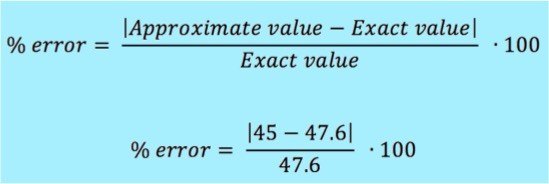
To calculate percent error, we'll use the formula below.

% error = |Approximate value - Exact value|/Exact value * 100

Image source: by Hannah Bonville

Recall that the straight lines around the numerator of the fraction represent absolute value. That means that whatever the difference between the approximate and exact values is, we will take the positive version of it.

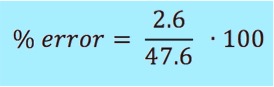
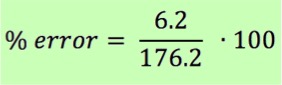
In chemistry class, Inna estimates that a solid melts at 45 degrees Fahrenheit. She reads in her textbook later that the actual melting point for the solid is 47.6 degrees Fahrenheit.

What is the percent error of Inna's experiment?

Image source: by Hannah Bonville

What is the approximate value for the melting point?

Choose one answer

Video

(Video) Relative Error and Percent Error

Kevin Dorey

This video by Kevin Dorey discusses a real world application of percent error.

Summary\large{\text{Summary}}

Imagine a pull-up bar (or tree branch) has a height of 220 cm220\text{ cm}. If I guessed that its height is 215 cm215\text{ cm} (before measuring it), then the error would be 5 cm5\text{ cm}.

% error allows us to better understand this error by factoring in the actual measurement, which is the denominator in the equation: % error=(Actual−ExperimentalActual)×100%\text{\% error} = \left(\frac{\text{Actual} - \text{Experimental}}{\text{Actual}}\right) \times 100\%

Let's plug in our values and solve. The actual height is 220220 and the experimental, or guessed, height is 215215. % error=(Actual−ExperimentalActual)×100%=220−215220×100%=5220×100%=144×100%=2.27‾%\begin{align} \text{\% error} &=\left(\frac{\text{Actual} - \text{Experimental}}{\text{Actual}}\right) \times 100\%\\ &=\frac{220-215}{220}\times100\%\\ &=\frac{5}{220}\times100\%\\ &=\frac{1}{44}\times100\%\\ &=2.\overline{27}\% \end{align} So our guess is about 2%2\% off from the actual.

Type a concept, like “slope” or “photosynthesis”.

↑ ↓ to choose · Enter to openSearch explanations and problems