Word Problems with Percents
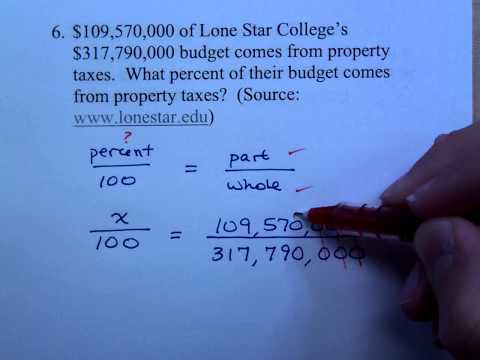
You need to translate problems with percentages into math and then solve them. You can break down this process into three steps.
- Identify the knowns and unknown from the problem.
- Convert values given in the problems into proportions.
- Solve the proportion.
Let’s try an example.
Example 1
Suppose 60% of people in a math class have a dog. If the math class consist of 150 people, how many people in the math class has a dog?
Step 1: Identify the knowns and unknown from the problem
Knowns: We know that 60% of people in a math class have a dog. We also know that there are 150 people in the math class.
Unknowns: We want to determine how many people in the math class have a dog. We can call this unknown value x.
Step 2: Convert values given in the problems into proportions
Next, we can plug in our known and unknown values into the proportion.
Remember, this is our general set up for a proportion:
WholePart=100Percent
We are solving for x, which is a part of the class that has a dog, so we can plug x into “Part”.
Wholex=100Percent
Next, we can substitute 60% and 150 into the proportion. Since 60% is a percent, we can plug 60 into ‘Percent”. 150 is the total number of students in the class, so 150 is the whole.
150x=10060
Step 3: Solve the proportion using cross multiplication
150x100x100xxx=10060=150⋅60=9,000=1009,000=90
There are 90 students in the class of 150 that have a pet dog.
Let’s try another example.
Example 2
Step 1: Identify the knowns and unknown from the problem
Knowns: We know that Nick bought 2 shirts and a pair of jeans. Each shirt costs $50, and the pair of jeans costs $75. We first need to calculate how much he spent on his purchase, before the discount.
(2⋅50)+(1⋅75)=100+75=175
We also know that Nick has a coupon for 25% off the entire purchase.
Unknowns: We want to determine how much Nick would pay after the discount. We can call this unknown value x.
Step 2: Convert values given in the problems into proportions
Next, we can plug in our known and unknown values into the proportion.
Remember, this is our general set up for a proportion:
WholePart=100Percent
We are solving for x, which is a part of the entire purchase after the discount, so we can plug x into “Part”.
Wholex=100Percent
Next, we can substitute 25% and 175 into the proportion.Since 25% is a percent, we can plug 25 into ‘Percent”. 175 is the total number of students in the class, so 175 is the whole.
175x=10025
Step 3: Solve the proportion using cross multiplication.
175x100x100xxx=10025=175⋅25=4,375=1004,375=43.75
$43.75 represents 25% of her purchase. This needs to be subtracted from her total amount to get the actual amount that Nick paid.
175−43.75=131.25
Nick paid $131.25 for his purchase.
Example 3
You will see percentages as test scores, interest rates, or sales. To understand how to calculate them, make sure you understand the relationship between proportions and percents.
Step 1: Identify the knowns and unknown from the problem
Knowns: We know that the sales tax is 7%. We also know that the computer costs $1,200 before tax.
Unknowns: We want to determine the amount of sales tax that Ben has to pay. We can call this unknown value x.
Step 2: Convert values given in the problems into proportions
Next, we can plug in our known and unknown values into the proportion.
Remember, this is our general set up for a percent proportion:
WholePart=100Percent
We are solving for x, which is the sales tax that Ben has to pay for the computer, so we can call this value “Part”.
Wholex=100Percent
Next, we can substitute 7% and $1,200 into the proportion. Since 7% is a percent, we can plug 7 into ‘Percent”. 1,200 is the price of the computer, so we can plug 1,200 into “Whole”
1,200x=1007
Step 3: Solve the proportion using cross multiplication
1,200x100xxx=1007=8,400=1008,400=84
$84 represents the sales tax that Ben has to pay. The total price that Ben would have to pay for the new computer is Price of Computer + Sales Tax, so the total price he has to pay is:
$1,200+$84=$1,284