Perfect Squares — Definition & Examples

Before this, knowSquare Root — Definition & Examples

Video · + 1 min read

(Video) What Is a Perfect Square?

by Brian McLogan

This video by Brian McLogan covers the definition and calculation of perfect squares.

Summary:\large{\text{Summary:}}

Let's start by looking at a square.

a square

A square has equal sides. If you know one side of the square has a length of 77, then you know all sides of the square have a length of 77.

A square with sides 7.

Now, what if we take the area of this square? Remember:

The area of a square is its length times its width.

So, we plug in ll and ww:

A=l×wA=7×7A=49\begin{align} A&=l\times w\\ A&=7\times7\\ A&=49 \end{align}

We say that 4949 is a perfect square because it is the product of an integer multiplied by itself, 7×77\times7.

If we had a square with an area of 5050, this wouldn't be a perfect square because no integer, multiplied by itself, will give a product of 5050. In fact, we'd have to resort to using irrational numbers.

To find other perfect squares, we just multiply integers. Positive ones, at that.

2×2=43×3=94×4=165×5=256×6=367×7=498×8=649×9=8110×10=100\begin{align} 2\times2&=4\\ 3\times3&=9\\ 4\times4&=16\\ 5\times5&=25\\ 6\times6&=36\\ 7\times7&=49\\ 8\times8&=64\\ 9\times9&=81\\ 10\times10&=100 \end{align}

We can keep going forever and ever. There is an infinite number of perfect squares. If we try to list them all we'd take forever.

Stretch your creativity

Contest problems rarely look like the examples you studied. Solving one means finding your own way in. These are real problems from the AMC 8, AMC 10, AMC 12 and AIME, the national math competitions for middle and high school students, each with a worked solution on LIVE by Po-Shen Loh.

Interactive · 2 questions

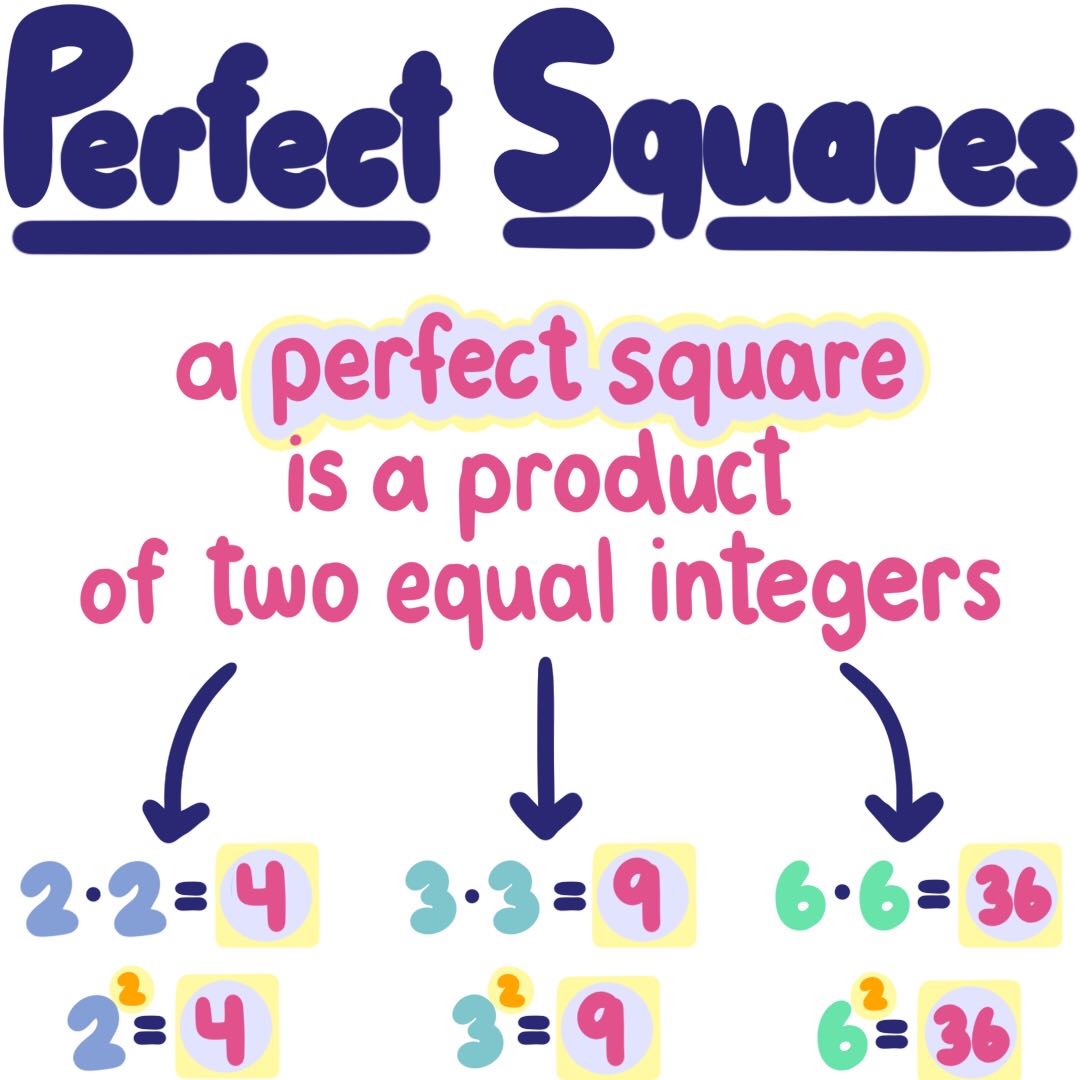
A perfect square is any number that can be expressed as the product of two equal integers.

Perfect Squares are products of two equal integers

Image by Caroline Kulczycky

In other words, a perfect square is a number that can be made by squaring a whole number. \\ For example, 99 is a perfect square because 32=3×3=93^2= 3 \times 3= 9 \\ 3636 is also a perfect square because 62=6×6=366^2=6 \times 6= 36. \\ However, numbers like 77, 1515 and 2424 are not perfect squares because you cannot express them as products of two equal integers. Here are some other perfect squares. 1×1=12×2=43×3=94×4=165×5=256×6=367×7=498×8=649×9=8110×10=100\begin{align} 1\times1&=1\\ 2\times2&=4\\ 3\times3&=9\\ 4\times4&=16\\ 5\times5&=25\\ 6\times6&=36\\ 7\times7&=49\\ 8\times8&=64\\ 9\times9&=81\\ 10\times10&=100 \end{align}

It is worth memorizing at least the first ten.

Let’s try some examples.

Example 1 \\ Is 8181 a perfect square?

Choose one answer

Illustrated · 1 min

Perfect squares and square roots are some of the best introductory material to multiplication.

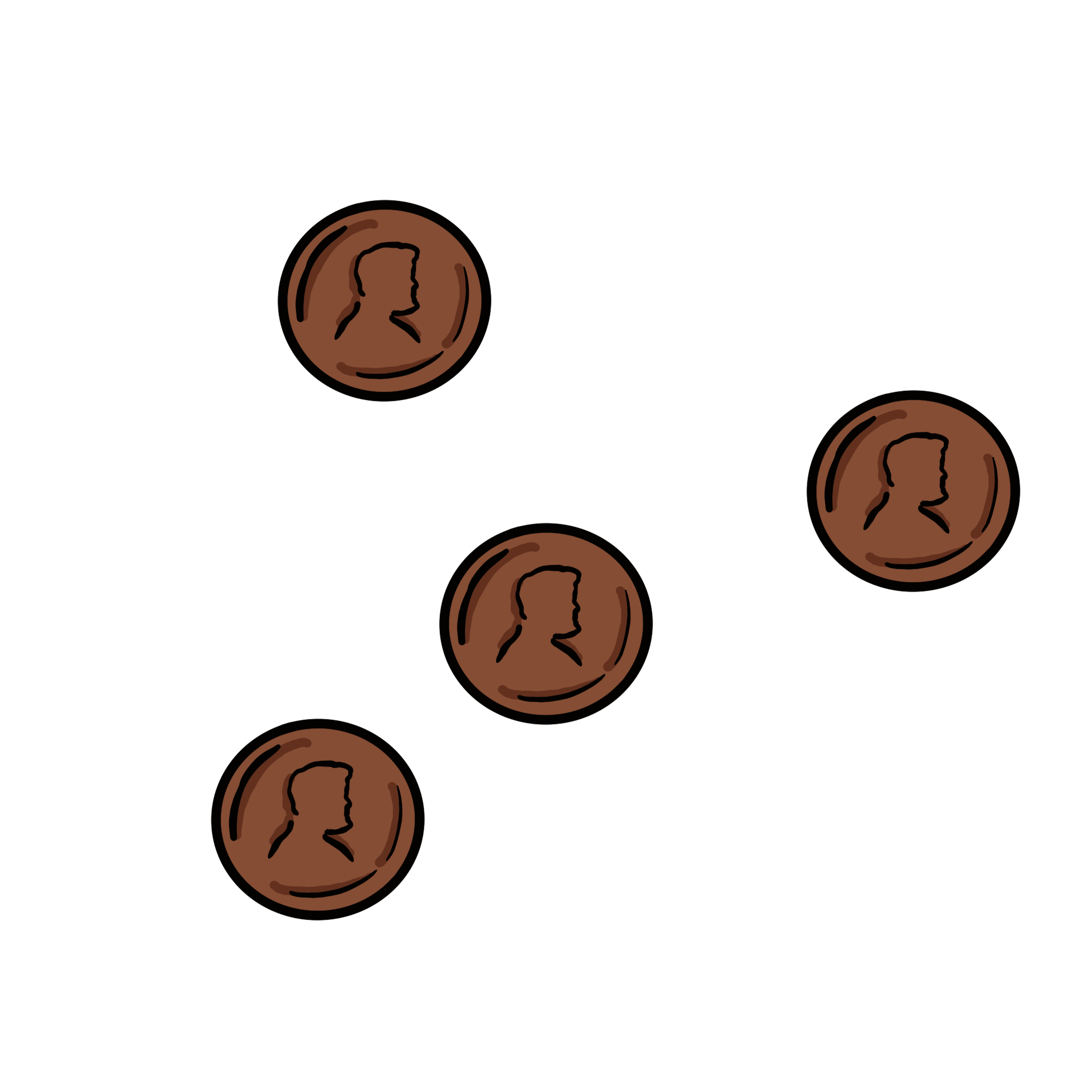
Let's take a set of coins. Now, let's say you want to arrange them into squares.

Set of 4 coins, strewn about

Image by Sylvia

Once you play around with the coins for a while, you notice that you can only arrange squares with 4,9,16,25,4, 9, 16, 25, etc. coins. These transfer over to being perfect squares in the mathematical world as well.

Picture of 4 coins, arranged into a perfect square

Image by Sylvia

For more advanced learners, try to make rectangles or squares out of any number of coins. Multiplication tells you which rectangles you can make (i.e. a rectangle made with 33 rows of 55 coins can be made with 1515 coins. Any number that you can't arrange into a rectangle with at least 22 rows and 22 columns is a prime number.

Read · 1 min

Perfect Squares

Let's think about what the definition of a "perfect square" is. When you are drawing a perfect square, what property makes it "perfect"? Well, it is perfect when each of the 44 sides have the same length!

Now, the context in which we are talking about perfect squares is not the same as physically drawing them. Here, we are talking about performing the inverse of an exponent. So, when you raise a number to an exponent, nn, you multiply that number by itself nn times. When n=2n = 2, we call that squaring a number. Just like drawing a perfect square, where all the sides are the same length, when you square a number, you are taking the same number and multiplying it with itself! Therefore, the perfect squares are the numbers that are the resultant of squaring a number! Let's list some of them below:

12=122=432=942=1652=2562=3672=4982=6492=81102=100\begin{align} 1^2 &= 1 \\ 2^2 &= 4 \\ 3^2 &= 9 \\ 4^2 &= 16 \\ 5^2 &= 25 \\ 6^2 &= 36 \\ 7^2 &= 49 \\ 8^2 &= 64 \\ 9^2 &= 81 \\ 10^2 &= 100 \\ \end{align}

Now, it is important to note that the perfect squares are the numbers on the right of the equal sign. So, our perfect squares are 1,4,9,16,25,36,49,64,81,1, 4, 9, 16, 25, 36, 49, 64, 81, and 100100.

Type a concept, like “slope” or “photosynthesis”.

↑ ↓ to choose · Enter to openSearch explanations and problems