Life on earth would be impossible without water. We use it every day. We drink from water fountains or water bottles. Our country's farmers are watering millions of crops. Industries use it in chemical processes. So far, we've studied many of water's properties. We've looked at water's hydrogen bonding, surface tension, solvent abilities, and density. Let's continue to explore why water is so unique.
When water freezes, it becomes a molecular solid. The molecules arrange themselves into a lattice. In ice, the molecules are further from each other than in liquid water. So, ice is less dense. That's why icebergs float in the sea. But, how does this affect our phase change diagram?
Phase Diagrams for Water
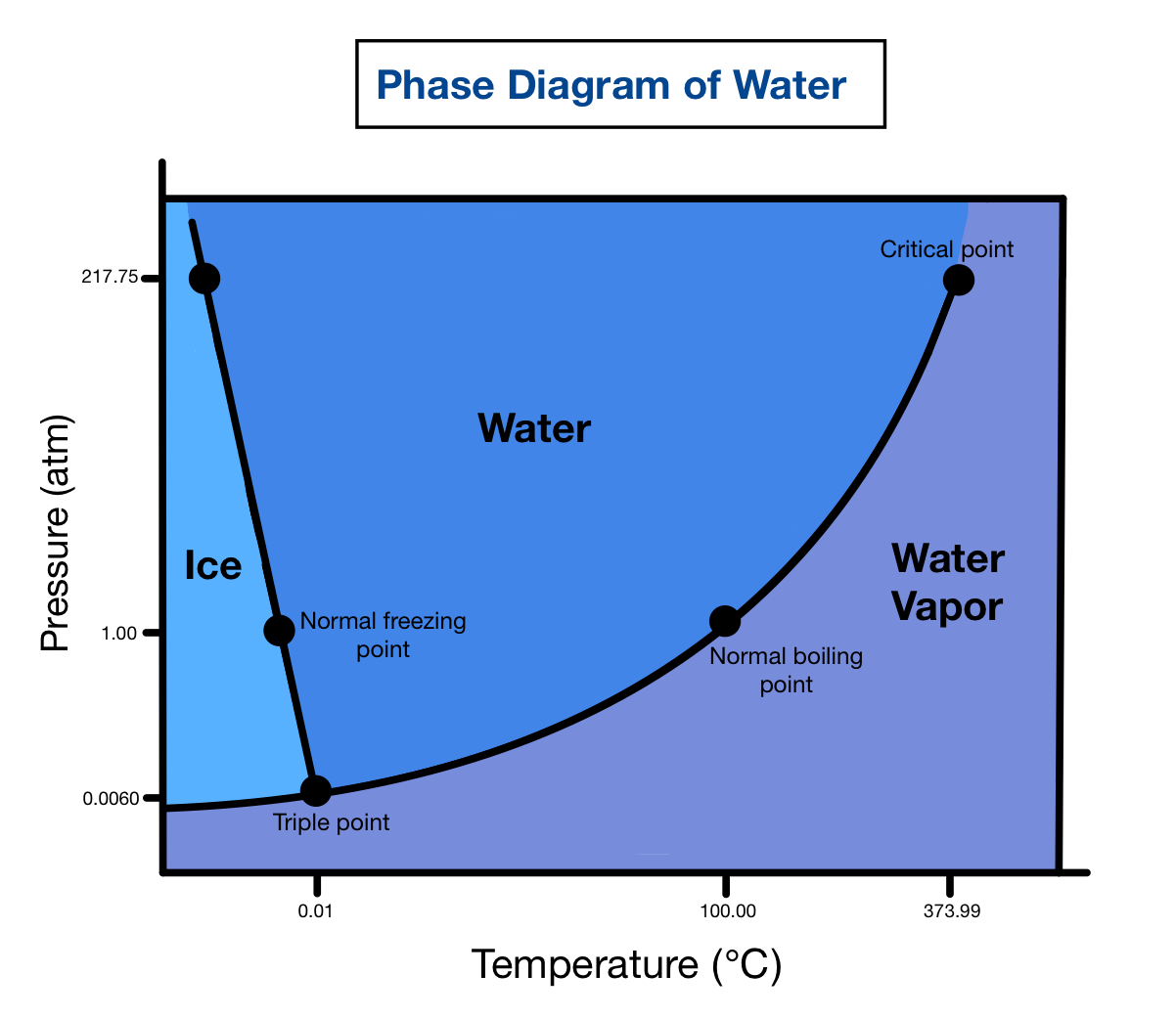
Water has a unique phase change diagram. The solid-liquid boundary has a negative slope. So, it points diagonally left. For most substances, if we apply pressure to a liquid, it freezes. There is more air pushing down which, causes the liquid molecules to get rammed together. As they come together, they experience more Van der Waal's interactions. So, there is more electrostatic attraction. If we are keeping the temperature the same, we know our average kinetic energy is not changing. Instead, we must be decreasing the potential energy. We lower the potential energy by increasing the attraction between molecules. That's why there are plateaus in heating and cooling curves. When we change phases, we affect both kinetic and potential energy.
Let's consider carbon dioxide's phase diagram. Start at the triple point and increase the pressure. At first, we are on the solid-liquid boundary. But soon, we arrive in the solid region. The solid-liquid line has a positive slope to the right. Carbon dioxide is a non-polar covalent molecule. As the molecules come together, the dispersion forces become more significant. So, they begin to attract one another. The attraction reduces the potential energy.
For water, the opposite is true. Again, start at the triple point. Now, increase the pressure. As the pressure increases, we are further from the solid-liquid boundary. We stay in the liquid region. As pressure decreases, we enter the gas phase. To transition to a solid from the triple point, we have to lower the temperature.
Now let's study water's freezing point. At atmospheric pressure, water freezes at OoC. Let's pretend we are a little above atmospheric pressure. As we decrease the pressure, the molecules have more space. They have the freedom to arrange into a lattice. Remember, water has a bent molecular geometry. Each water molecule has two hydrogens that interact with oxygen's two lone pairs. Hydrogen bonding reduces the potential energy. But, increasing the pressure again disrupts the lattice's symmetry. The molecules move too close together. The potential energy will increase. Now, water would rather be in the liquid phase.
If we decreased the pressure more, ice would sublimate. At the solid-gas boundary, the molecules' vibrational energy overcomes the hydrogen bonding. They enter into the gas phase. Remember, we enter the gas phase when vapor pressure equals external pressure.
Heavy Water
You may have heard of a unique instance where ice sinks in liquid water. Heavy water is an isotope. We replaced the hydrogen atoms with deuterium. Deuterium is hydrogen with one extra neutron. So, the molar mass of heavy water is about 20 molg instead of the normal 18 molg. When frozen, heavy water still arranges into a lattice. So, its volume is the same as regular ice. But, it has more mass. So, its density is greater than liquid waters.
Chemistry In the Real World: Snowball Fights and Ice Skating
When I was in high school, I carpooled with two of my best friends. One time, it was my mom's turn to pick us up. She forgot! So, we were standing around on a frigid January day. We were throwing snowballs at a street sign to waste time. Suddenly, a group of guys comes around the corner and starts throwing snowballs at us! What was most surprising was that we didn't know them. We were in an impromptu snowball fight! It was crazy!
Did you know you wouldn't be able to make a snowball without chemistry? To make a good snowball, you want it to be wet. Liquid water is denser than ice (or snowflakes). The liquid molecules pack tightly. With moist snow, water's hydrogen bonding helps to hold the frozen snow together.
Have you ever made a snowball with dry snow? When you pack it, you are creating pressure. The increase in pressure causes the snow to melt. But, when you release it, the pressure reduces. Some of the liquid becomes solid again. So, the snowball has a hard time holding together. When you throw it, it can break apart. If you want to make a snowball with dry snow, take off your gloves! The heat from your hands will melt some of the snow. The extra liquid water will help hold it together.
The same principles apply to ice skating! My dad and uncle grew up in Connecticut. They have childhood stories of ice skating on a pond behind their house every winter. Even though they are both in their fifties now, they are still skilled ice skaters. Ice skates work the same way as snowballs. When you press down with the blade, you generate pressure. The pressure causes some of the ice to melt. The liquid water between the skates and the ice acts as a lubricant. And if you have some balance, you're gliding across the ice. If not, you might find yourself falling across the ice instead.
These same concepts apply to sledding, skiing, snowboarding, and even building snowmen. All our favorite winter activities need snow to liquefy with pressure. So, next time you're in a snowball fight, take a second to appreciate chemistry!