Phenotype — Definition & Overview

Illustrated · 2 min

What's a Phenotype?

A phenotype is the physical traits of an organism.

By physical traits, I mean things like behavior, physical structures, and coloration. It's basically how we describe observable characteristics with words, like saying blonde hair or freckles. Phenotypes are what natural selection acts on, because they are what interacts with an organism's environment, not the genotype. These physical traits can be tracked through multiple generations of animals with a pedigree chart.

In the pedigree chart below, we are tracking whether or not someone is affected by a disease. This is an example of a physical or observable trait.

A simple example of a pedigree chart

Image source: By Valeri Natole using: Image by YassineMrabet CC BY-SA 4.0, via Wikimedia Commons

Physical Appearance and Genetic Variation

Phenotypes are controlled by the genetic makeup of an organism, called genotype. This means that dominant, recessive, and all the other types of alleles control how traits are expressed. Environmental factors can also end up affecting how traits appear. Even if organisms have different genotypes, they might still have the same phenotype. This may sound confusing, but the example below might help clear things up.
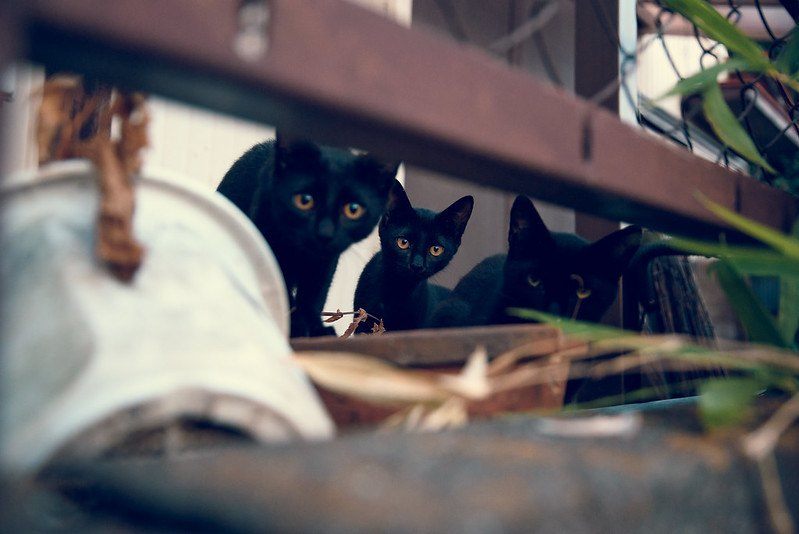
Three black cats with orange eyes stare at the camera.

Image source: By torne (where's my lens cap?) CC BY 2.0, via flickr.com

If we were comparing the color of cats, one cat might be homozygous dominant for black fur (BB) while another cat is heterozygous for black fur (Bb). They have a different genetic makeup, but they both physically show the same trait: black fur. So, they have different genotypes (heterozygous vs. homozygous) but the same phenotype.

P.S. Here's a trick for remembering these terms:

Pheno kinda sounds like physical. So, pheno-type = physical-type

Geno kinda sounds like gene. So, geno-type = gene-type

Vocabulary Review:\color{#8925AE}{\text{Vocabulary Review:}}

Genotype\color{#8925AE}{\text{Genotype}} : The genetic makeup of an organism

Phenotype\color{#8925AE}{\text{Phenotype}} : The physical characteristics of an organism

Dominant\color{#8925AE}{\text{Dominant}} : In a pair of genes, the stronger of two expressed genes

Recessive\color{#8925AE}{\text{Recessive}} : The weaker of two expressed genes. A recessive trait is only visible if a gene is homozygous recessive

Heterozygous\color{#8925AE}{\text{Heterozygous}} : Two different kinds of allele, one dominant and one recessive

Homozygous\color{#8925AE}{\text{Homozygous}} : Two of the same type of allele, both dominant or both recessive

Punnet Square\color{#8925AE}{\text{Punnet Square}} : A method of determining the odds of which traits the offspring of two organisms will inherit

Illustrated · 1 min

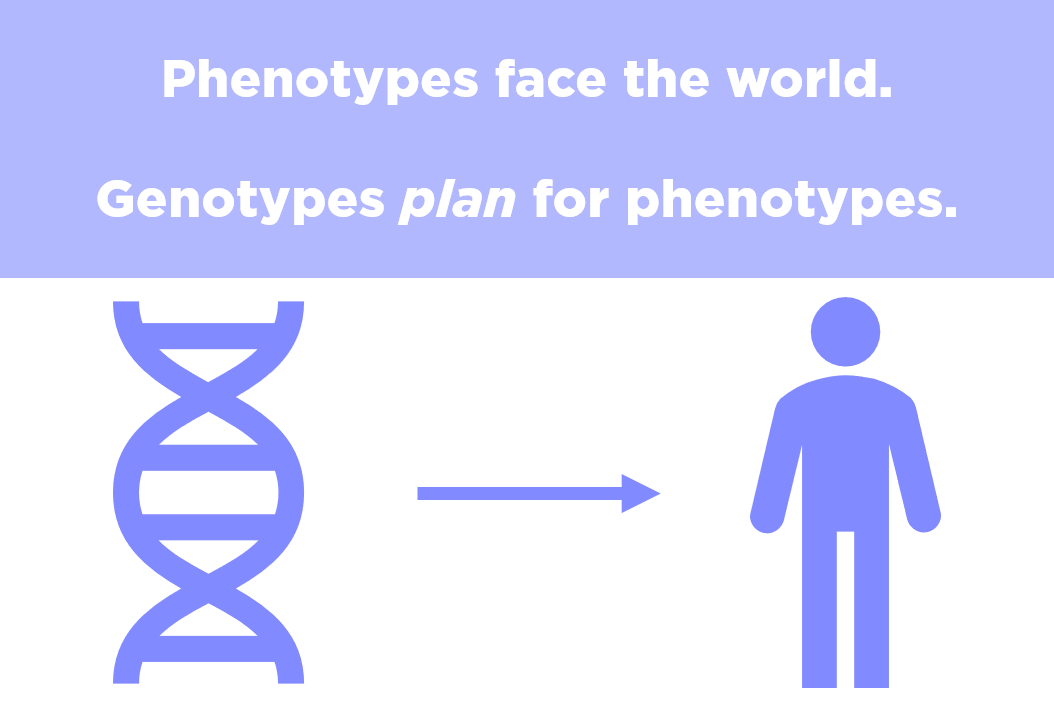
A genotype is the genes that an organism has. A phenotype is the shape, size, colors, patterns, behaviors, and other traits of the organism based on its genetics.
Genotypes code for the traits of an organism, such as a person, that will be acted on my natural selection. Those traits are the organism's phenotype.

Image source: By Valeri Natole

Read · 1 min

Observable Traits

An organism's phenotype is all of its observable traits.

If an organism has a certain phenotype, it is because it's expressing a gene a certain way. If a person's hair is brown, then they are expressing the gene for brown hair. This may seem kind of obvious, but it is important because knowing an organism's phenotype (observable traits) helps scientists figure out what its genotype (genetic traits) is. Genotypic traits and their relationship to each other are usually hidden and complicated to figure out. Gregor Mendel used the phenotypic traits of pea plants to determine their genotypes. Traits can also be partly determined by environmental influences, not only genes.

Now that we know more about genetic inheritance, scientists can make use of genetic engineering. This is a technique used to give organisms some specific traits, like resistance to bugs or parasites.

Video

(Video) Genotype and Phenotype

by Adam Porth

The term phenotype refers to any observable trait possessed by an organism, like eye color or a certain behavior. In this video, Adam Porth explains the difference between this term and genotype. The word genotype refers to the set of genes an organism carries for a specific trait. This genotype determines how the organism will express the trait, or its phenotype.

Type a concept, like “slope” or “photosynthesis”.

↑ ↓ to choose · Enter to openSearch explanations and problems