
Illustrated · 1 min
By Gabi Slizewska

+1 contributors
Contributors

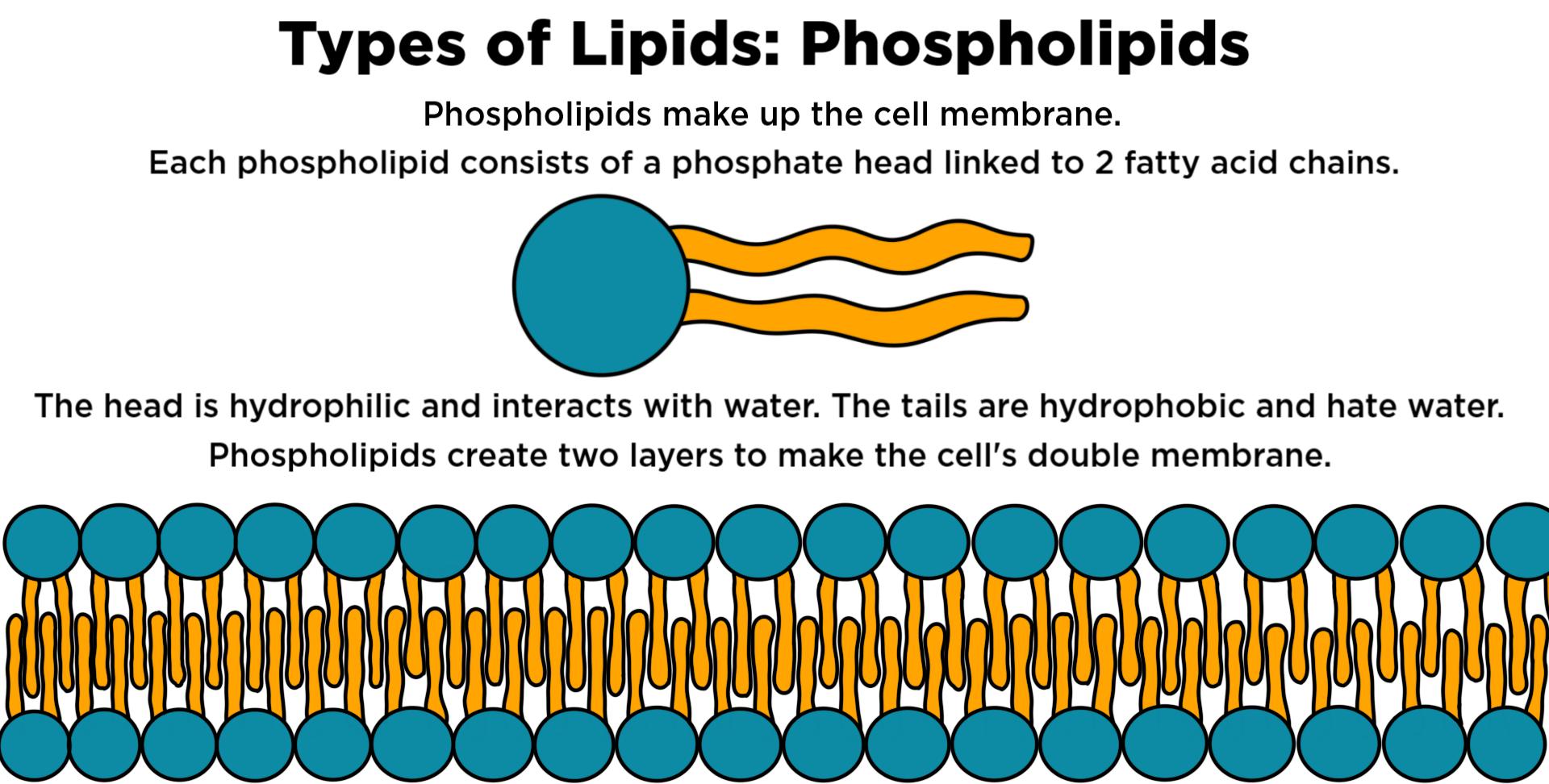
Image source: By Gabi Slizewska
Illustrated · 1 min
Image source: By Gabi Slizewska
Illustrated · 2 min

Image source: By Sarah Morgan
Phospholipids are specialized lipids produced in the endoplasmic reticulum that are used to create double-sided membranes. You can find them in cell membranes and in organelles.
They are made of a phosphate group attached to a glycerol structure that has two fatty acids attached to it. One fatty acid is saturated, and one is unsaturated. Because the one fatty acid is unsaturated, it has a double bond that causes it to bend slightly.

Image source: By Sarah Morgan
The phosphate end of the molecule is negatively charged because of an oxygen ion. The fatty acids do not have ions. This means that the phosphate end is polar, while the fatty acid end is nonpolar. Since water molecules are polar, they attract the phosphate end. The nonpolar fatty acid tails are hydrophobic, however, so they avoid water. This means that the phospholipid is amphipathic: hydrophilic and hydrophobic at the same time.
When many of these lipid molecules gather together in water, they create bubbles where there are phosphate heads facing outwards, while the lipid tails gather in the middle. If you have ever heard of micelles, such as those in micellar water, then you know that single layer phospholipid sheets are great for capturing and removing nonpolar grease and dirt molecules.
However, in cells, the phospholipids form double-layered sheets known as phospholipid bilayers.

Image source: By Sarah Morgan
This lipid bilayer creates a flexible and selectively permeable membrane that can be used in a wide variety of activities such as generating energy, storing dangerous materials like acids, or engulfing and digesting bacteria.
: A molecule made of a glycerol backbone attached to two fatty acids chains and a phosphate group. A major component of cell membranes
: A polymer that has a large (macro) molecular mass. There are four main types in organisms: carbohydrates, proteins, lipids, and nucleic acids
: Saturated fatty acids occur when each carbon atom in the chain is linked by a single bond
: Unsaturated fatty acids have one carbon-to-carbon double bond
: Fats and oils
: "Water-loving". Attracted to water and will easily dissolve in it
: "Water-hating". Not attracted to water and will not dissolve in it
Video
by Clutch Prep

What makes a phospholipid different than other lipids? This video explains phospholipid structure and how that structure leads to special roles in organisms.

Phospholipids are pretty super—they assemble to form membranes for cells and organelles.
Image source: By Valeri Natole
