
Illustrated · 3 min
+2 contributors

What is a Chemical Change?
It is a change that alters the chemical makeup of molecules. Everything around you (including your body) is made of chemicals. Sometimes changes can occur with chemicals to create something new, this is a chemical change.
What is an Example?
Let's imagine we are going camping! While camping, we decide to create a campfire using wood cut from a tree. Cutting wood for a campfire is NOT a chemical change, it is a physical change. No matter how small the wood pieces are cut, the chemical makeup remains the same.
As our campfire combusts, the wood will blacken and turn to ash. The wood is made of long chains of carbon and hydrogen. When we light the wood on fire, it reacts with oxygen in the air. The covalent bonds break and reform. What's the result? Carbon dioxide, water, and heat. This is an example of a chemical change because something new was created. If we were to look at the molecules that made up the wood versus the ash, they would be different.

Wood is being chemically changed by fire into ash.
Image source: By Richard Skelton CC0, via publicdomainpictures.net
Did You Know?
Chemical changes occur all the time, even when we don't realize it! You have probably seen a picture of the Statue of Liberty in New York City. What color is the statue? It is a greenish color, but it wasn't always that way! The statue is made of copper metal () and it originally was the reddish-brown color associated with copper.
What Chemical Changes are Happening?
Overtime, the oxygen () in the air interacted with the statue's copper causing a new chemical to form on the surface, copper oxide (). This chemical change is also known as an oxidation reaction. The statue started with molecules, and interacted with molecules, to form a new chemical compound, . This is a chemical change because the chemical composition changed. If the color change was due to coating the statue in paint, this would be a physical change. The copper underneath the paint would chemically be the same.
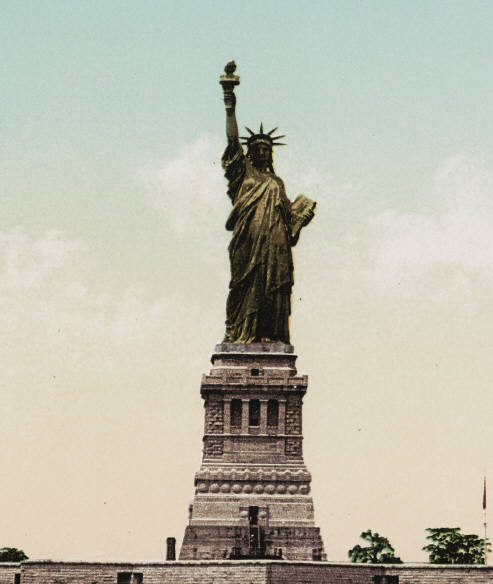
The Statue of Liberty in the original copper copper, circa 1900. The green color is due to the interaction of air and copper.
Image source: By Unknown author - Beinecke Rare Book & Manuscript Library, Yale University, [Public Domain], Wikimedia Commons
What is a Physical Change?
It is a change to a substance that does not alter molecules or the chemical makeup. This is in contrast to chemical changes, which do alter substances at a chemical level.
When Does it Happen?
When deciding if a change is physical, think about whether the change is reversible. For example, you grab a piece of paper and fold it multiple times into a paper airplane. You could unfold your airplane to reveal the original paper you started with! This means a change occurred physically and not chemically. We start and end with a piece of paper.

Origami is the art of folding paper to create new shapes and objects. Origami is an example of making physical changes to paper.
Image source: By Jacek Halicki ,via [Wikimedia Commons](https://commons.wikimedia.org/w/index.php?
Chemical or Physical?
Deciding what type of change is made can be tricky, especially if the name of the substance changes. Let's consider water or , it is a liquid. If we were to place this same water in the freezer, we would then have ice or the solid form of water. Chemically the ice is still , it is just in a different state. The ice can easily be turned back to water by warming it. If enough heat energy is added, the water will turn into steam, or the gas form of . The changes of between solid, liquid, and gas are examples of physical changes.

An iceberg has the same chemical makeup as water, it is just in a different state. The melting of ice to water is a physical change.
Image source: By AWeith [Public Domain], via Wikimedia Commons



