Read · 3 min

Jeremy & Jokie
Jeremy is a researcher at the University of Gotham. He has designed a new serum, jokie, and he wants to test whether this serum makes people funnier. He designs an experiment where he randomly assigns Gotham citizens into one of two groups. One group gets the serum, jokie. The other group does not get the serum. By having one group get the serum, while the other one doesn't, he is able to determine whether the serum actually works by making people funnier.
However - Jeremy doesn't tell the participants whether they got the serum or not. The participants who do not get the serum get saline, which is just salty water. All participants are injected with a liquid, but the participants don't know whether they're injected with the serum or saline.
Let's think about why Jeremy does that. We will first consider the placebo.
Placebo
A placebo is a substance, treatment, or injection that has no therapeutic value. That means that the chemical or treatment doesn't do anything. A placebo has no direct effect on the body or the brain.
We see placebos in our everyday life. If you take a birth control pill everyday, chances are you take a "sugar pill" for a few days per month. This "sugar pill" is a placebo - because it doesn't contain any active hormones in it. The crosswalk button is another example of a placebo. Pressing the crosswalk button used to change the light, but nowadays, most crosswalk buttons do not do that. So, when you press a crosswalk button, you are just pressing the button, without the light changing in your favor.
The Placebo Effect
Let's consider why we use placebos in research. Placebos can tell us whether a drug or intervention actually works or not. Oftentimes, even just a suggestion or something can change behavior. We want to determine whether a change in behavior or feeling is due to an active drug or intervention, or whether it's just the suggestion.
The mind is a powerful muscle - it is able to convince itself of a lot of different things. It's important to figure out whether it's the brain or the drug causing a change in behavior!
Let's go back to Jeremy's example. Jeremy wants to know whether his serum, jokie, actually works. Maybe the participants injected with the saline solution, or placebo, think they were injected with jokie, and so they feel funnier, even though they were not injected with the jokie serum. Participants who were not injected with jokie but still became funnier are feeling the placebo effect because they are feeling the effects of a drug they did not get, but think they did.
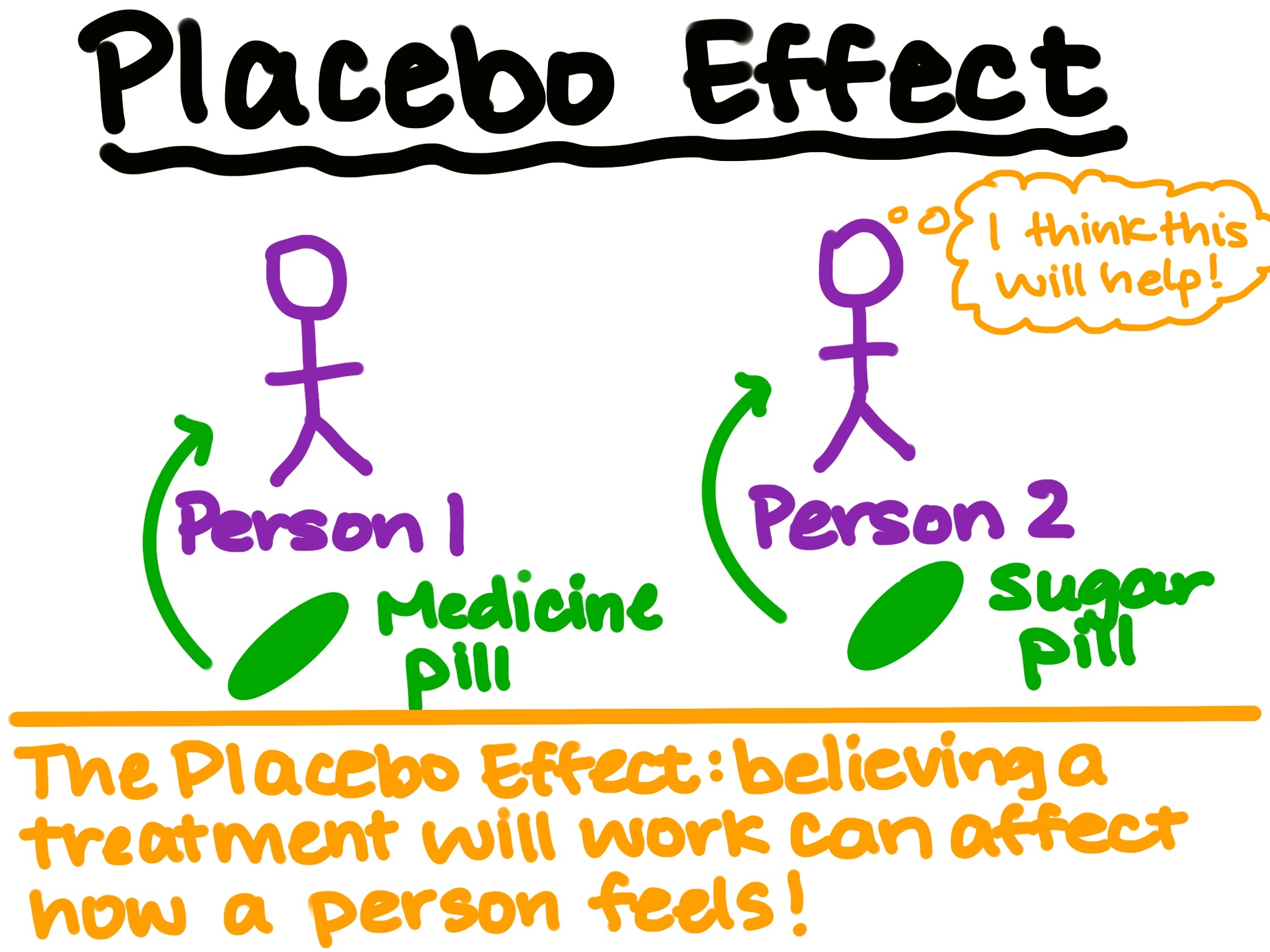
The placebo effect is when someone feels the effect of a treatment, drug, or intervention that they did not receive the active ingredient for. Because the participant thinks they received the drug or intervention, they unconsciously begin to act differently.
According to WebMD, there are a lot of medical conditions that are proven to show improvements due to the placebo effect, including:
-
Depression
-
Pain
-
Sleep disorders
Back to Jeremy & Jokie
Let's circle back to Jeremy's research on jokie. His research sample has participants. Of those, half received jokie and half received a placebo.
Let's look closer at the who received the saline solution, or placebo. Of these , said that they felt funnier. These did not receive jokie, but they still felt funnier. These participants are feeling the placebo effect because they're feeling the effects of an active ingredient that they did not get.