We're beginning our study of quantum mechanics. Quantum mechanics explains the behavior of electrons. Why do we care? In chemistry, it helps to explain bonding. We want to know how atoms interact to form covalent and ionic bonds. Eventually, we'll understand different models of how atoms bond. For example, we'll look at the valence bond theory and the molecular orbital theory. But, for now, we need to build the foundation. Let's explore how scientists began to rethink their understanding of the laws of physics.
Science in 1900
At this point in history, many chemists and physicists thought our understanding of the universe was almost complete. We were incredibly familiar with Newton's laws and electromagnetism. And we were continually using them to develop and adapt new technologies. But, there were a few outstanding problems that we needed to solve. One of those problems was blackbody radiation.
You've probably seen this phenomenon before. If you have an electric stove, the coils glow as they heat up. We manufacture stove coils by alloying the transition metals nickel and chromium. Remember alloying improves the chemical and physical properties. So, it's unbelievably strong! Its melting point is 1400.0oC! So, we can heat it to a very high temperature, and it will remain solid. But what happens as it's heated? At first, it begins to glow orange-red. Then, eventually, it will glow white.
So, what is a black body? Technically, a black body is an object that absorbs all wavelengths of electromagnetic radiation. We can also think of it as emitting all wavelengths of light. However, the intensity and peak wavelength depends on the temperature. Most room temperature objects peak in the infrared region and have minimal intensity. We can't see that. But, as the temperature increases, the peak shifts to the visible region. The intensity also increases dramatically. That's why we see the red glow of the stove coil. What about at high temperatures? The peak shifts into the ultraviolet region.
But what was the problem? Classical electromagnetism predicted a black body would emit at an infinite intensity in the ultraviolet region. That disobeys the first law of thermodynamics! Why? A black body could produce an unlimited amount of energy. Thankfully, everyone recognized that it was a problem. It didn't match our understanding of thermodynamics. Moreso, it didn't fit the experimental data. The experimental data showed that the intensity drops to zero as the wavelength decreases. But no one understood why!
Quantization of Energy
In 1901, Max Planck solved the problem. He proposed that energy was quantized. What does that mean? The emitted energy is restricted to specific values. To help us understand, let's consider the atomic scale. Heat is the transfer of kinetic energy between atoms and molecules. So, as we heat a black body, the atoms have more kinetic energy. So, what's happening in our stove coil? Metals experience metallic bonding. So, the atoms form a lattice structure. That limits the variety of movements they have. In a crystal lattice, the atoms can only oscillate. But, the metal also has a sea of electrons. The electrons also oscillate as they gain energy. What happens when charged particles oscillate? They produce electromagnetic waves. That's a fancy way of saying they emit light!
But where does quantization occur? At the quantum scale, most things are quantized. So, the oscillations of the atoms and electrons are quantized. The promotion of electrons to higher energy levels is also quantized. The rotations of a molecule are quantized. A black body has various methods of gaining and losing energy. Some are beyond my explanation above. But, oscillating electrons are the main method. The key concept is that they only occur in set amounts. For an electron to reach a higher energy level it must absorb a specific amount (quanta) of energy. It cannot absorb more or less. To return to the lower energy state, it emits light. The ultraviolet region is at a high energy level. So, it's unlikely that many electrons will reach the correct energy state. In the classical model, scientists assumed all energy states were equally likely. Planck realized that the high-energy states have a significantly lower probability. Why? Because they would have to absorb the exact right amount of energy. And that amount is much larger than the visible or infrared regions.
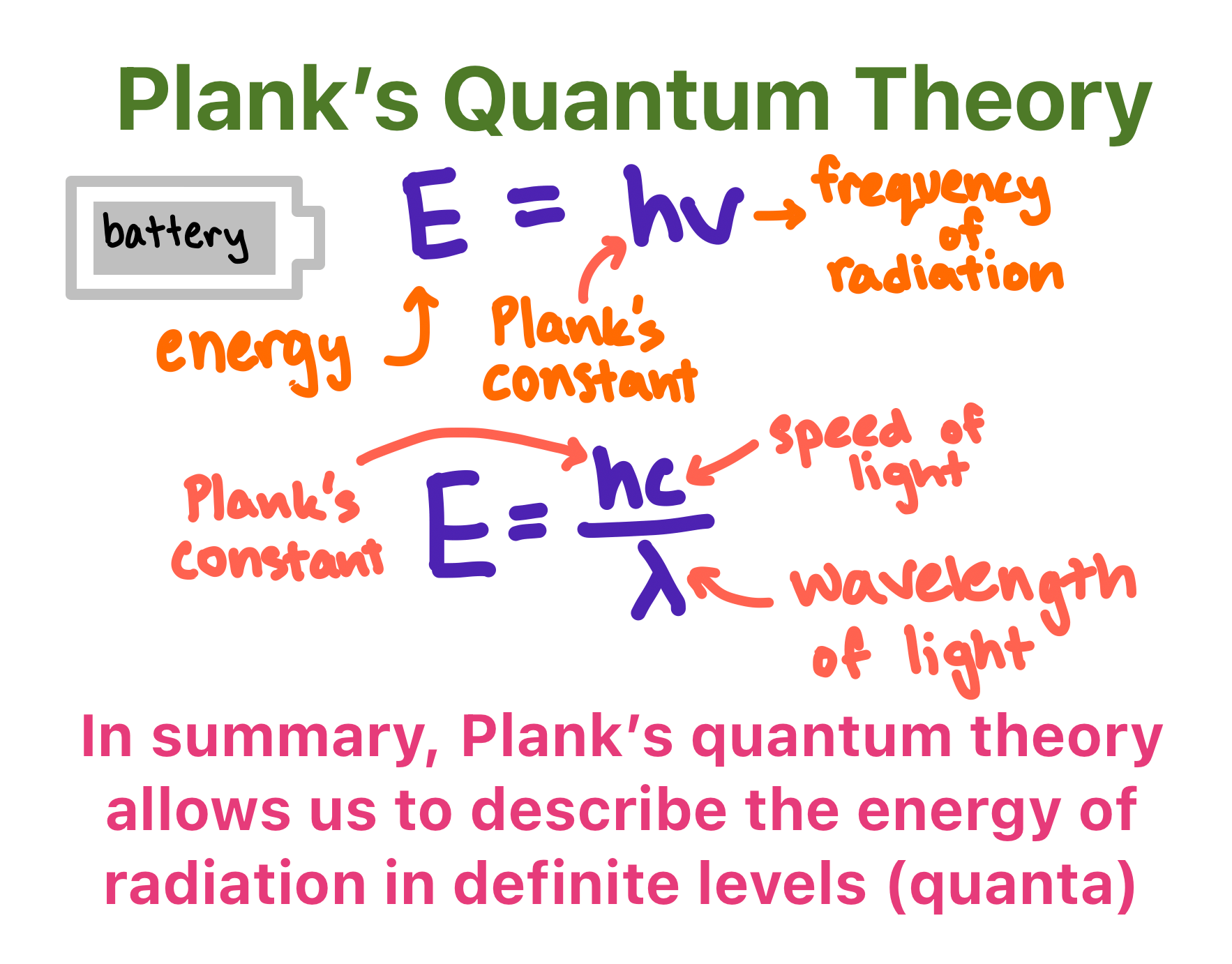
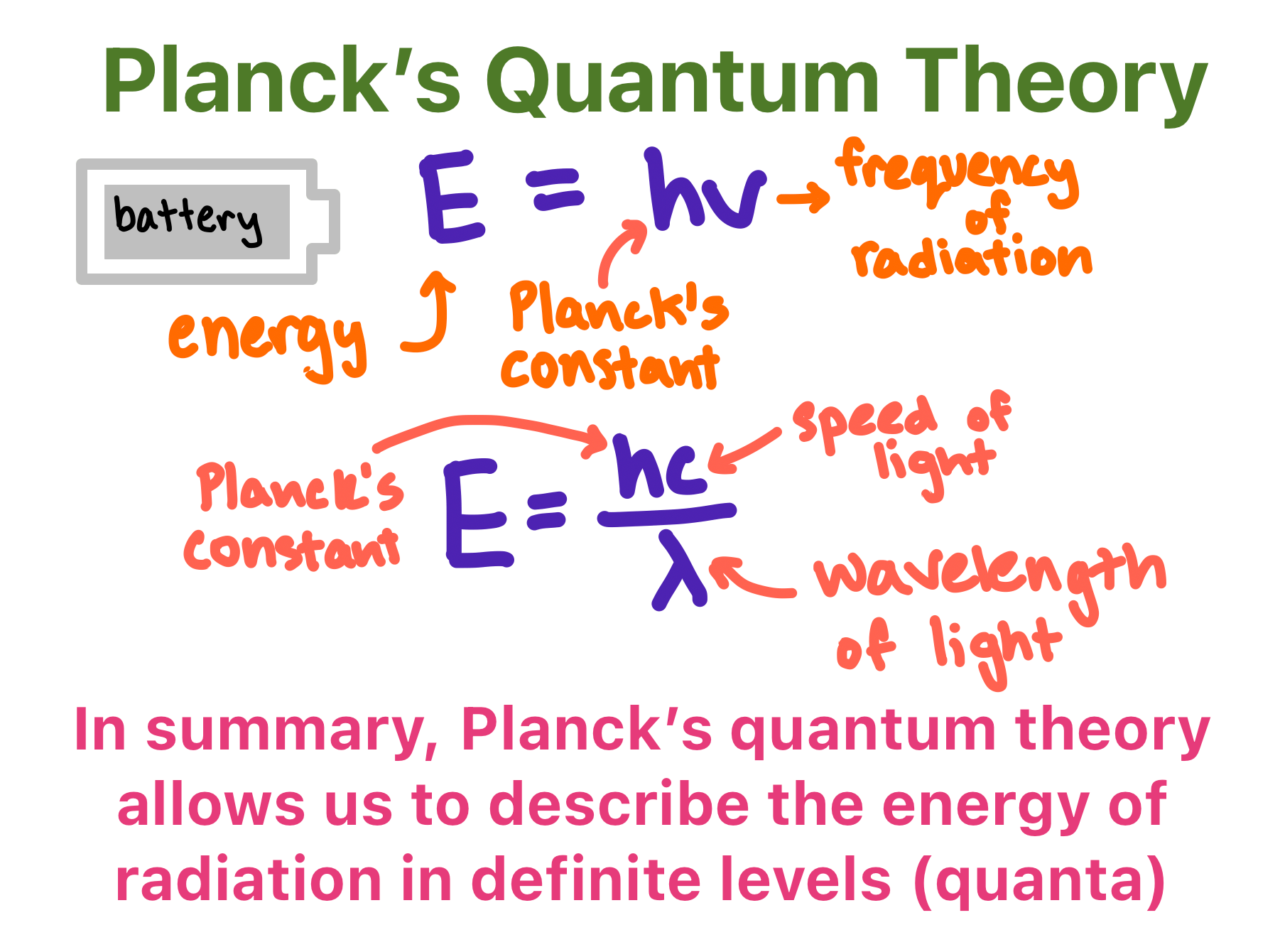
From Planck's concept, we can determine the equation E=nhν.
-
E is the energy of the emitted light. In a blackbody, the light's energy equals the energy lost by an electron as it relaxes.
-
n is a whole-number integer (0, 1, 2, 3, etc.) that creates the quantization.
-
h is Planck's constant with a value of 6.626×10⁻³⁴sJ.
-
ν is the frequency of the light.
What does this equation tell us? At a specific frequency, matter can only emit and absorb energy in whole-number ratios. The ratio is determined by the n value and Planck's constant. Notice that Planck's constant is tiny! The scientific notation is 10−34. That explains why we don't perceive quantization at the macroscale. The boundaries are too small except at the atomic and subatomic scales. This solved the black body radiation problem because n could equal zero. So, a blackbody can have high frequencies but low intensities in the ultraviolet region.