There are a few ways to define a plane. You could define a plane with a line, and some point that isn't on that line. You could also define a plane using two distinct lines, or with three distinct points that aren't on that line.
Dimension + Examples
Planes are two-dimensional objects. Polygons and faces of polyhedra can be drawn on a plane.
Mr. Evil Wizard has trapped you in his evil dungeon. He offers to play a game with you: he provides three points on a plane he's thinking of and you have to guess the plane. If you get it right, you will be freed; if not, you are doomed...
Mr. Evil Wizard acknowledges that the game is unfair. So now he offers you a new rule: the points he gives you must be distinct.
So... when do three points not define a plane?? Think about it a bit before moving on.
It turns out that while three points are the minimum number needed to define a plane, if the three points that are chosen are collinear, then you won't be able to figure out which plane Mr. Wizard has in mind! It is absolutely vital that the three points form a triangle, and not just a line.
When studying geometry it is important to know some key terms. In this explanation we will begin to discuss some of those key terms such as planes, figures, shapes, and triangles.
Let's begin with planes. In geometry a plane does not refer to a flying object, instead it refers to a flat, infinite, two dimensional surface. I remember this by thinking of plains in the geographic sense. In geography a plain is a flat stretch of land, similarly a plane is a flat surface.
When determining if something qualifies as a plane look for one of the following attributes: ∙ three points that are not on the same line ∙ a line and a point not on that line ∙ two parallel lines ∙ two distinct but intersecting lines
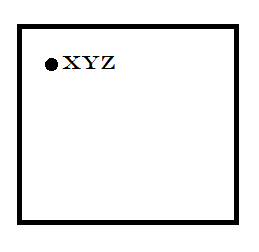
Planes are made up of points, and lines and can have segments, rays, solids, angles, etc. on them. All of these things that lie on a plane are called figures. For example, the point in the plane below is called a figure.
Now that we know the definition of figures, what exactly is a shape?
The form a figure takes, whether it is round, it has three sides or thirteen sides, is called the shape of the figure. The shape of an object is used to define the form of the boundary/outline of the object. The shape of an object does not tell us where the object is located. Common shapes include circles, squares, rectangles, and triangles.
Triangles are three sided two dimensional shapes with three vertices. Much of geometry is spent studying triangles and their angles and sides. A triangle is made up of three non co-linear points (points that are not on the same line). Because a triangle is made up of three non co-linear points, a triangle can be classified as a plane itself.
Intuitively, a plane is a "flat," two-dimensional surface.
More formally, a plane in Euclidean space is, for some point P and two non-parallel vectors v1 and v2, the set of points X whose position, as a vector, can be written as P+av1+bv2 for some real numbers a and b.
Notice that since the points on a plane can be linearly parametrized by two independent variables, a plane has dimension 2.
Alternate definition:
A plane is the set of all points P in space such that given a point P0 and a vector N, the vectors N and P0P are perpendicular. Any two nonzero, nonparallel vectors v1 and v2 that lie in the plane defined by P and N satisfy v1×v2=k⨀N.
To be specific, the three points must actually be non-collinear in order to determine a unique plane. If the three points given were on the same line, then they would in fact all lie in an infinite number of planes -- namely, those that intersect the line that contains the 3 points.