
Illustrated · 1 min
By Gabi Slizewska

+1 contributors
Contributors

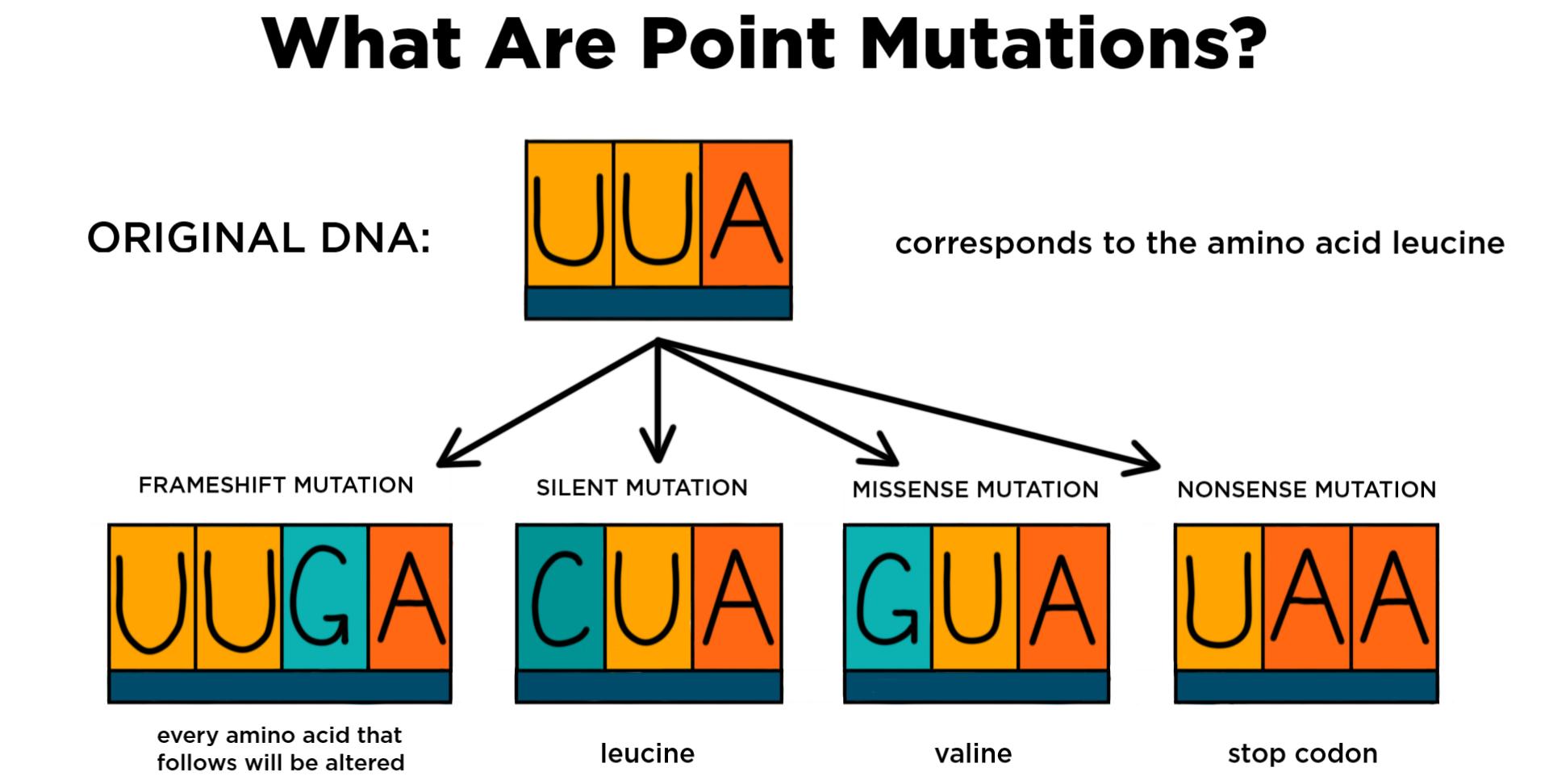
Image source: By Gabi Slizewska
Illustrated · 1 min
Image source: By Gabi Slizewska
Video · + 1 min read
by Simple Science Answers

Mutation might seem like a scary word, but did you know it's just like changing one word in a sentence? Only, the sentence is DNA, and changing that one word can have a range of effects on an organism. This video explains different types of mutations using phrases and sentences.
There can be various effects depending on the type of mutation that happens.
Substitution mutations cause a single base pair to be exchanged for another. They can cause:
Insertion mutations happen when an extra base is inserted into a sequence. Similarly, a deletion mutation happens when a base is removed from the sequence. These changes can cause:
Illustrated · 2 min
During either DNA replication or transcription, a nucleotide can get placed incorrectly. Enzymes like DNA polymerase or RNA polymerase can make these mistakes.
A point mutation is a gene mutation that changes a single nucleotide or just a few nucleotides in the DNA sequence. In other words, at least one nucleotide gets messed up. They show up at a single point in a DNA sequence.

Image source: By Jonsta247 CC BY-SA 4.0, via Wikimedia Commons
These mutations can be base substitutions, deletions, or insertions.
These mutations can be good, bad, or have no effect on the protein. Occasionally, they can have serious evolutionary consequences. Point mutations alter codons—groupings of three nucleotides which correspond to different amino acids. What matters is, does the codon code for a different amino acid due to the mutation?
Also, these changes can cause more significant mutations like frameshift mutations. These mutations result in the entire amino acid sequence of a protein shifting. Frameshifts happen when nucleotides get inserted or deleted. These mutations tend to have serious effects on protein functionality.
: A change in genetic code
: A mutation that occurs at a single point in the DNA sequence
: A mutation that causes all the nucleobases following it to be shifted
: A group of three nucleobases that code for a specific amino acid
: A substitution mutation that codes for an incorrect nucleobase
: A mutation that causes a stop codon to appear in an incorrect location which prevents the protein from being completed
: A mutation that has no effect on the final protein
Illustrated · 1 min
Point mutations occur when there is a mistake at a single point in either a DNA or an RNA sequence.
These mutations, like most other mutations, occur when genetic material is being modified in the cell. During either DNA replication or transcription, a nucleotide can get placed incorrectly. Enzymes like DNA polymerase or RNA polymerase can make these mistakes. Polymerases have the ability to read and correct their own mistakes, but sometimes they still miss one.

Image source: By Olivia Jester CC0 1.0, via Public Domain Pictures
There are three types of point mutations: deletions, insertions, and substitutions.
Deletions occur when a nucleotide is deleted. Insertions happen when a new nucleotide is inserted into the genome. Substitutions happen when a nucleotide is swapped for another nucleotide.
These mutations can cause one of several possible effects:


