Polar vs. Nonpolar Bonds — Overview & Examples

Illustrated · 1 min

Electronegativity and Bonding

If you've studied any chemistry or biology, you've probably heard the word polar tossed around a lot. If you're afraid of polar bears, don't worry. If you forget the characteristics of the polar biome, never fear. In chemistry, polar means oppositely charged, just like how magnets have north and south poles.

For a compound to be polar, the molecule needs to have polar covalent bonds and geometric asymmetry.

What Are Polar Bonds?

Bonds are polar when one element in a compound is more electronegative than the other. This creates a dipole in the molecule where one end of the molecule is partially positive and one end is partially negative.

Okay, so Then What Is Electronegativity?

This is a cartoon image illustrating the electronegativity of commonly encountered elements. In order, the relative electronegativties are: 4.0 for fluorine, 3.5 for oxygen, 3.0 for nitrogen, 2.5 for carbon, and 2.1 for hydrogen. Fluorine is the most electronegative element of all in the periodic table. A handy mnemonic to remember this order is the acronym "FONCH", which stands for the elements in order from greatest to least.

Image source: By Sylvia Freeman

You can think of electronegativity as a measure of how badly the atom wants electrons. A very electronegative species is greedy. In a covalent bond it will hold onto electrons more tightly.

For a bond to be polar, the electronegativity difference between the two elements needs to be higher than 0.50.5. If the electronegativity difference is less than 0.50.5, the bond is nonpolar.

For example: fluorine, the most electronegative element of them all, has a electronegativity number of 4.04.0. Hydrogen is very weakly electronegative with a value of 2.12.1. When the two elements come together, they form the polar compound HFHF.

This is a cartoon illustrating an example of a polar bond. The image shows the compound HF, hydrofluoric acid. A caricatured fluorine atom looks at hydrogen with disdain while the electrons between them are much closer to fluorine. The text reads: "Fluorine is far more electronegative than hydrogen. The electrons in the bond are held much closer to fluorine, creating a dipole in the molecule". As a result, fluorine has a partial negative charge and hydrogen has a partial positive charge.

Electronegative elements are bad at sharing. \\ Image source: By Sylvia Freeman

Because the negatively charged electrons in the bond between hydrogen and fluorine are concentrated around fluorine, fluorine has a partial negative charge and hydrogen has a partial positive charge.

Be careful not to get confused, though: even though both species are partially charged, this is not an ionic bond. It is a polar covalent bond.

Well, What about Nonpolar Bonds Then?
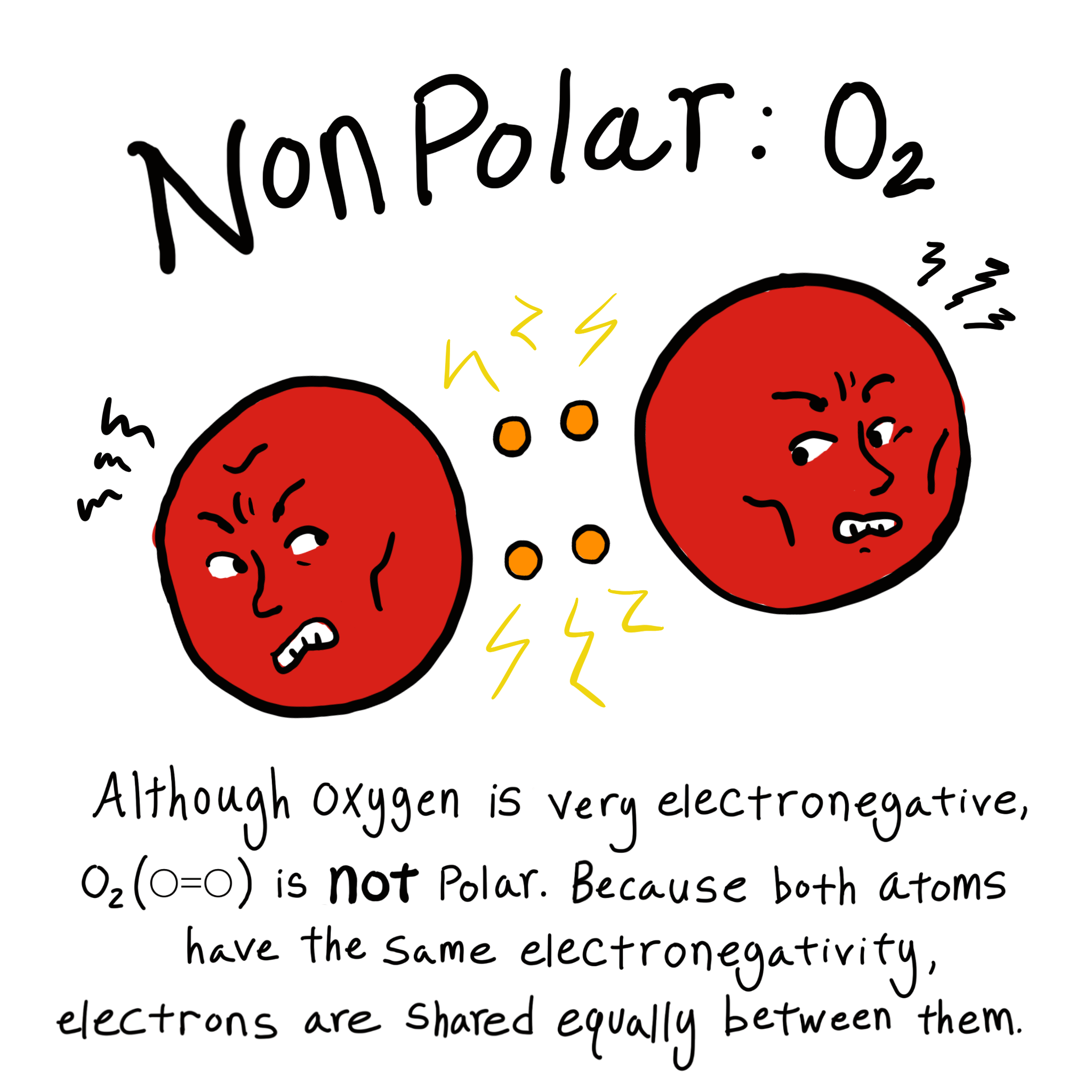
This is a cartoon illustrating an example of a nonpolar bond. The image shows the compound O$_2$.  Two caricatured oxygen atoms are glaring at each other while the electrons between them are spaced evenly between them. The text reads: "Although oxygen is very electronegative, O$_2$ is not polar. Because both atoms have the same electronegativity, electrons are shared equally between them."

Image source: By Sylvia Freeman

Quick refresher: For a bond to be polar, the electronegativity difference between the two elements needs to be greater than 0.50.5. If the electronegativity difference is less than 0.50.5, the bond is nonpolar.

Illustrated · 1 min

Covalent Bonding: Polar vs. Nonpolar

Each element has a specific electronegativity. This number tells us how strongly an atom attracts electrons to itself. The higher the number, the stronger the attraction.

A periodic table showing the electronegativities of the elements. The electronegativity of fluorine is 4.0, and that of potassium is 0.8.

Image source: By Gabi Slizewska

When two atoms form a covalent bond, they are sharing a pair of electrons. Each atom is pulling on the electrons, and if their electronegativities are the same, they will equally share the electrons. This is a nonpolar molecule.

Iodine is a nonpolar molecule made of two iodine atoms. Both atoms have the electronegativity 2.5, so electron density is spread out.

Image source: By Gabi Slizewska

If the electronegativities of the two atoms are different, the atom with a higher electronegativity will be able to pull those electrons in closer to itself than the other atom. This is a polar molecule.

In a polar molecule, the more electronegative atom will have a higher density of electrons near it. Since electrons carry a negative charge, this atom will also have a partial negative charge on it. In turn, the other atom will have a lower electron density around it so it will have a partial positive charge.

The partial charges are usually represented by a δδ (delta) and a −- or ++ depending on the charge.

A polar molecule. The electronegativity of oxygen is 3.5 and that of hydrogen is 2.1. There is unequal distribution of electron density.

Image source: By Gabi Slizewska

The partial charges create a dipole, which is a separation of charges between the two atoms. The difference in charges is called a dipole moment and it's represented by a special arrow that points towards the more electronegative atom. The greater the difference in electronegativities, the greater the dipole and the more polar the molecule is.

When a molecule has more than two atoms, things get a little bit more complicated.

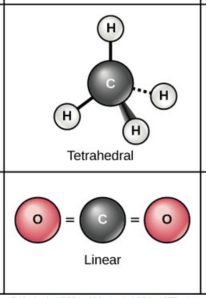
Dipole moments can cancel each other out. Carbon dioxide is nonpolar because electron densities are equally distributed even though the electronegativity of oxygen is 3.5 and that of carbon is 2.5.

Image source: By Gabi Slizewska

Even if the atoms have different electronegativities, the overall molecule can still be nonpolar. It largely depends on how the atoms are arranged. Sometimes, the electronegativities of different atoms can cancel each other out.

Interactive · 2 questions

Polar and Nonpolar Bonds

Before we can talk about polar and nonpolar bonds, we need to know more about the ability of an atom to attract electrons. Some elements want to attract and hold onto electrons more than anything, while other elements just want their electrons to give them some space.

F > O > Cl, N > Br > I > S > C > P > H\color{#8925AE}{\text{F > O > Cl, N > Br > I > S > C > P > H}} (Most Electronegative)⟶(Least Electronegative)(\text{Most Electronegative}) \longrightarrow (\text{Least Electronegative})

An element's ability to attract electrons is called its electronegativity. Atoms that are very electronegative will try to take all the electrons near them, while atoms that are not electronegative will give up their electrons easily.

The periodic table

The darker red the element, the more electronegative it is.

Image source: By Adblocker CC BY-SA 3.0, via Wikimedia Commons

What is the best definition of electronegativity?

Choose one answer

Illustrated · 1 min

What Are Polar and Nonpolar Covalent Bonds?

Polar bonds and nonpolar bonds are both types of covalent bonds.

Covalent bonds are formed when two atoms share electron pairs, holding them together. (This is in contrast to ionic bonds, where electron pairs are transferred completely from one atom to another.)

When a covalent bond forms, electrons are shared between atoms.

Image source: By Hannah Bonville et al.

Have you ever "shared" a dessert with another person, but somehow they end up eating most of it and all you get are a few bites? The same thing actually happens with atoms.

Uneven sharing of electrons between atoms has to do with something called electronegativity. You can think of an atom's electronegativity as its level of electron greediness. The more electronegative an atom is, the more likely it is to share electrons unevenly with the atom it's bonded to.

When electrons are shared unevenly, you end up with a polar covalent bond.

Uneven sharing occurs with pie and with atoms that have different electronegativities (electron greediness). \\ Image source: By Jean Beaufort CC0, via publicdomainpictures.net

When electrons are shared unevenly by two atoms in a covalent bond, we call their attachment a polar covalent bond.

Recall that electrons are negatively charged. The greedier atom in the bond (the one with greater electronegativity) is going to hog the shared electrons, drawing them in close. This makes that part of the bond have a slightly negative charge (δ−δ-).

The other end of the bond, where there are fewer electrons (fewer negative charges) will have a slightly positive charge (δ+δ+).

These two ends of the new molecule are called poles. One pole has a slight negative charge and the other has a slight positive charge.

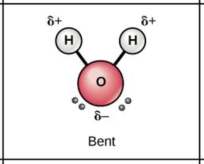
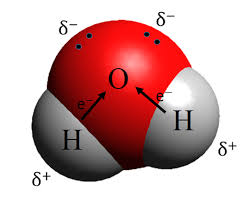
There are fewer free electrons at the hydrogen end of a water molecule. As a result, this is the positive pole. There are more free electrons at the oxygen end of a water molecule. As a result, this is the negative pole.

Water is a polar molecule.

Image source: By Hannah Bonville et al.

As shown in the image above, water is a polar molecule. This is the most important polar molecule.

When two atoms involved in a bond manage to share electrons evenly (because they have the same electronegativity and neither one is greedier than the other), we end up with nonpolar covalent bonds.

Take a look:

Methane is a non-polar molecule. Electrons are distributed evenly throughout.

Image source: By Hannah Bonville et al.

Important nonpolar substances are oils, fats, and waxes.

Key Vocabulary:

  1. Covalent bond
  2. Polar covalent bond
  3. Nonpolar covalent bond
  4. Electronegativity
  5. Pole

Video

(Video) Polar and Non-Polar Molecules

by CrashCourse

A bond is non-polar when the electron distribution of the entire molecule is the same. This means, in the simplest terms, that the molecule has no partial charges. Many non-polar molecules have a symmetric geometry. That is, if you were to cut it in half, both pieces would look the same.

Type a concept, like “slope” or “photosynthesis”.

↑ ↓ to choose · Enter to openSearch explanations and problems