Polyatomic Ions — Nomenclature & Compounds

Before this, knowIonic Bond — Formation & Compounds

Interactive · 1 question

Polyatomic Ions

  • Polyatomic ions are two or more atoms covalently bonded together that act as one unit.

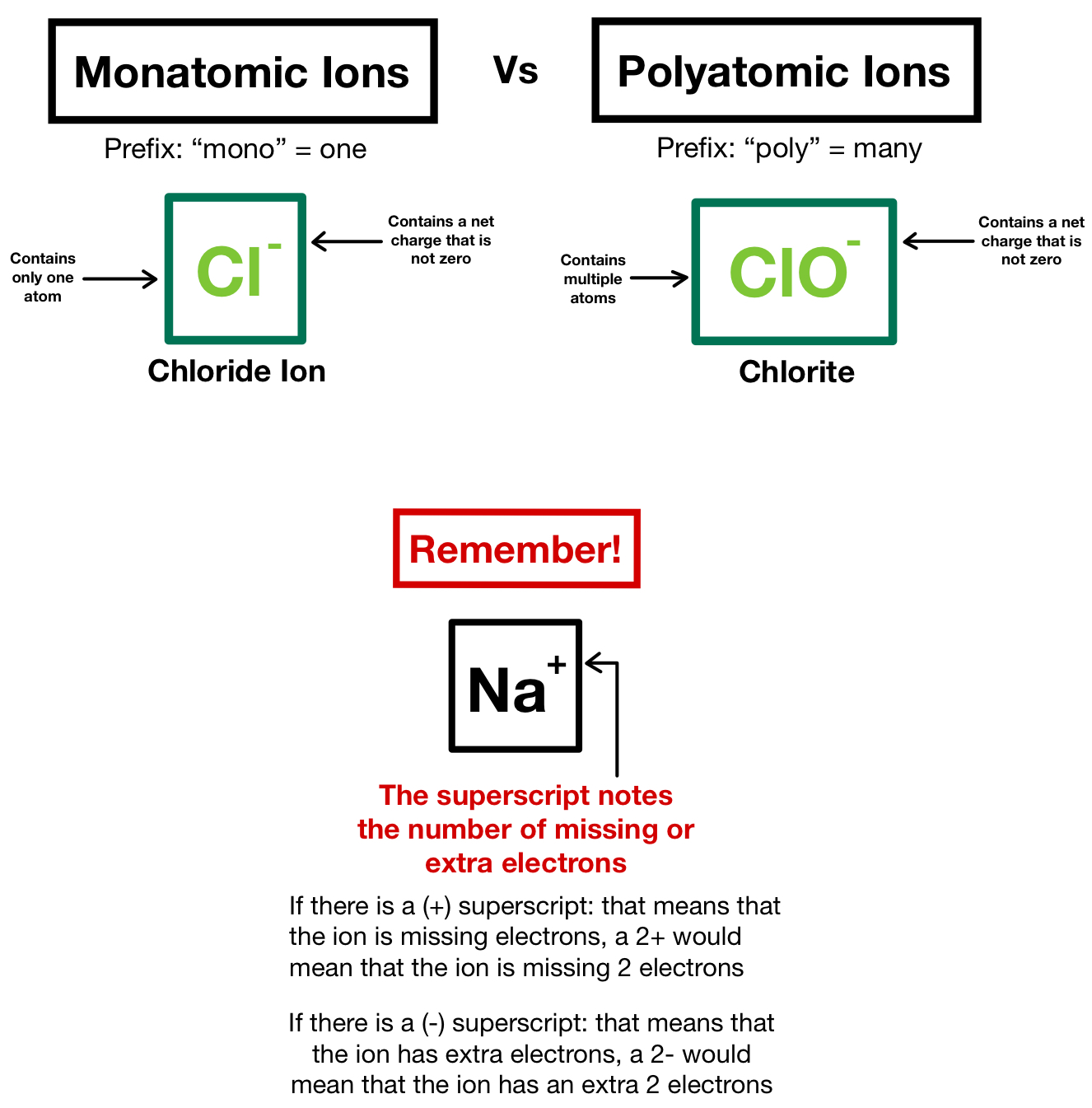
  • Polyatomic ions are similar to monatomic ions, in that they have positive or negative net charge (polyatomic ions do not have a net charge of zero) which is due to the gaining or loss of electrons.

Image showing the difference between monatomic ions (ions that contain one atom without a net neutral charge) and polyatomic ions (ion that contains more than one atom without a net neutral charge)

Image source: Caroline Monahan

Common Polyatomic Ions

  • Here is a list of the most common polyatomic ions:
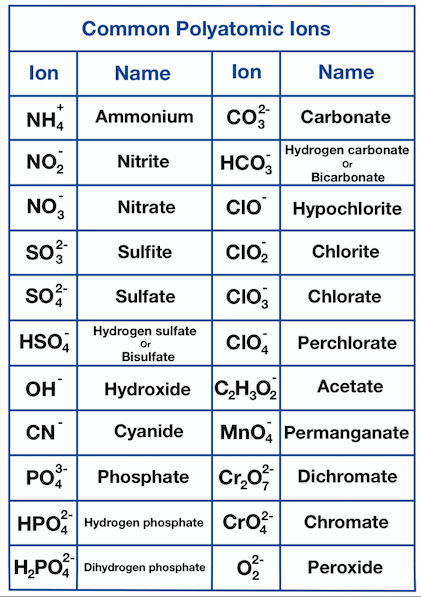
List of the 22 most common polyatomic ions and their names

Image source: Caroline Monahan

Nomenclature With Polyatomic Ions

  • Polyatomic ions can take part in chemical reactions to help form new ionic compounds.

  • Note: ionic compounds have an overall neutral charge, meaning the ions that come together to form it must form a neutral charge.

Here are the rules for naming compounds that contain polyatomic ions:

  1. Cations
  • Like all ionic compounds the cation is written first.

  • The cation is almost always a metal or metalloid. For elements with only one charge (alkali and alkaline earth), we use their elemental names.

  • If the cation is a transition metal it has a variable charge. So, it can form more than one ion because the d-orbital electrons are easily lost. The successive ionization energies are very low. For example, chromium has ions with a 2+ or 3+ charge. To name it, we use the elemental name followed by parentheses. The parentheses contain a roman numeral of the charge. For example, the 2+ ion is Chromium(II). The 3+ ion is Chromium(III).

  1. Anion
  • The anion end in -ide if it is a monatomic ion (ion containing one atom). For example, the halogen ions are fluoride, chloride, bromide, and iodide.

  • Generally, the polyatomic anions are oxoanions. They have their own naming system.

Writing the Chemical Formula for Polyatomic Anions

To write the molecular formula for a compound with polyatomic ions...

  1. Start by writing the cation's atomic symbol and charge.

  2. Next, write the formula and charge of the polyatomic anion.

  3. Balance the charges.

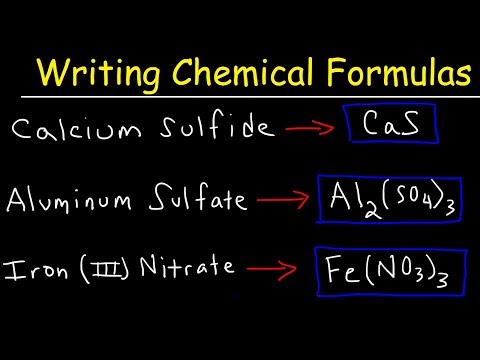
  • Use parentheses if there is more than one polyatomic ion. For example, MgSO4MgSO_{4} versus Ni(SO4)2Ni(SO_{4})2.

Examples:

  • AlPO4AlPO_{4} → Aluminum phosphate

  • Fe(OH)2Fe(OH)_{2} → Iron (II) hydroxide

  • NaOHNaOH → Sodium hydroxide

  • Li2Cr2O7Li_{2}Cr_{2}O_{7} → Lithium dichromate

  • NH4ClNH_{4}Cl → Ammonium Chloride

Try a Practice Problem!

What is the chemical formula for: Sodium Sulfate?

Choose one answer

Video

Polyatomic Ions

(Video) What's a polyatomic ion?

by: Tyler DeWitt

This video goes over the basics of polyatomic ions. It discusses what they are, what give them their charge, as well as other useful information

Naming Ionic Compounds Containing Polyatomic Ions

(Video) How To Write Ionic Formulas With Polyatomic Ions

by The Organic Chemistry Tutor

This video goes over the rules for naming ionic compounds containing polyatomic ions. The video goes in-depth about the rules for naming. So, you'll know how to write the name or chemical formula of the ionic compound every time!

Illustrated · 1 min

Polyatomic Ions

We encounter polyatomic ions every day! For example, sodium hypochlorite is the active ingredient in household bleach. Another example is sodium laureth sulfate. It's the cleaning/soap ingredient in many shampoos. As with any ion, polyatomic ions are charged compounds. They can have either a positive or negative charge. It depends on if the atoms gained or lost electrons to complete their valence shell. But, notice that polyatomic contains the prefix "poly-". That means it has "many atoms". Polyatomic ions contain multiple atoms that together have a net charge. The charge equals the sum of the formal charges. Each atom has a full octet, but the overall ion is charged.

Formal Charge=(valence electrons)+(nonbonded electrons+12(bonded electrons))\text{Formal Charge} = (\text{valence electrons}) + (\text{nonbonded electrons} + \frac{1}{2} \text{(bonded electrons)})

Polyatomic ions consist of covalent bonds. For example, let's consider the sulfate anion (SO4SO_{4}) and think about how we determine its charge. First, we should draw the Lewis dot structure. Then, we can sum the individual oxidation states of each atom to find its net charge.

Sulfur has a formal charge of 0\text{Sulfur has a formal charge of 0} Two of the oxygens have a formal charge of 0\text{Two of the oxygens have a formal charge of 0} Two of the oxygens have a formal charge of -1\text{Two of the oxygens have a formal charge of -1}

The overall charge of SO4SO_{4} is the sum of its individual atoms’ formal charges: 0+0+(-1 ×\times 2) = -2.

Image is a drawing depicting the text description for calculating the formal charge of SO4.

Image By: E. Burnham

The most common polyatomic ions are listed in the following posts\color{#D73D75}{\text{The most common polyatomic ions are listed in the following posts}}.

Main Takeaways‾\underline{\text{Main Takeaways}}

  1. You can find the charge of the polyatomic ion by adding the formal charge of each atom.
  2. Polyatomic ions are multi-atom-containing ions that have only one charge.

Read · 2 min

Polyatomic Ions

Polyatomic ions are groups of two or more atoms that have an overall charge. The atoms in the group are held together by chemical bonds. The whole group acts like one ion.

This is different from a monatomic ion, which is only made up of one atom. For example Na+\text{Na}^+ is a monatomic ion. Polyatomic ions contain two or more atoms!

There are many common polyatomic ions that you will see often in chemistry. Some examples are nitrate, NO3−\text{NO}_3^-, sulfate, SO42−\text{SO}_4^{2-}, and carbonate, CO32−\text{CO}_3^{2-}. Learning a list of polyatomic ions can help you recognize them more easily.

Each polyatomic ion has its own charge. These are called polyatomic ion charges. For example, nitrate has a charge of −1-1. Sulfate has a charge of −2-2. You need to know the charge when writing a chemical formula. Polyatomic ions also have special names. This is part of naming polyatomic ions. For example, NO3−\text{NO}_3^- is nitrate. NO2−\text{NO}_2^- is nitrite. The names can help you tell different ions apart.

####The Periodic Table and Ionic Charges

The periodic table will help you to learn the main group ionic charges. We group these together based on how they show up in the periodic table. Memorizing this list will be helpful - but remember, not all elements show up in this list!

  • Group 1: The Alkali Metals (examples: Li, Na, K) have a +1+1 charge
  • Group 1: Alkaline Earth Metals (examples: Be, Mg, Ca) have a +2+2 charge
  • Group 13: Boron Group (examples: Al, Ga) have a +3+3 charge
  • Group 14: Carbon Group (examples: C, Si, Ge, Sn) have a +4+4 charge
  • Group 17: Halogens (examples: F, Cl, Br) have a −1-1 charge
  • Group 18: Noble Gases (examples: He, Ne, Ar) do not naturally form ions because they have a full valence shell

####Ionic Compounds

Polyatomic ions can combine with other ions to make ionic compounds with polyatomic ions. For example, sodium and nitrate form sodium nitrate, NaNO3\text{NaNO}_3. Calcium and nitrate form calcium nitrate, Ca(NO3)2\text{Ca(NO}_3)_2. We will learn more about these and their properties in later lessons.

Notice the parentheses in Ca(NO3)2\text{Ca(NO}_3)_2. They show that there are two nitrate ions. Without the parentheses, the formula would mean something different.

When writing an ionic compound, the positive and negative charges must balance. The total charge of the compound must be zero. Think of it like a team where everyone has to balance each other out. Chemistry's version of "Avengers, assemble!"

A polyatomic ion formula tells you which atoms are in the ion and its charge. It is helpful to practice the most common ions until you recognize them quickly. Later, you will use polyatomic ions to write chemical formulas, name compounds, and understand chemical reactions.

Type a concept, like “slope” or “photosynthesis”.

↑ ↓ to choose · Enter to openSearch explanations and problems