Interactive · 1 question
+3 contributors


Polyatomic Ions
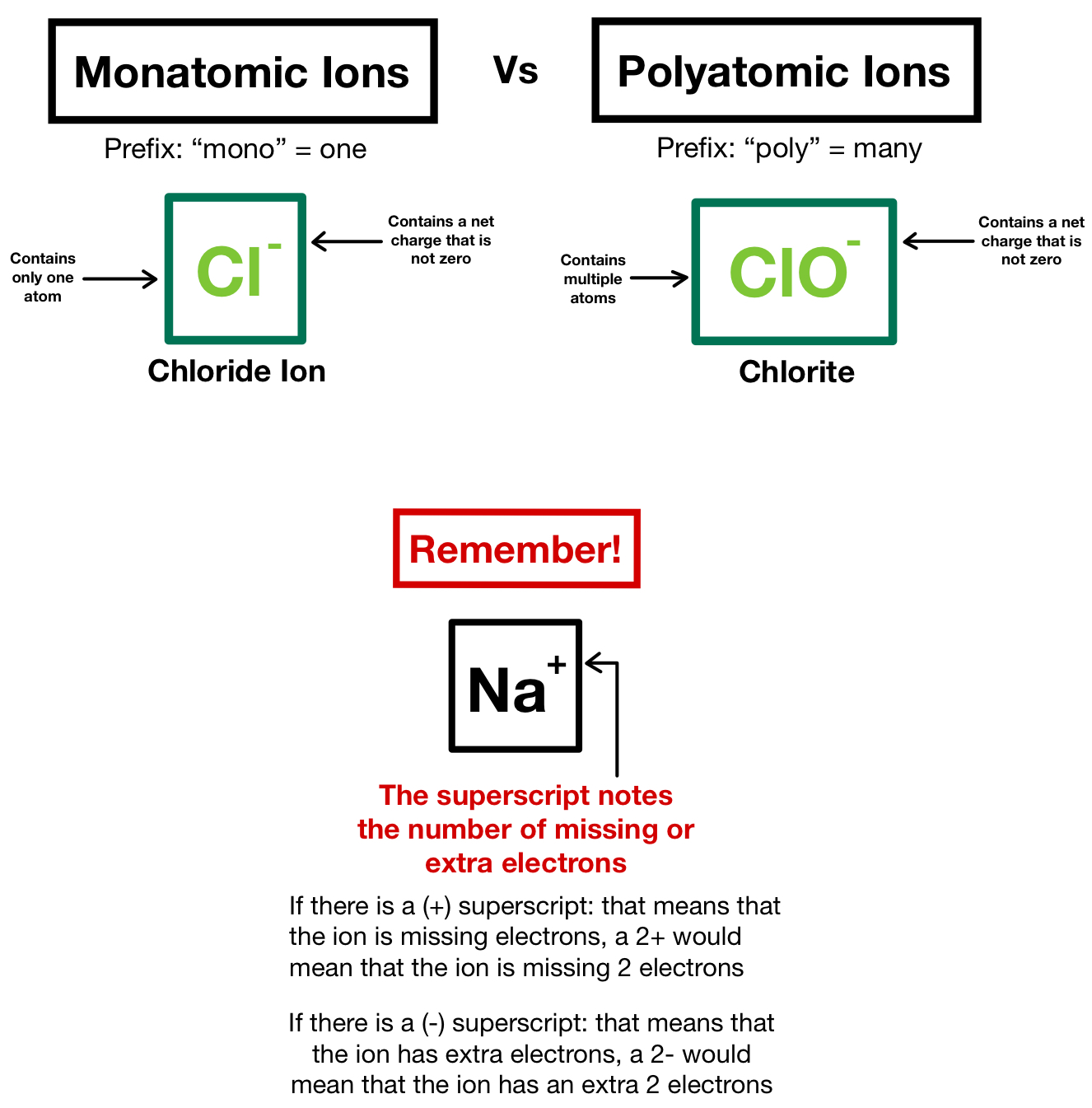
Image source: Caroline Monahan
Common Polyatomic Ions
- Here is a list of the most common polyatomic ions:
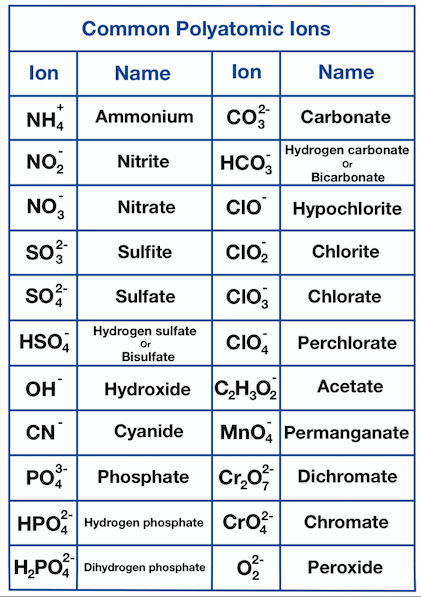
Image source: Caroline Monahan
Nomenclature With Polyatomic Ions
-
Polyatomic ions can take part in chemical reactions to help form new ionic compounds.
-
Note: ionic compounds have an overall neutral charge, meaning the ions that come together to form it must form a neutral charge.
Here are the rules for naming compounds that contain polyatomic ions:
- Cations
-
Like all ionic compounds the cation is written first.
-
The cation is almost always a metal or metalloid. For elements with only one charge (alkali and alkaline earth), we use their elemental names.
-
If the cation is a transition metal it has a variable charge. So, it can form more than one ion because the d-orbital electrons are easily lost. The successive ionization energies are very low. For example, chromium has ions with a 2+ or 3+ charge. To name it, we use the elemental name followed by parentheses. The parentheses contain a roman numeral of the charge. For example, the 2+ ion is Chromium(II). The 3+ ion is Chromium(III).
- Anion
Writing the Chemical Formula for Polyatomic Anions
To write the molecular formula for a compound with polyatomic ions...
-
Start by writing the cation's atomic symbol and charge.
-
Next, write the formula and charge of the polyatomic anion.
-
Balance the charges.
- Use parentheses if there is more than one polyatomic ion. For example, versus .
Examples:
-
→ Aluminum phosphate
-
→ Iron (II) hydroxide
-
→ Sodium hydroxide
-
→ Lithium dichromate
-
→ Ammonium Chloride
Try a Practice Problem!
What is the chemical formula for: Sodium Sulfate?