
Illustrated · 1 min
By Gabi Slizewska

+1 contributors
Contributors

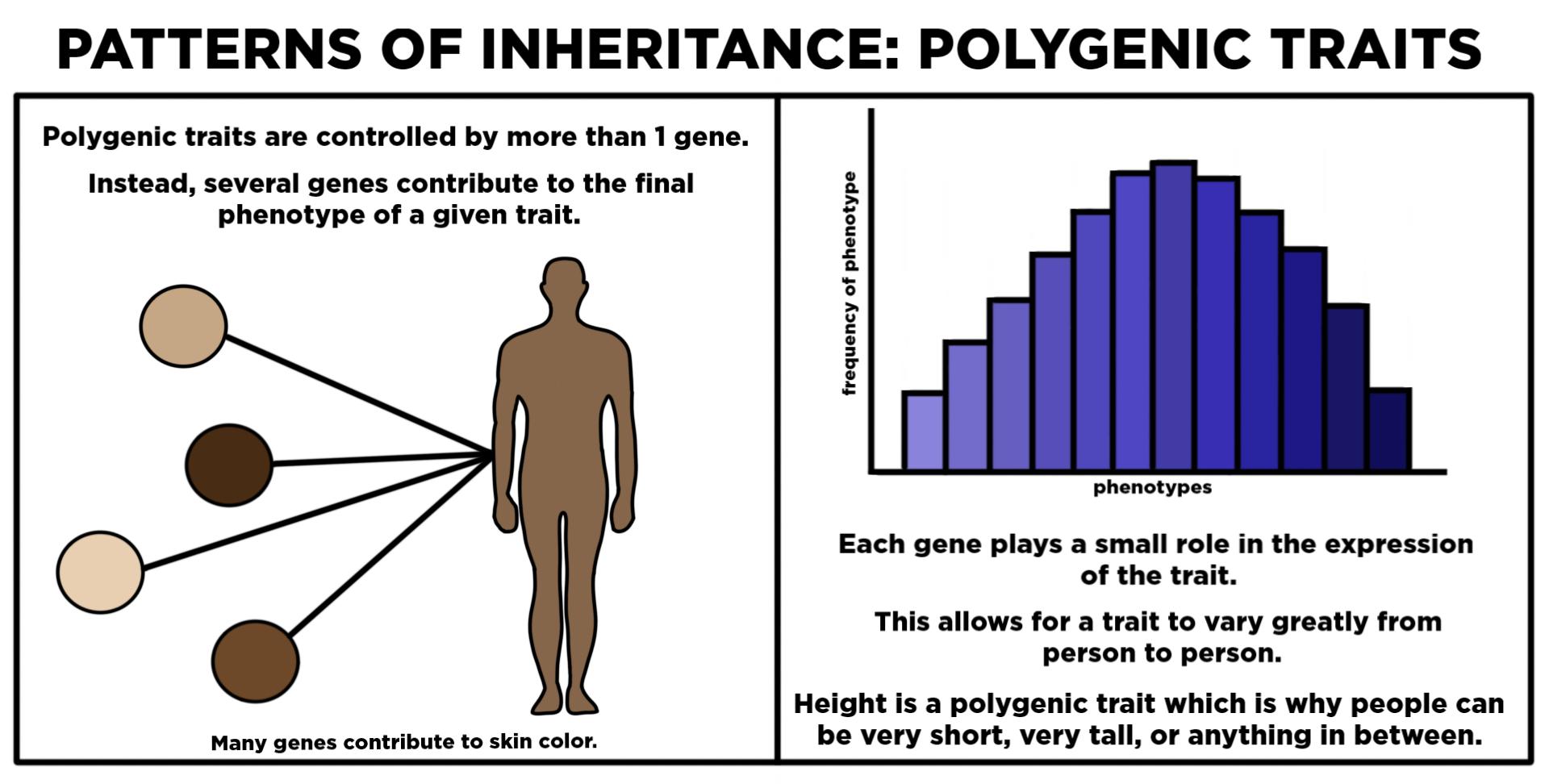
Image source: By Gabi Slizewska
Illustrated · 1 min
Image source: By Gabi Slizewska
Illustrated · 1 min
A polygenic trait is a trait that is coded for by many different genes. When we talked about genes and alleles before, we always talked about a trait being coded for by two alleles of a single gene. With polygenic traits, there's no set number of genes that could code for a specific trait. Instead of
This type of trait would show all the genes working together like
We can see these traits all over the human genome. For example, both height and skin color are considered polygenic traits. There are different genes for height, each of which will encode an allele that determines whether or not you will be on the taller or shorter side. This makes the traits very complicated and variable. Environmental influence also plays a role in how genes are expressed. Two people with all the same alleles won't be exactly the same height, but will most likely be in the same range.

Image source: By domdomegg CC BY 4.0, via Wikimedia Commons
Traits that follow this pattern tend to make a bell-shaped curve when graphed. What this means is that there will be a large number of cases where people have a medium value. Let's look at height again as an example. The further away we move from the middle, the more extreme height becomes. As we move to the left, people get shorter and shorter. As we move to the right, people become super tall. The graph below doesn't show specific heights but, rather, the percentage of total cases. The number of cases drops wildly the closer you get to the outer edges.
You may have observed this pattern in your daily life as well. There are much more "average" height people than there are very short or very tall people.

Image source: By Mario Janakis
Read · 1 min
Traits that are controlled by two or more nonallelic genes are called polygenic traits. Some traits are influenced by many different genes that are in different locations on different chromosomes. Human skin color is controlled by more than four different alleles on different chromosomes.
Remember: poly- means "many", and genic means "having genes".
Different combinations of alleles can cause very different traits. For example, hair and eye color are both examples of this inheritance pattern. This is how there is such a large variety of colors for both of those phenotypes. There are so many possible combinations.
: Genes of the same type that contain different kinds of information. Alleles can be dominant or recessive
: The stronger of two expressed genes
: The weaker of two expressed genes. Only shown if a gene is homozygous recessive
: Two different kinds of allele, one dominant and one recessive
: Two of the same type of allele, both dominant or both recessive
: Occurs when two heterozygous alleles are fully expressed. Neither one can dominate so both alleles show up but they do not blend
: Occurs when two alleles are not dominant nor recessive. The alleles are both expressed and show up as a mixture of the two alleles
: Traits caused by alleles located on a sex-chromosome
: Traits that are controlled by two or more genes
Video
by Amoeba Sisters
Height is an example of a trait that is determined by many genes. Check out this video by Amoeba Sisters to learn how multiple genes work together to create some of your unique characteristics.


