Read · 6 min
+7 contributors




There are many different methods for dividing polynomials, but one thing remains the same: every division will have a divisor (the denominator of the fraction) and the dividend (the numerator of the fraction). Also, in many cases, the same division problem can be solved in multiple ways. To highlight this fact, we're going to do the same problem three different ways, explaining each technique in general and using the same problem as a repeated example.
Our task will be to divide
where we assume (that way we aren't dividing by zero).
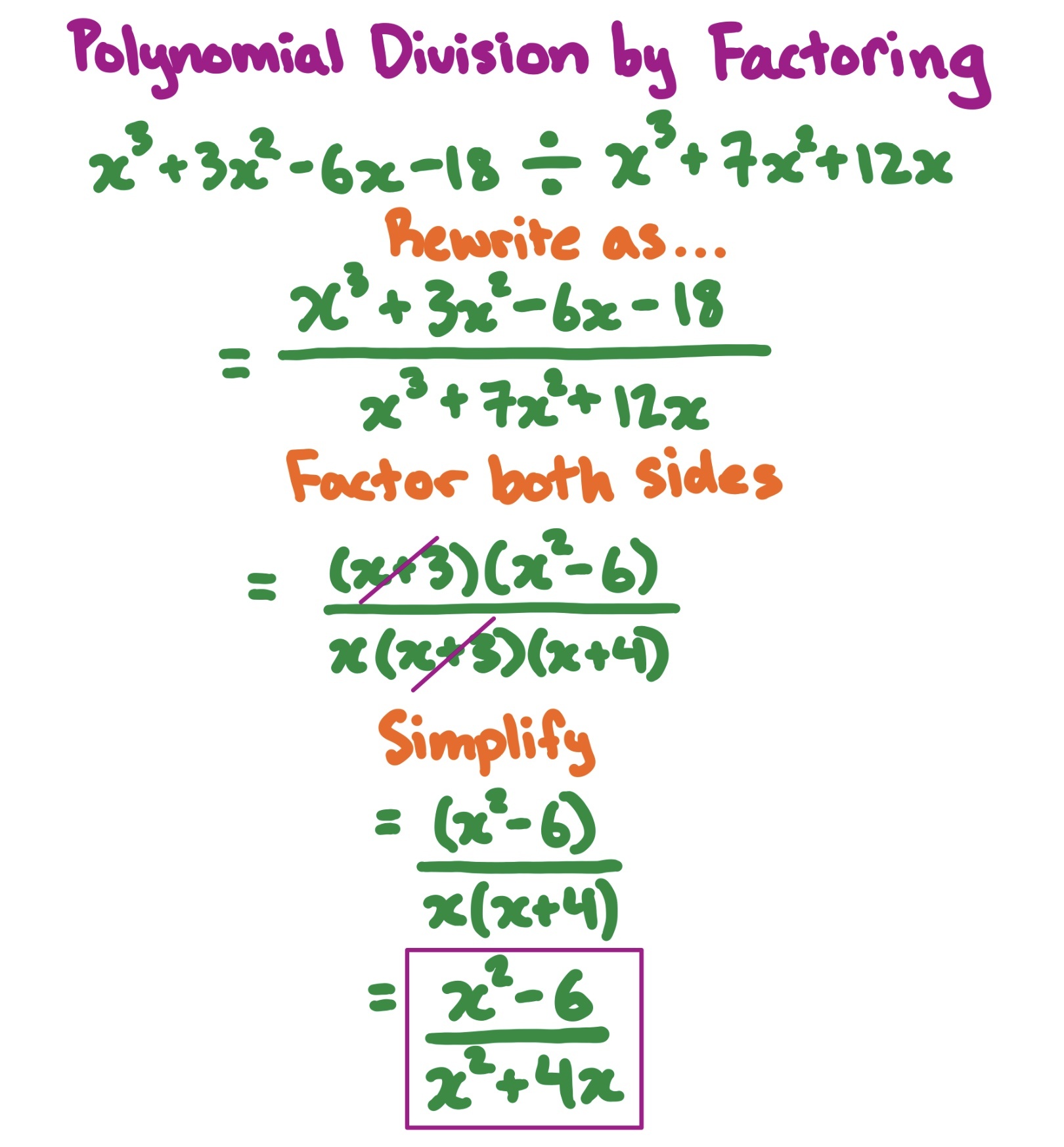
Method 1: Factorization
Sometimes, factoring the numerator and/or the denominator can make things a lot easier. Even if this doesn't make the whole thing simple, it will make the math easier to handle. But this trick doesn't always work, especially if the number you're dividing by doesn't go evenly into the number you're dividing. Still, when it does work, it works really well! That is why it is the first thing we try.
First notice that the numerator and the denominator have a common factor of
Now we can the factors of , and we are left with
We are left with a quadratic in the numerator and a linear binomial in the denominator. It turns out we can factor the numerator again, as follows:
Now it is apparent the numerator and denominator have a common factor of
Therefore our final answer is
Now, we're going to see two more ways to solve this problem. It's a good idea to try different methods because it helps you check your work. If the new answer doesn't match the one you got before, there is likely a mistake.
Method 2: Yanking Factors
Perhaps you weren't able to recognize the factorization done in Method 1. While it's important to notice these factorization patterns, there are other methods that get around this. One of them involves pulling factors out of the numerator term-by-term (this is why I call it "Yanking Factors"). It is helpful if you can't seem to factor the numerator and/or denominator, but it will not help if the polynomial in the numerator has a lower degree than the polynomial in the denominator. In the fraction
the numerator is a cubic and the denominator is a quadratic, so we're OK.
Here's how the method works: we pull off the last term in the numerator and make it its own, "new" fraction:
Now we borrow terms from the numerator of the "old" fraction so that we can cancel factors in the new fraction. so if we add to the second fraction, we will get a multiple of in the denominator. It looks like this:
Now we've made some headway with the second fraction. The quadratic term in the numerator is twice the one in the denominator, and the same is true for the linear terms. That is, so in the second fraction we have a common factor of
We still have a fraction, but the numerator is simpler. There's nothing more to be done than to try the same process again. The lowest-ordered term in the numerator is a factor of more than the lowest-ordered term in the denominator, so we want to build a fraction where there is also a term that is a factor of more than With that in mind, we split our fraction into two, isolating the last term in the numerator:
Since we need to borrow an term from the first fraction to get a multiple of in the numerator of the second fraction. But is the only term left in the numerator of the first fraction! So, there are no leftovers and we know that has a factor of We also know that the other factor is because the lowest-ordered terms in the numerator and denominator differ by a factor of (that is, ). Therefore,
There is no longer a fraction, so we are done. We also got the same answer as before, which is good.
**Method 3: Polynomial Long Division **
We've saved the most involved method for second to last because it works for any polynomial long division problem. Since Methods 1 and 2 are faster when they do work, it's worth trying those first, but if they don't work, long division comes to the rescue. Another way to do long division is method called synthetic division.
Polynomial long division works very similarly to long division for whole numbers. Each step in long division for whole numbers comes from one place value in the number being divided. Instead of place values, however, the polynomial division is broken into steps based on the terms of the polynomial, in decreasing order of their degree. As a result it is important that both the dividend and divisor are in standard form before attempting long division. It is also necessary to make sure that the dividend has zero terms added. In this case, there is no constant term, so we pretend there is constant term with coefficient
Just like in long division of whole numbers, we write long division of polynomials by putting the dividend under the long division sign and the divisor to its left:
Now the first step is somewhat inspired by Method 2 in that we look at one pair of terms from the numerator and denominator at a time. Divide the first term in the numerator by the first term in the denominator, which gives We indicate this by putting an above the long division sign:
Now we take the term we just added above the long division sign and multiply it by ALL terms to the left of the long division sign. We put this result on a new line underneath the dividend:
Notice that we aligned the terms so that the terms of the same degree are in the same column. This makes it much easier to keep organized and I recommend you do the same. Now we subtract these two quantities (which is just combining like terms):
We dropped the down from the first row below the long division sign to the bottom row. This is just a reminder of what terms haven't been subtracted away from the dividend yet. Since we haven't run out of these terms, we repeat the first step again. Now, however, our first term of the dividend is so dividing this by the first term in the divisor gives We place a above the long division sign:
Now we multiply the across all terms in placing the result at the bottom.
Finally, we subtract one last time:
We have run out of terms in the dividend and got a at the bottom. That means the fraction divides evenly, and there is no remainder. We found that
Again, we got the same answer. We should feel really confident now.
If we run out of terms in the dividend and the result at the bottom is something other than then that is the remainder. If we have a remainder, we add it to our final answer, divided by the original divisor. For instance, if the remainder were a then we'd add to our answer above. As a quick check, the remainder will always be a polynomial of lower degree than the divisor. So if we got a quadratic remainder, for instance, then we made a mistake.
In general, polynomial division problems can only be solved with Method 1 if Method 3 gives no remainder. Methods 2 and 3 will work regardless of whether there is a remainder or not. Method 3 is the most straightforward to execute but also takes the longest. Keep this in mind when deciding which method(s) to try.
If that breakdown wasn't enough or you want more examples, you can see more examples of long division and a summary of all the different techniques for dividing polynomials.