Illustrated · 2 min

+2 contributors


Intuition
Division formalizes the notion of evenly distributing or splitting some number of objects into some number of groups.
Suppose we have cowboy hats and cowboys and we want to give both cowboys the same number of hats. We can divide the number of cowboy hats by the number of cowboys to get that each cowboy gets hats. Mathematically, this is: We can also write: This represents the idea that cowboy hats, when divided into groups of yields such groups.
Opposite of multiplication
Division can also be seen as the reverse of multiplication. In the previous cowboy hat example, we know that there are cowboys with cowboy hats each. This gives cowboy hats among the two of them.
This example tells us that the following equations tell us equivalent information: In each situation, there are hats, cowboys, and hats per cowboy.
Anatomy of division
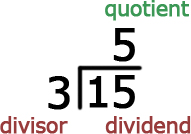
Division consists of three elements: the dividend, the divisor, and the quotient. The dividend is the total number that gets divided by the divisor, which results in the quotient. There are several ways to denote the division operation:
The division as the reverse of multiplication framework tells us that the product of the quotient and the divisor gives the dividend.
Dividing with remainders
So what happens if the divisor does not evenly divide the dividend? One way to approach this issue is to use remainders - this process involves making the quotient as large as possible and seeing what remains.
Let's say we have those two cowboys again, but now there are cowboy hats. We can evenly give each cowboy hats, but then there's extra hat left over. We represent this information with the following expression: This tells us that there are hats total, cowboys total, cowboy hats per cowboy, and hat remaining after the hats are distributed. If we put the remainder over the , we get the fractional part. In this case, the fractional part is .
Here's a graphic with another example:

Image by Caroline Kulczycky