Predicting Direction of a Reaction — Overview & Examples

Before this, knowReaction Quotient — Definition & Overview

Read · 1 min

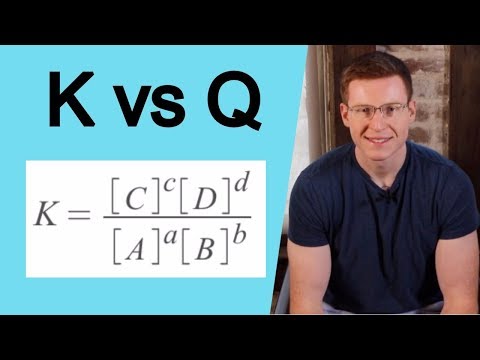
Sometimes, we have a reversible reaction that's not in equilibrium. So we have to compare the equilibrium constant to the reaction quotient. Remember, its formula is the same as the equilibrium constant. It's Q=[Product][Reactants]=[C]c[D]d[A]a[B]bQ=\frac{[Product]}{[Reactants]}=\frac{[C]^{c}[D]^{d}}{[A]^{a}[B]^{b}}. Comparing the two will tell us our reaction's direction.

  • Q<KeqQ < K_{eq}
  • The reaction favors the reactants' side.
  • The forward reaction will dominate. Reactants will convert to products to reach equilibrium.
  • The forward reaction's rate will exceed the reverse reaction's rate until equilibrium.
  • Q>KeqQ > K_{eq}
  • The reaction favors the products' side.
  • The reverse reaction will dominate. Products will convert to reactants to achieve equilibrium.
  • The reverse reaction's rate will exceed the forward reaction's rate.
  • Q=KeqQ = K_{eq}
  • The reaction is at equilibrium.

Video

(Video) K (Equilibrium Constant) vs Q (Reaction Quotient)

By Denovo Tutor

In this short video, Denovo Tutor demonstrates how we compare the reaction quotient and equilibrium constant. Chemical reactions always want to achieve equilibrium. So, by comparing the two values, we can determine the direction of our chemical reaction. This video will teach you how!

Type a concept, like “slope” or “photosynthesis”.

↑ ↓ to choose · Enter to openSearch explanations and problems