
Illustrated · 2 min
How Many Primes Are There?
This is a question pretty much everyone who has encountered primes wonders. So did Carl Fredrich Gauss, and after observing a lot, he conjectured that there are nearly primes less than or equal to for a real number . The number of primes less than or equal to is denoted by . So, according to Gauss, as grows bigger, gets close to . But Gauss couldn't prove it himself. It was unproved for about years and the conjecture became known as the Prime number theorem. Later mathematicians like Chebyshev and Hadamard worked on this.
For , . For , . As you can see, the error in and reduces as gets bigger. Probably a table would be nicer for this purpose. You can search for more information on these values.
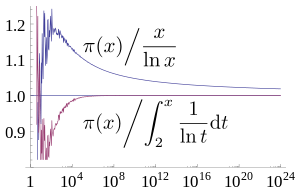
Graph of ratio of prime counting function (taken from Wikipedia)
See the graph to have an idea about the error term. The blue line is the line we are talking about. The one below considers another function.
Anyway, the first proofs of prime number theorem belonged to analytical number theory. Alte Selberg and Paul Erdos together found an elementary proof of this theorem for the first time, though there was a dispute about it, we will not get into that. Personally, after reading an article written by someone close to both of them, I think that Selberg provided the main theorem (which is now known as the famous Selberg Identity). Later Erdos proved prime number theorem using that identity. So, the credit goes to both. Though I am not sure if Selberg proved it later himself. From what I read, it took about one or two hours for Erdos to prove it after he saw Selberg's theorem.
Summary is, prime number is a really fascinating idea for mathematicians. Now there is a branch called prime number theory dedicated to research on prime numbers. It is quite rich already, and it will get richer. So, it is of huge importance.