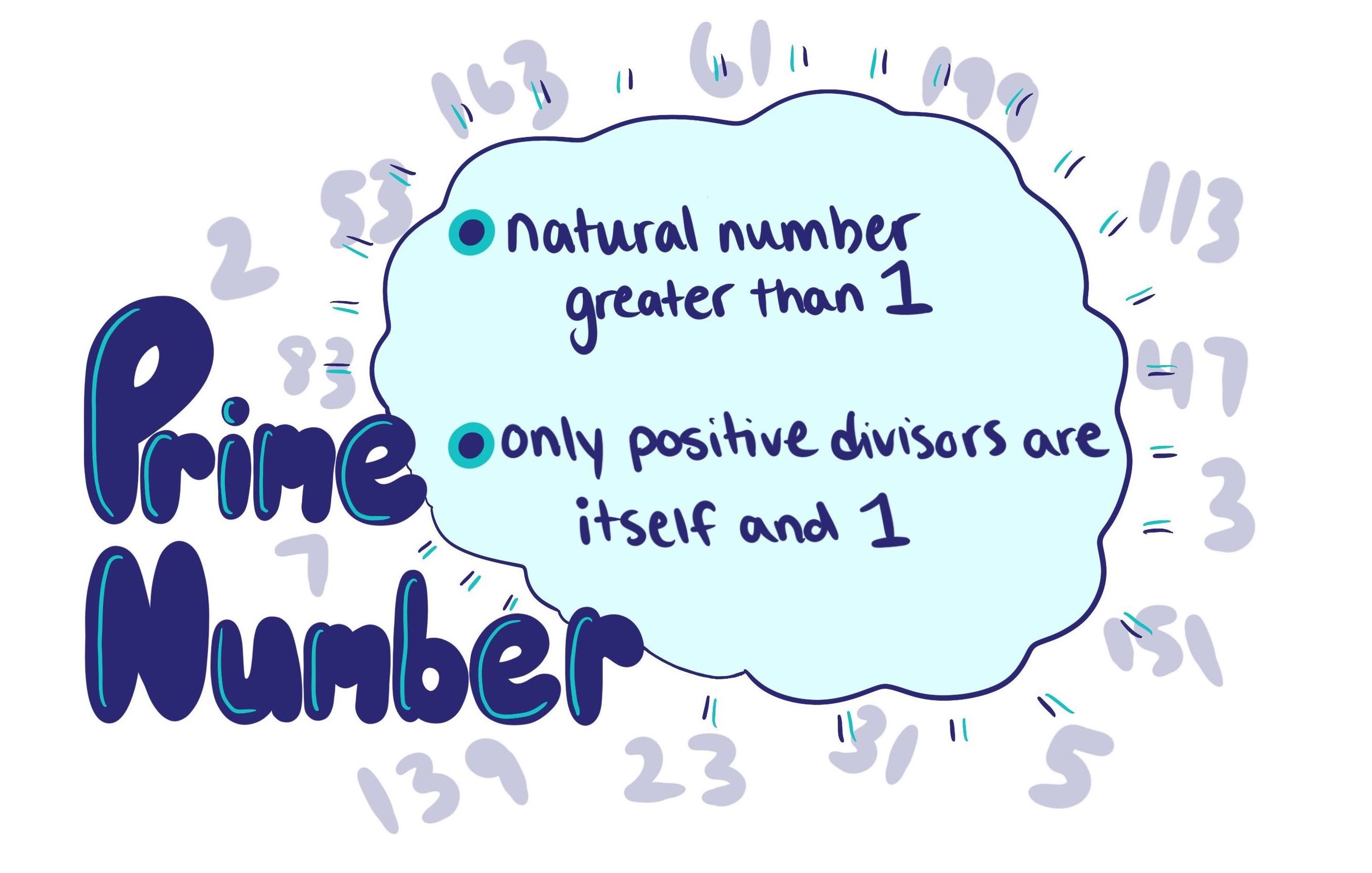
A prime number is a natural number with exactly 2 divisors / factors: 1 and the number itself.
Primes are always greater than 1 and they're only divisible by 1 and themselves. They cannot be made by multiplying two other whole numbers that are not 1 or the number itself.
Another fact to keep in mind is that all primes are odd numbers except for 2.
Prime numbers include: 2,3,5,7,11,13,17,19… and so on.
Any number that is not prime is called a composite number.
Let’s take a look at an example.
Is 37 prime?
Yes, 37 is a prime; the only way of writing it as a product of two numbers is 1×37. 37 cannot be evenly divided by anything but itself and 1.
The number 1 is very special. It is the only number that is not prime nor composite. All other numbers are either prime or composite but not both.
Example Questions
Now, let’s try a couple of problems about prime numbers that you might encounter.
Which of the following numbers are examples of primes? Select all that apply.
A prime number is a number with exactly 2 divisors / factors: 1 and the number itself.
2,3 are examples of primes.
1 is not an example of a prime because prime numbers have to be greater than 1.
4 is not an example of a prime number because it has another factor other than 1 and the number itself (The other factor is 2).
Is 85 a prime number?
Taking a look at 85, since it ends at 5, we know that it is divisible by 5 from our common divisibility rules. Therefore, 85 is not prime.
Check what you really know
If you can solve a contest problem with this idea, you know it well. If not, you know exactly what to review. These are real problems from the AMC 8, AMC 10, AMC 12 and AIME, the national math competitions for middle and high school students, each with a worked solution on LIVE by Po-Shen Loh.
A prime number is a natural number with exactly two positive divisors: itself and 1. There are infinitely many primes!
Some examples of primes are:
2 (which has positive divisors 2 and 1)19 (which has positive divisors 19 and 1)283 (which has positive divisors 283 and 1)
The largest known prime number is way too big to write here because it has over 20 million digits! There are also a bunch of primes that are one less than a power of 2; these are called Mersenne Primes.
Natural numbers with more than two positive divisors are called composite numbers.
Some examples of composite numbers are:
4 (which has positive divisors 4,2, and 1)26 (which has positive divisors 26,13,2, and 1)108 (which has positive divisors 108,54,36,27,18,12,9,6,4,3,2, and 1)
The composite number 26 can be written as a product of two smaller primes, 13 and 2.
Finally, a number which is the sum of all of its divisors except itself is called a perfect number. Compared to primes and composites, there are very few perfect numbers. As an example, 6 has positive divisors 1,2,3, and 6, so the sum of all the divisors except for 6 is
1+2+3=6.
Sieve of Eratosthenes
The Sieve of Eratosthenes is an ancient number theory trick, where we find prime numbers starting with a list or grid with the numbers 1 through 100. They are listed in order:
How do we pick the prime numbers? By ruling out everything else, especially the composite numbers.
First let's rule out (cross out) all multiples of 2 except for 2. We leave 2 alone because it's prime: its only divisors are 1 and itself. But all the other even numbers on our list have 2 as a divisor so we get rid of them.
Now we get rid of all multiples except for 3. Since the only divisors of 3 are 1 and itself, 3 is prime, so we leave 3 alone and cross out 6,9,12 and so on (if a number is crossed out more than once don't worry; that just means the number has lots of divisors, and if you want to learn more go to our article about factoring).
You can keep going as far as you want. The next step would be to cross out multiples of 11 except for 11, and so on. Checking for possible composite numbers to cross off can sometimes be made easier by using divisibility tests.
Finally, let's talk about the number 1. The number 1 is neither prime nor composite, because it has exactly one positive divisor: itself. This makes 1 special and unique, so circle or highlight it a different color from everything else.
Voila! For those of you who like colors, here is a graphic showing the prime numbers and composite numbers between 1 and 100:
Image by Caroline Kulczycky
From this picture we can identify the list of primes from 1 to 100:
The prime numbers are a collection of positive integers that have been studied for centuries. They're so important, there's a theorem named after them: the Prime Number Theorem. They've been studied for so long, the historic mathematician Euclid devoted Book ix of his text "The Elements" to them. And now, we have a video describing prime numbers, and their companions, the composite numbers. The video was made by Mahalo Math.
Prime vs. Composite Numbers
The positive integers, 1234 ..., can be classified as either prime numbers or composite numbers. A prime number is a counting number that has only two factors, 1 and itself. A composite number is any number that has more than two factors.
How many different positive integers can we divide by, and still get a positive integer? If the answer to this question is exactly 2, we have a prime number. Otherwise, the number we started with is composite. It's important not to mix up factors and multiples. Prime numbers have infinitely many multiples, but only two factors. In fact, any positive integer will have infinitely many multiples.
Some Small Numbers
The number 1 is special. It is the only number that is neither prime nor composite. This number only has one factor, so it can't be composite. A prime number must have two different factors, so 1 can't be prime, either.
The number 2 is prime. This is because it has only two factors: 1 and itself, 2. Notice 2 is a factor of all other even numbers. As a result, no other even number can be a prime, and all other even numbers are multiples of 2. 2 is the only even prime number.
The number 3 is also a prime number. This is because it has only two factors: 1 and itself, 3.
The number 4 is a composite number. This is because it is even, so 2 will be one of its factors. The other factors are 1 and 4.
It turns out for any number, prime or composite, we can find all of its factors. You'll need some new tricks to do this. Divisibility tests can be very helpful for this goal.
Check the rest of the numbers up to 20. Which are primes? Check the box next to each prime number.
There are infinitely many primes. Sadly, there isn't a good method of figuring out whether a number is prime. You just have to divide numbers into it to see if it has other factors.
One way which can help is divisibility tests. There are tricks to quickly determine if a number is divisible by 2, 3, 4, etc.
For example, a number is divisible by 3 if and only if the sum of its digits is divisible by 3. Here we apply that test to 587: