Illustrated · 1 min

Chromatography is a family of analytical techniques based around relative binding activities. Chromatography is primarily used to separate out chemicals in a mixture. Most chromatographic methods are non-destructive, and can be coupled to analytical techniques such as absorption spectroscopy for easy analysis. The most common forms of chromatography are based on molecular polarity, however, molecular size, molecular weight, and molecular shape may be used as well. This document will focus primarily on polarity based techniques, but the ideas presented translate well into all other forms of chromatography.
Consider the three molecules below,
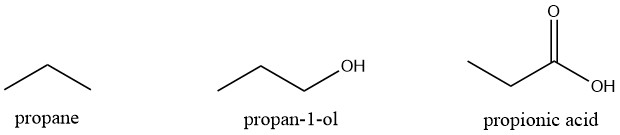
Image courtesy of ChemDraw
From left to right these molecules become increasingly more polar. What this means is that propionic acid will have the strongest bond to another polar molecule, and propane will have the weakest. Now imagine these molecules passing through silica gel, whose structure is shown below.
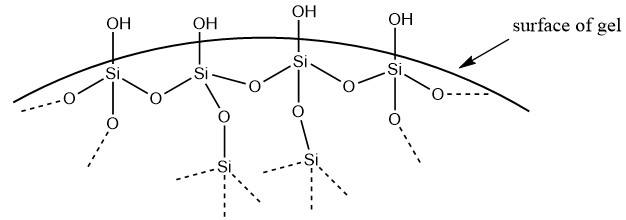
Image courtesy of ChemDraw
Since silica gel has a highly polar exterior that is capable of hydrogen bonding, silica gel will heavily interact with propionic acid. On the other hand, propane is non-polar, and cannot H-bond, so propane and and silica gel will barely interact. If we passed a mixture of propane, propan-1-ol, and propionic acid through silica gel, we would expect the three compounds to leave, or elute, in that order. Indeed, this is what is observed in experiments.