Interactive · 1 question

+2 contributors

Compound Event
A compound event is an event in statistics where there is more than one possible outcome occurring. In other words, two or more things are happening at once in a compound event. Usually, we'll want the probability of all things occurring, not just each individual event.
Measuring Compound Events
There are several ways to measure compound events. The first one I will discuss is the organized list method.
Organized List Method
Let's use the famous example of rolling a die and flipping a coin. If we roll and flip at the same time, what is the probability of us getting heads and an odd number?
We need to start this by making an organized list of all possible outcomes:
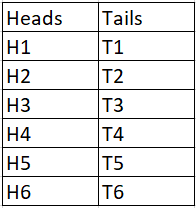
Table by Sarah Walker
How many possible outcomes are there?
Right! There's outcomes for this event, since there are ways in which you can have an outcome after rolling the die and also flipping the coin. Now, we only want the outcomes that contain a heads and an odd number. These are H1, H3, and H5. So, the probability is:
We get a probability of flipping a heads and also rolling an odd number of %.
Tree Diagrams
Tree diagrams are not just pictures of trees. They're a tool we can use to give us the same answer as lists, but this is a more visual way of learning.
Continuing with the rolling a die and flipping a coin example from above, a tree diagram would look like:
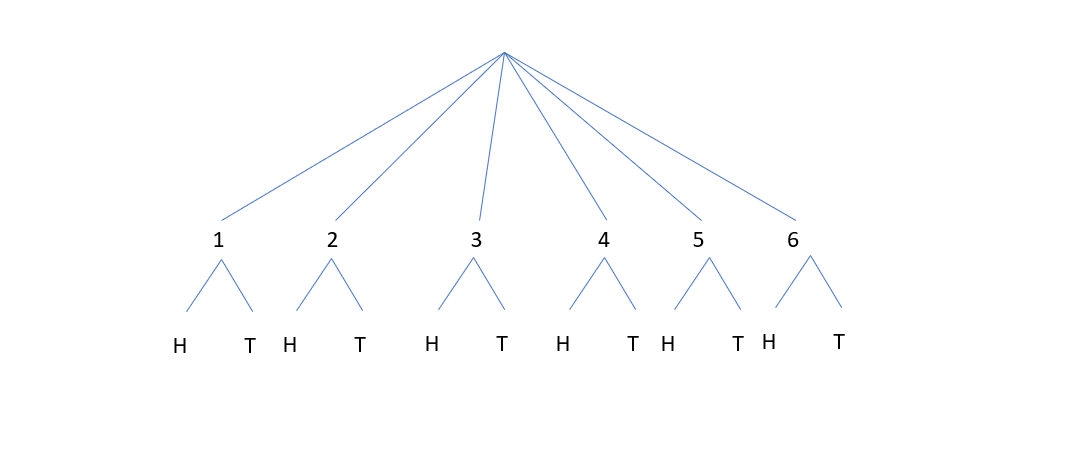
Diagram by Sarah Walker
From the diagram, we can show each "branch", where we have numbers through , then each branch can split off into getting either heads or tails. From counting all the H and T at the bottom, we can count that we have outcomes, just like we had above!
We will have the same probability of rolling an odd and flipping a heads, which can be seen:
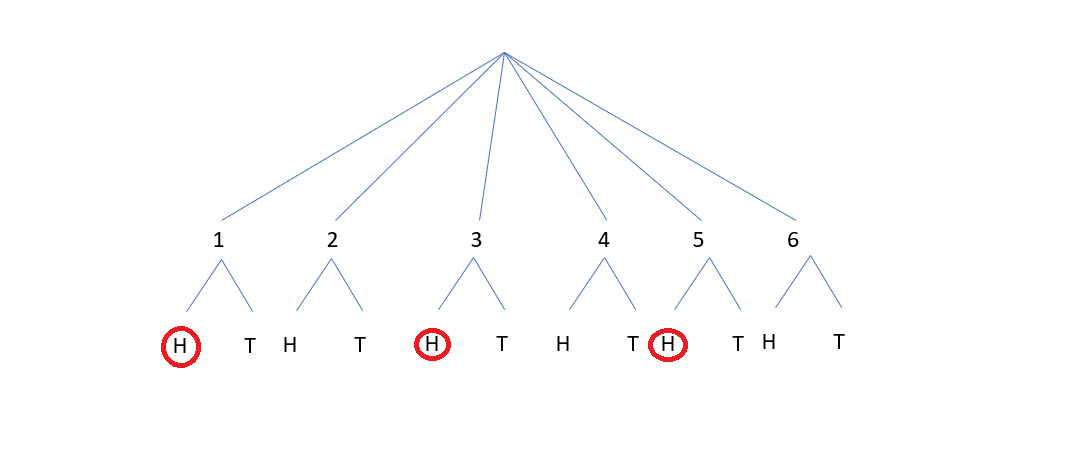
Diagram by Sarah Walker