Interactive · 3 questions
+3 contributors



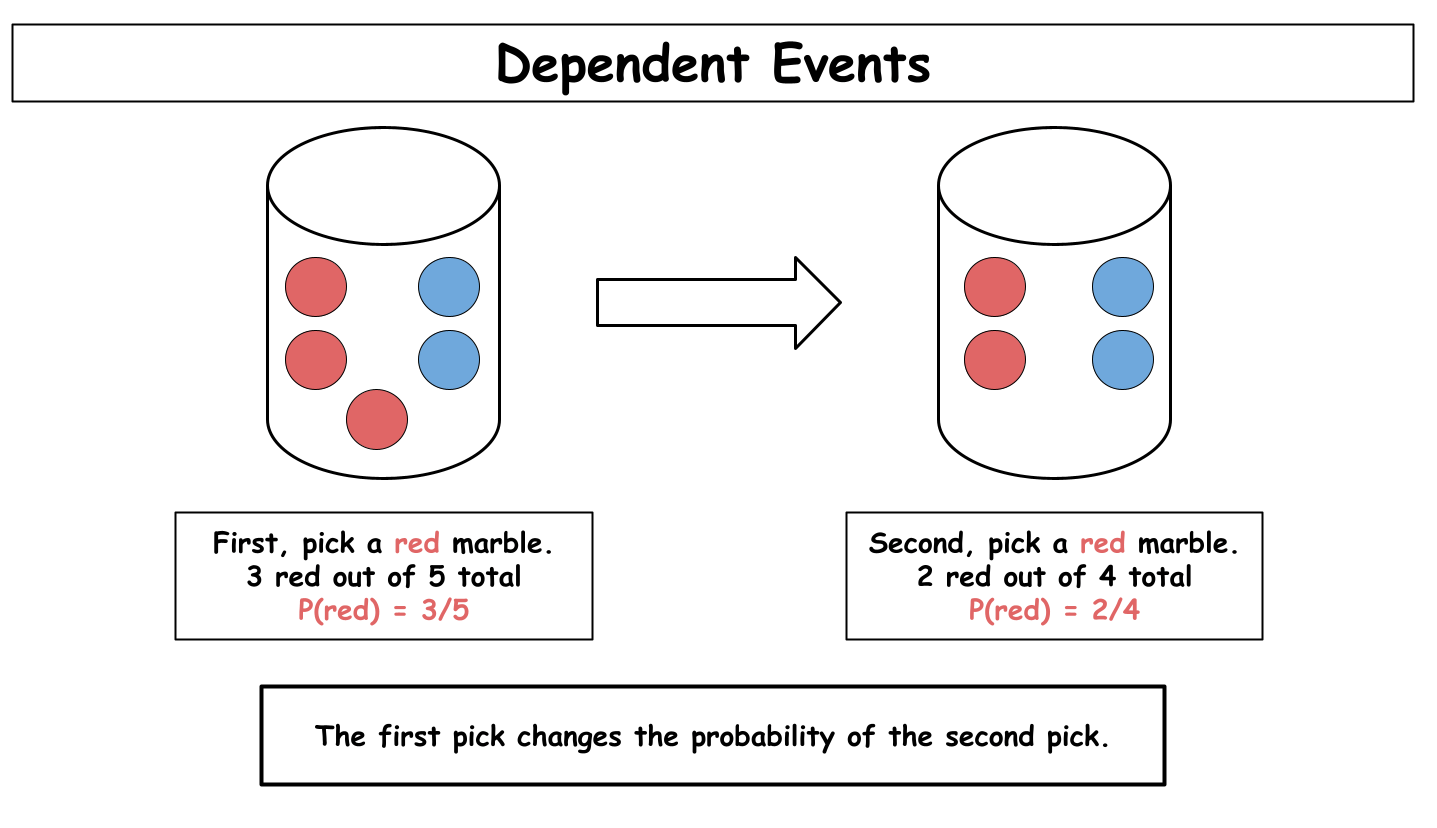
Two events, and , are dependent if the fact that occurs affects the probability of occurring. An example of dependent events would be randomly selecting marbles out of a bag, without replacement.
Suppose there are two red and three blue marbles in a bag, and you want to know the probability that you pick a blue marble on two different attempts, without replacing the first marble.
The first time you pick a marble out of the bag, the probability that you pick a blue marble is because there are three blue marbles and five total marbles. This is the probability of occurrence of one event. The second time you pick a marble out of the bag, the probability that you pick a blue marble depends on the outcome of the first selection because the first event affects the outcome of the second attempt.
If the first marble you picked was blue, then there are two red and two blue marbles left in the bag. Now, the probability that you pick another blue marble is , or .
If the first marble you picked was red, then there are one red and three blue marbles left in the bag. Now, the probability that you pick a blue marble is .
If the first marble you picked was blue, what is the probability that the second marble you pick is red?
If the first marble you picked was red, what is the probability that the second marble you pick is also red?
If after the first selection, you put the marble back in the bag, are the first and second selections still dependent?