Expected Value
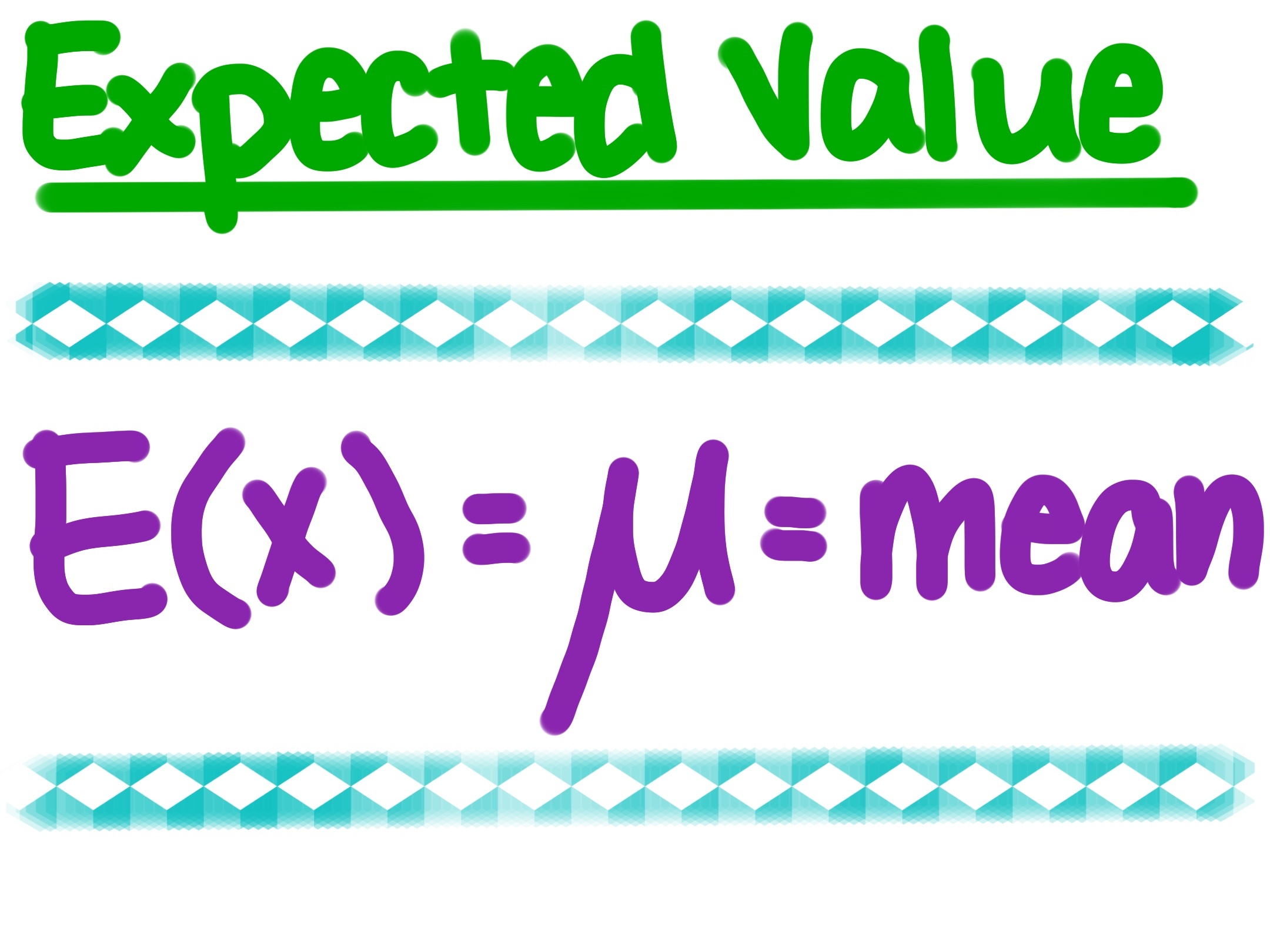
The expected value in probability is a more complicated way of saying mean, which we are already pretty familiar with. More specifically, when talking about the expected value, we are talking about the weighted average.
In the real world, we can use expected value to what outcomes to expect in the long run, especially for uncertain outcomes. For example, we can use expected value when analyzing investment returns and when predicting lottery ticket wins.
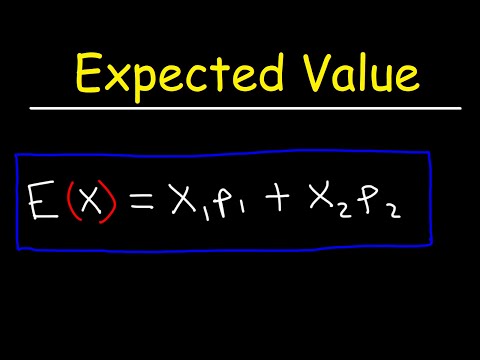
To find the expected value of a discrete random variable, we want to sum the product of the random value and its probability.
Mathematically, to calculate the expected value of a discrete random variable, we use the following formula:
E(X)=i∑xi⋅P(X=xi)
, where E(X) is the expected value and X is a random variable.
We can also find the expected value of continuous random variables and density functions, but that is slightly beyond the scope of this course. All you need to know is that you would use integration (calculus!) to find this value.
Overall, we will use expected value more and more when we calculate things in the long run or calculate values with a large number of trials. Think back to the law of large numbers: as the number of trials increases, the average outcomes will get closer and closer to the expected value.