Processing Energy With Chloroplasts (Plants) — Overview

Illustrated · 1 min

What Are Plastids?

Plastids are a group of sac-like organelles found in plant cells. They all have a double membrane and, conveniently, names that end in "plast". There are three types of plastids: chloroplasts, chromoplasts, and leucoplasts.

In general, plastids are responsible for production and storage of pigments or food in plant cells.

Here's a quick look at each plastid and its function in the plant cell:

Chloroplasts contain chlorophyll (green pigment) that absorbs sunlight in photosynthesis. They produce and store glucose. Chromoplasts contain carotenoids (red, oragen, and yellow pigments). They are found in flowers and fruit. Leucoplasts contain no pigment. They are used to store starch.

Image source: By LadyofHats [Public domain], via Wikimedia Commons

While there are three types of plastids, the one you really need to be familiar with is the chloroplast.

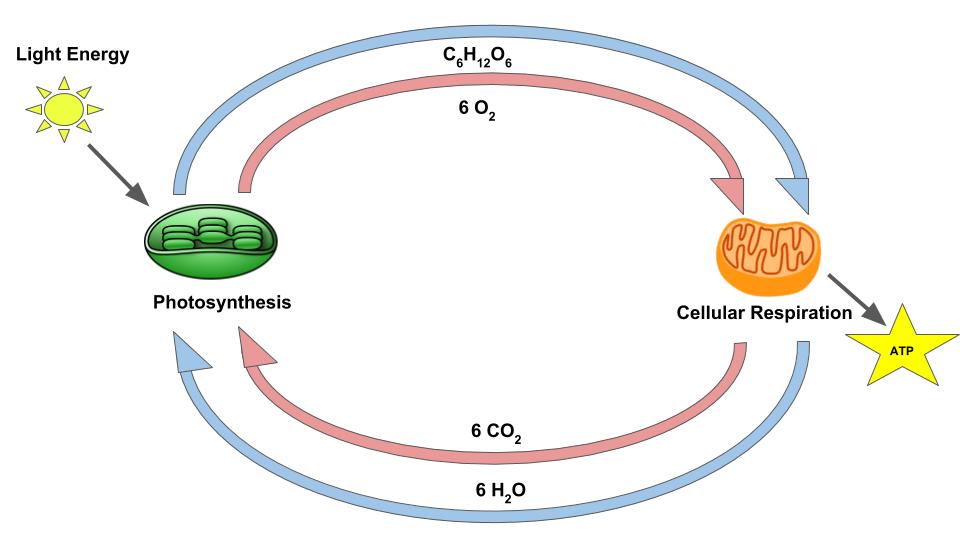
Their job is to absorb sunlight and use it (along with water and carbon dioxide) to produce glucose, a simple sugar. The process in which chloroplasts convert absorbed light energy into sugar is called photosynthesis.

Chloroplasts in plant cells

The little green shapes inside each of these cells are chloroplasts. They are green because chloroplasts are full of the pigment chlorophyll, which itself is green.

Image source: By Kristian Peters -- Fabelfroh CC BY-SA 3.0, via Wikimedia Commons

Chloroplasts are also the reason why plants are green. They contain a pigment (almost like a dye) called chlorophyll, which is green.

(To help myself remember this, I always think, "chloroplasts are phylled ("filled") with chlorophyll.)

We also need to talk about the parts of a chloroplast. Let's look at a picture first.

Chloroplast structure

Image source: By Kelvinsong (modified by expii) CC BY-SA 3.0, via Wikimedia Commons

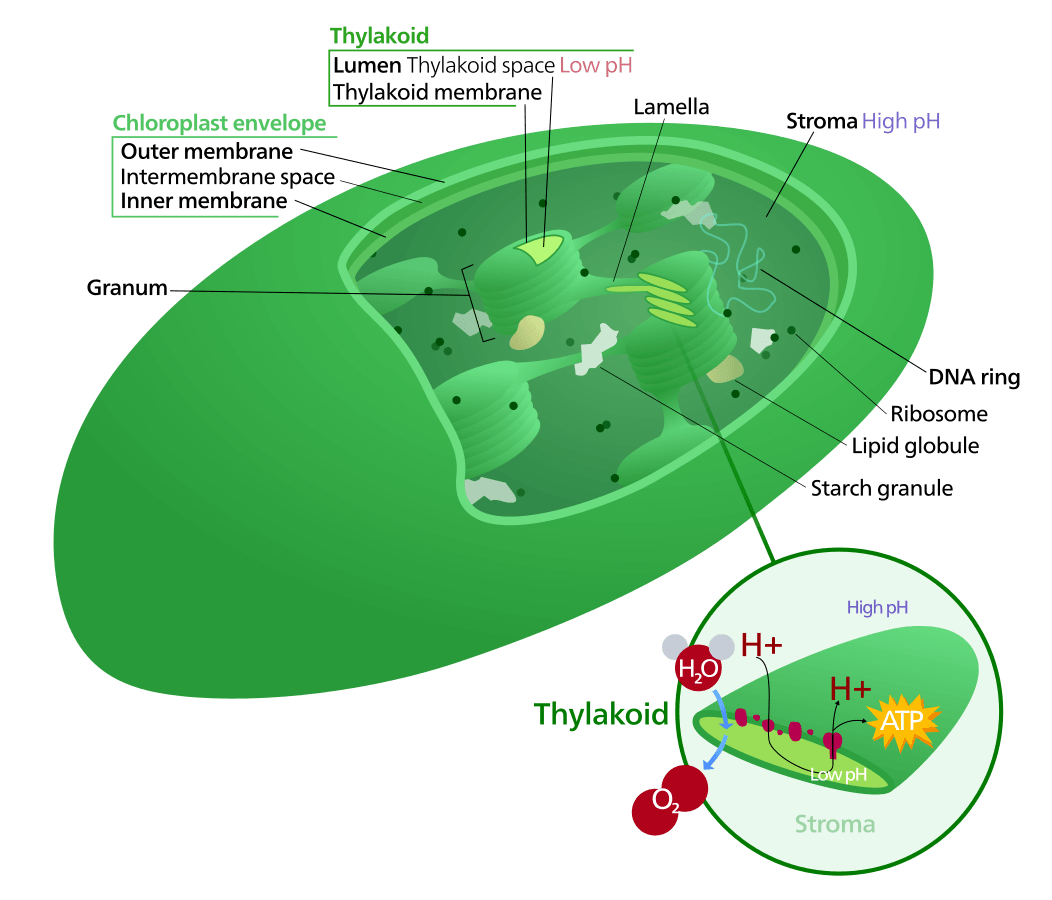
This picture shows a chloroplast (looks like a green potato) with part of the top carved off so we can see the inside.

Here's what's inside:

Chloroplast structure

Image source: By It'sJustMe (modified by expii) [Public domain], via Wikimedia Commons

Inside, chloroplasts have stacks of pancake-like sacs. A single pancake is called a thylakoid. A stack of these thylakoids makes a structure called a granum (plural: grana). The thylakoids are green because this is where chlorophyll is stored.

There is a watery liquid surrounding all of the stacks. This liquid is called stroma.

It's important to know these parts of a chloroplast because different reactions of photosynthesis occur in each location.

Key Vocabulary:

  1. Plastid
  2. Organelle
  3. Chloroplast
  4. Pigment
  5. Chlorophyll
  6. Photosynthesis
  7. Stroma
  8. Thylakoid
  9. Granum (plural: grana)

Illustrated · 2 min

Structure of Chloroplasts

Plastids are a group of organelles found within plants and algae. They are thought to have originated from bacteria that were consumed by eukaryotic cells. Plastids are no longer considered alive. They do contain their own unique DNA in the form of small circular rings, much like bacteria.

The most common plastid is the chloroplast.

Chloroplasts are responsible for converting light energy into chemical energy during photosynthesis. Chloroplasts also produce oxygen and large organic compounds (glucose).

Chloroplasts have different membranes and fluids. They contain stacks of thylakoids.

Image source: By CNX OpenStax CC BY 4.0, via Wikimedia Commons

A chloroplast has an inner and an outer membrane. The inner membrane is the same shape as the outer membrane, just slightly smaller. The outer membrane is freely permeable to molecules. The inner membrane is selectively permeable, much like the cell membrane.

The gap between the inner and the outer membrane is called the intermembrane space. The prefix inter means between, so it is the space between the membranes.

Inside of the inner membrane is a nutrient-dense fluid called the stroma. The stroma contains the ribosomes, sugars, enzymes, and DNA for the chloroplast.

The granum contains stacks of thylakoids.

Image source: By Vanessaezekowitz CC BY-SA 3.0, via Wikimedia Commons

Also residing inside of the stroma are many membrane-bound discs called thylakoids. The thylakoid membrane is where the light reactions of photosynthesis occur. The space within the thylakoid is called the lumen. Thylakoids contain the pigment chlorphyll which is used to capture the sun's energy. A stack of thylakoids is called a granum.

Due to the different membranes, chloroplasts have three separate and unique spaces.

  1. Intermembrane Space: The intermembrane space is found between the inner and outer membranes. It contains molecules that the inner membrane can pump into the stroma using trans-membrane proteins.
  2. Stroma: The stroma is found between the inner membrane and the thylakoid membrane. The stroma holds DNA, proteins, ribosomes, and enzymes. The Calvin cycle (dark reactions) also occurs here.
  3. Lumen: The lumen is inside of the thylakoid membrane. It contains chlorophyll.

All of these spaces and the products made in them are important for different process of photosynthesis. They are all connected in some way. For example, the light reactions produce ATP and NADPH, which are then used for carbon fixation during the Calvin cycle.

Vocab Review

  • Chloroplast : Photosynthetic organelle in algae and plants that produces glucose and oxygen
  • Outer Membrane : Porous outer membrane that is permeable to everything except large proteins.
  • Inner Membrane : Selectively permeable membrane that allows oxygen, carbon dioxide, and water to flow freely. It pumps sugars in and out
  • Stroma : The fluid inside of the inner membrane that contains DNA, proteins, enzymes, and ribosomes. It is where the Calvin cycle takes place
  • Thylakoid : The sacs where the light reactions of photosynthesis occur
  • Lumen : The space within the thylakoid which contains chlorophyll and other pigments
  • Granum : A stack of thylakoids
  • Chlorophyll : A pigment used in plants to capture energy from the sun
  • Photosynthesis : A process that converts energy from the sun into chemical energy stored in glucose molecules
  • Intermembrane Space : The space between the inner and outer membranes

Interactive · 2 questions

How Do Chloroplasts Help Cells?

Plastids are small, double-membraned organelles that are specific to plants. They may be small, but they are powerful. Plastids are used for creating and storing food for the plant cells. There are quite a few types of plastids such as chromoplasts and leucoplasts.

One of the most well-known plastids is the chloroplast, which helps plants undergo photosynthesis. We're going to focus on chloroplasts and the important role they play in a plant's life. They are the food producers of the cell, undergoing photosynthesis to supply nutrients and energy.

Chloroplasts contain thylakoids, which is where photosynthesis actually happens.

Image source: By Ollin, Smartse [Public domain], via Wikimedia Commons

Use the picture above to answer the following question. Which of the following is not found inside a chloroplast?

Choose one answer

Video

(Video) Chloroplasts - Structure

by Edurite

A chloroplast is an example of a plastid. Watch this video for a detailed look at the structure of chloroplasts.

Type a concept, like “slope” or “photosynthesis”.

↑ ↓ to choose · Enter to openSearch explanations and problems