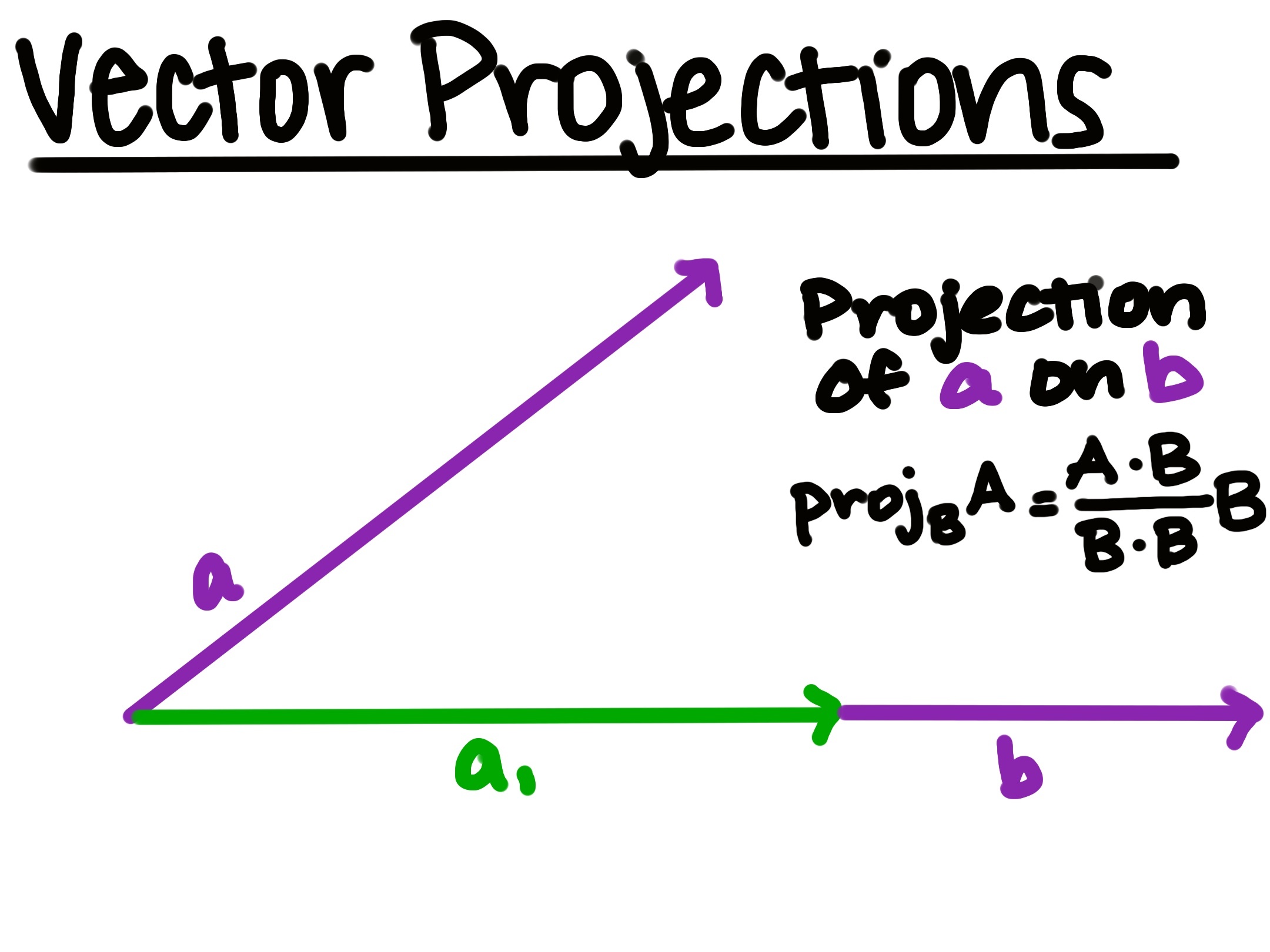
Now that we've already learned about vectors more generally, including dot products, operations, magnitude and unit vectors, and cross products, we can now dive into the projection of vectors.
In simple terms, the projection of a vector is like "casting" one vector onto another. Imagine shining a light onto a vector so it creates a shadow on another vector. The shadow is the projection.
Vector Projections
Projections Helps us to understand how one vector "acts" along the direction of another vector. This concept is useful in many areas of physics and engineering. For example, if you're moving along a slope, the projection of your velocity on the direction of the slope shows how fast you are moving along the shape.
Suppose you have two vectors, vector A and vector B. You want to "project" vector A onto vector B. You want to know what the "shadow" of vector A would look like.
This idea seems complicated - but there is a formula that can help us! The projection of a vector A onto a vector B is a vector that points in the direction of B and has a length that represents how much of A is in the direction of B.
projBA=B⋅BA⋅BB
In this formula, remember that:
-
A⋅B is the dot product of vectors A and B.
-
B⋅B is the dot product of vector B with itself, which is just the magnitude of B squared.
-
projxx represents the projection of A onto B.
Example
Given:
-
Vector A = ⟨3,4⟩
-
Vector B = ⟨1,2⟩
We want to find the projection of A onto B.
Step 1: Calculate the Dot Product of A⋅B
The dot product of two vectors A⋅B=a1b1+a2b2
So for our vectors A and B:
A⋅B=(3)(1)+(4)(2)=11
Step 2: Calculate B⋅B
Now we need to calculate the dot product of B with itself:
B⋅B=(1)(1)+(2)(2)=5
Step 3: Apply the Formula for the Projection
Now, we can use the projection formula: projBA=B⋅BA⋅BB
projBA=511⟨1,2⟩
Now, multiply the scalar 511 by each component of vector B;
projBA=⟨511,522⟩
We've found the projection of vector A onto vector B!
#####Interpretation
The projection vector ⟨511,522⟩ is a vector that points in the direction of B and has the length that represents how much of A lies in the direction of B. If you imagine vector B as a straight line, the projection vector is the shadow of A on that line.
Some Important Notes
The projection will always be a vector that points along B. If A and B are in the same direction, the projection will be exactly A. If they are at a right angle, then the projection will be the zero vector, meaning that there's no "shadow" or component of A in the direction of B.
The second big thing to note is that the length of the projection depends on how much A "overlaps" with B. If A and B are pointing in very different directions, the projection will be shorter.
Another Example
Here's another example for you to try on your own.
Find the projection of vector A =⟨4,−3⟩ onto vector B =⟨2,1⟩