
Interactive · 3 questions

+1 contributors
In Euclidean geometry, almost all lines intersect.
Which lines do not intersect in Euclidean geometry?
That's right. But, wouldn't it be nice if parallel lines intersected? That's why we have a new type of geometry called projective geometry. Here's a little bit of intuition for visualizing an important concept in projective geometry: points at infinity.
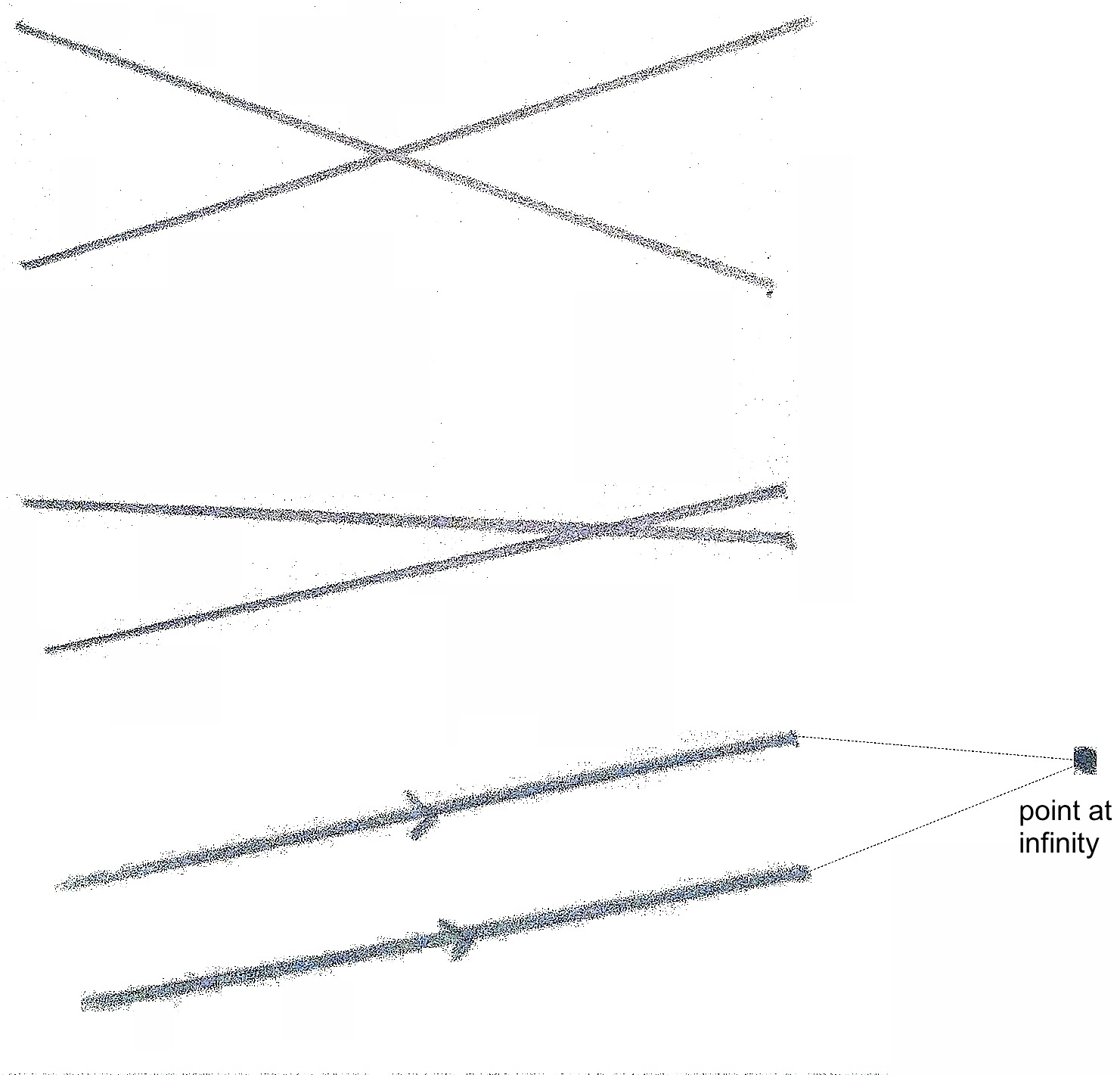
Imagine having two intersecting lines, and changing the slope of one of them little by little, moving the intersection point, until the lines are parallel.
Where do you think the intersection point of the two lines went?
Here's a drawing of the above scenario (can someone edit in asy code? thanks in advance):
This small amount of intuition actually leads us perfectly into one of the crucial theorems of projective geometry: Any two lines intersect at a unique point in the projective plane.
Proof: There are two types of lines: parallel lines and intersecting lines (note: intersecting lines refer to those that intersect in the Euclidean plane). We will consider each case individually.
As shown in the diagram above, two parallel lines intersect at a unique point at infinity. Since they don't intersect in the Euclidean plane, parallel lines have a unique intersection in the projective plane.
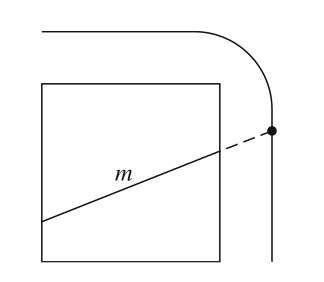
A line m and its point at infinity. All lines parallel to m intersect at that point at infinity.
Intersecting lines intersect uniquely in the Euclidean plane, but they intersect at different points at infinity, as shown in the diagram below:
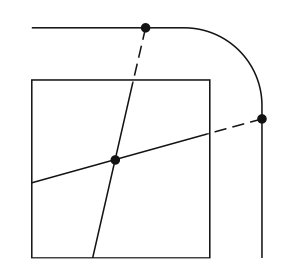
If two lines intersect in the Euclidean plane, they intersect different points at infinity.
Therefore, any two lines have a unique intersection in the projective plane, QED.
In Euclidean geometry, what materials did we need in order to construct a unique line?
To formally state this theorem, it is any two points lie in a unique line in the projective plane.
Proof: We will proceed via casework; the three cases are two points at infinity, two Euclidean points, and one of each.
Every point at infinity is on the unique line at infinity, so two points at infinity lie on a unique line in the projective plane, as shown below:
As we know from Euclidean geometry, two Euclidean points lie on a unique line (projective geometry is very similar in that regard).
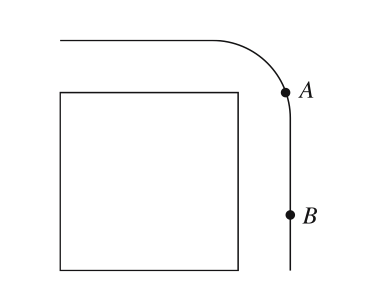
Now we must consider one of each. Note that this may be confusing because a whole family of parallel lines intersects at the given point at infinity, as shown below:
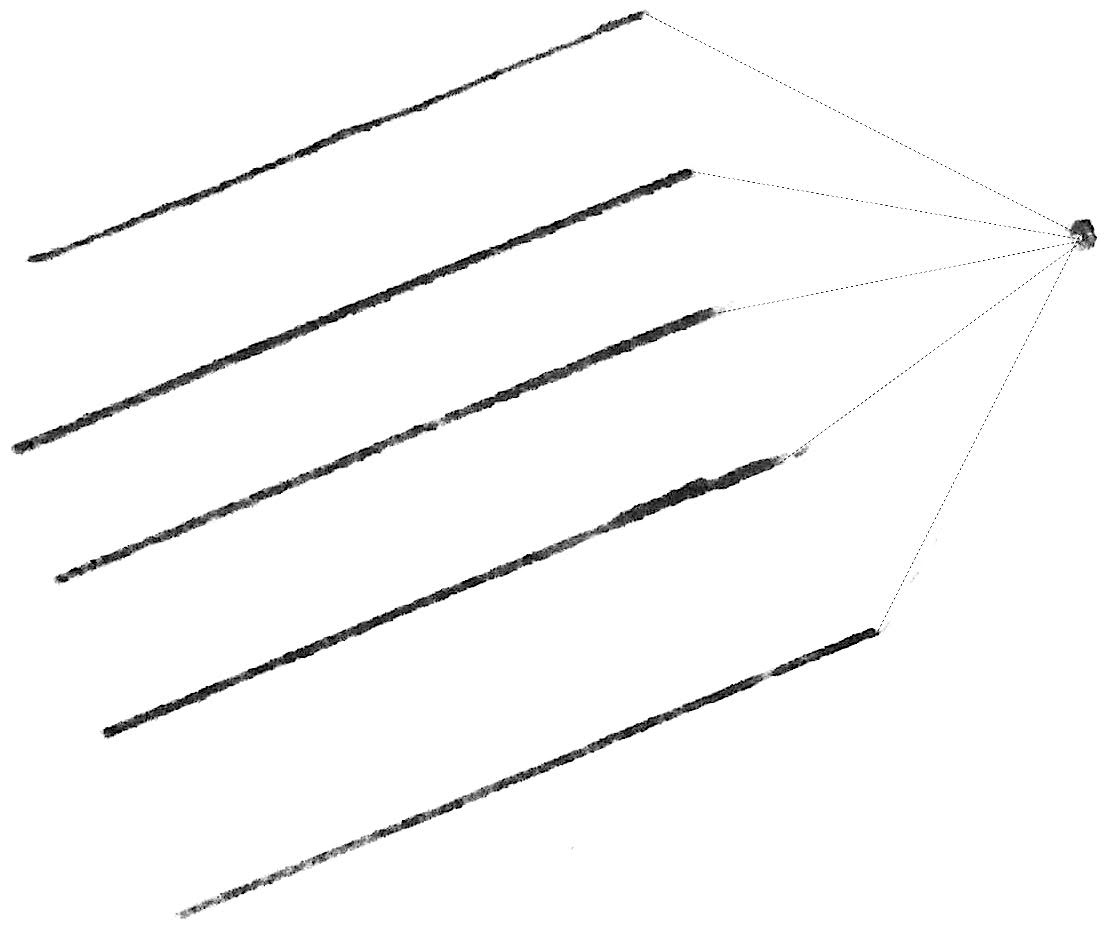
However, only one member of the family of parallel lines goes through the given Euclidean point (diagram shown at end of proof). Therefore, since this case is proven, any two points create a unique line in the projective plane, QED.
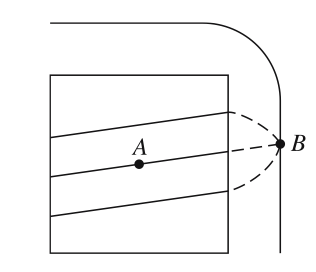
Finite point A on a unique line in the family passing through B, a point at infinity.
This is the end of my brief introduction to projective geometry. There is much more to the field of projective geometry, such as homogeneous coordinates. You may encounter those in a future explanation. But, for now, I'd suggest that (if you desire to learn more about projective geometry, which is really cool!) you read up on Pappus's Theorem. :-)