Prokaryotic Cell — Definition & Examples

Before this, knowCell Theory — Overview & Parts

Illustrated · 1 min

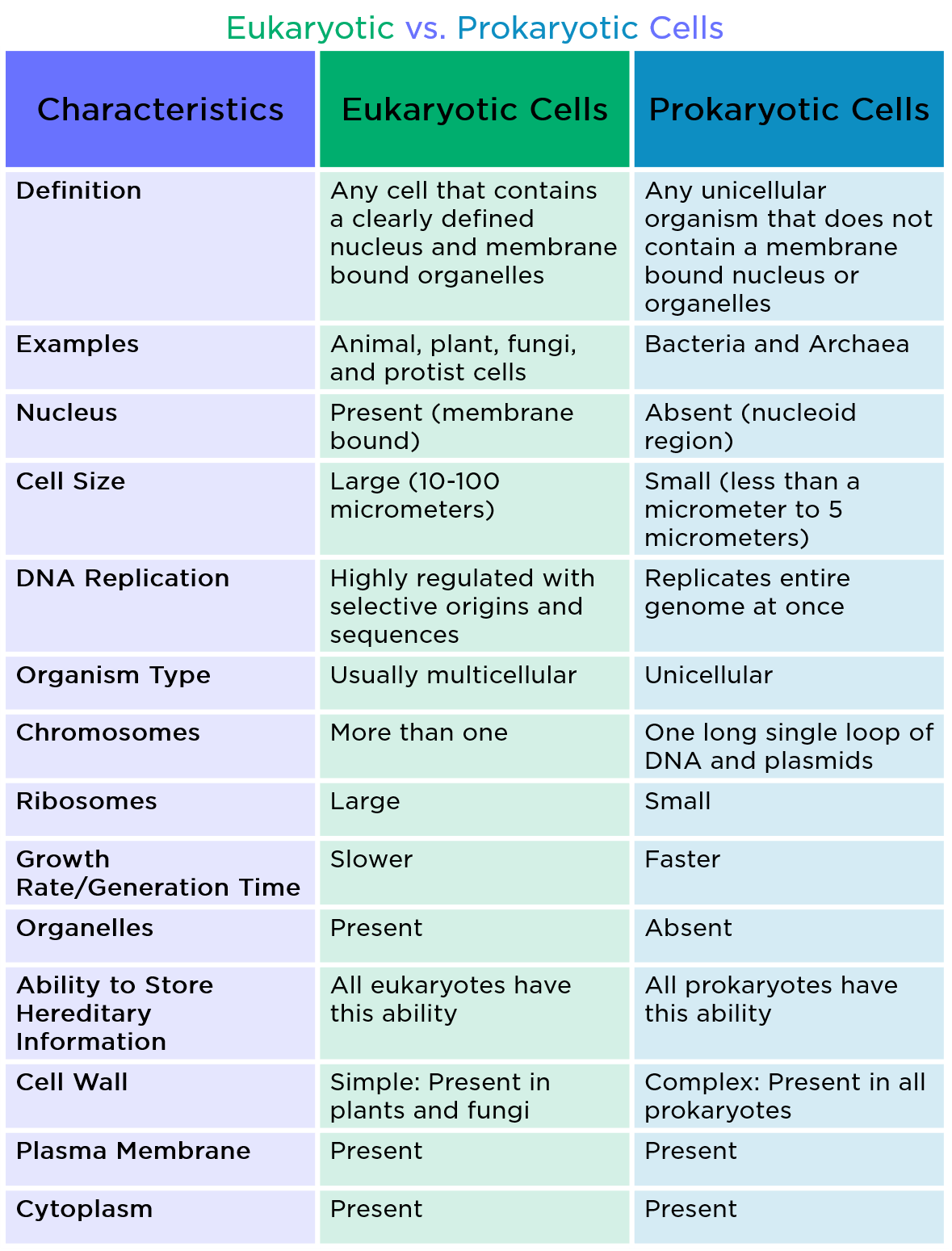
Eukaryotic Cells vs. Prokaryotic Cells

Differences and similarities between prokaryotes and eukaryotes

There are many differences between eukaryotic cells and prokaryotic cells. Some of these differences include size, manner of DNA replication, and number of chromosomes.

Image source: By Aaron Lauer et al.

Video

(Video) Prokaryotic vs. Eukaryotic Cells

by Amoeba Sisters

This video explains some of the key differences between prokaryotes (like bacteria and archaea) and eukaryotes.

Illustrated · 1 min

What Is a Prokaryote?

Prokaryotes are single-celled organisms that do not have a true nucleus. Their internal structures are not bound by membranes. Archaea and bacteria are both types of prokaryotic cells. This might creep you out a little, but your body contains a lot of these little guys. In fact, the number of bacterial cells and human cells in you are almost equal. Now that's pretty neat.

Prokaryotes are single-celled organisms. They have weird tails, called flagella.

Image source: By LadyofHats [Public domain], via Wikimedia Commons

Vocabulary Review:\color{#8925AE}{\text{Vocabulary Review:}}

Cell\color{#8925AE}{\text{Cell}} : The simplest form of life and the basic unit of structure and function

Eukaryote\color{#8925AE}{\text{Eukaryote}} : Cells that contain a nucleus and membrane-bound organelles

Prokaryote\color{#8925AE}{\text{Prokaryote}} : Cells that do not contain a nucleus or membrane-bound organelles

Illustrated · 1 min

What Are Prokaryotes?

Prokaryotes are organisms made from a prokaryotic cell. Let's look at three main structural characteristics they have (or lack) that distinguish them from eukaryotes:

Prokaryotic cells have no nucleus and DNA arranged in a single circular loop that floats in the middle of the cell. The contain no membrane bound organelles (like Golgi bodies, lysosomes, etc). They do have ribosomes, though, so keep that in mind.

Image source: By LadyofHats, Sponk, Radio89 (modified by expii) CC BY-SA 3.0, via Wikimedia Commons

Cells that aren't prokaryotic are called eukaryotic.

Types of Prokaryotes

Now, let's talk a little about what types of organisms are made from prokaryotic cells.

Prokaryotes are unicellular organisms like bacteria and archaebacteria. The differences between bacteria and archaebacteria are mostly related to their metabolism. Archaebacteria can use a unique process called methanogenisis that bacteria cannot.

Image source: By Hannah Bonville

Prokaryotic cells are surrounded by a capsule covered in tiny hairs called pili. They have a cell wall and cell membrane. A flagellum, a tail-like appendage, is used for movement. Prokaryotes have DNA stored in an area called the nucleoid region. They still contain ribosomes.

Regardless of minor differences in metabolism, bacteria and archaebacteria lack a nucleus and membrane-bound organelles. \\ Image source: By CNX OpenStax CC BY 4.0, via Wikimedia Commons

Finally, here are some defining behaviors of prokaryotic cells:

  • They are unicellular

  • They tend to be smaller than eukaryotic cells

  • They can reproduce asexually (usually with binary fission)

  • They usually have a cell wall surrounding their cell membrane

Read · 1 min

How Is a Prokaryote Different from a Eukaryote?

Just like with eukaryotic cells, there are a few distinguishing characteristics of prokaryotic cells:

  • Prokaryotic DNA is free-floating in prokaryotic cells and is not contained within a membrane-bound nucleus. Their genetic material is also not bound to any proteins. Instead of being composed of multiple linear chromosomes, their DNA is made up of circular rings called plasmids.

  • Prokaryotic cells lack a distinct nucleus and have no membrane-enclosed organelles.

  • Protein production happens directly in the cytoplasm with free-floating ribosomes. This is different from eukaryotes, where protein production sometimes occurs on the rough ER.

  • Prokaryotic cells tend to be smaller (around one to five micrometers) compared to eukaryotes (around ten to 100 micrometers).

There are several other differences between the two cell types, but these are the primary differences that you will observe.

Type a concept, like “slope” or “photosynthesis”.

↑ ↓ to choose · Enter to openSearch explanations and problems