
Illustrated · 1 min
Proofs by picture are explanations of a formula or theorem without using any written equations. In order to understand this type of proof, we first need to learn about the history of mathematics.
While it may seem foreign to modern learners, the world's first mathematicians did not have the luxury of "algebraic language", i.e. the symbols necessary to write equations efficiently. Thousands of years ago, for example, early mathematicians stated the Pythagoren Theorem as "the area of the square built upon the hypotenuse of a right triangle is equal to the sum of the areas of the squares upon the remaining sides". If such a clumsy sentence was needed to express the Pythaogren Theorem, just imagine how tough it might be to prove the theorem, using only sentences rather than equations.
Since early mathematics struggled to express algebraic ideas eloquently, most ancient mathematicians, most notably Euclid, focused on geometry. Geometric proofs lend themselves rather easily to visual proofs because geometry was fundamentally a visual science. For example, a visual proof of Pythagorean is below:
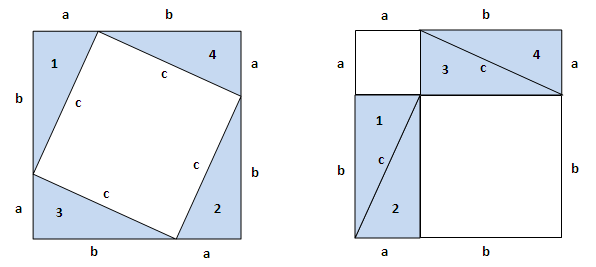
Since both squares have side length a+b and have the same amount of blue area, the white areas must be of equal size. That is, a^2+b^2=c^2.
The Pythagorean Theorem is just one notable example of a proof without words. More of these clever proofs can be seen at https://www.artofproblemsolving.com/articles/proof-without-words.
In summary, mathematics existed before we used variables and operation signs (+, - and so forth). As a result, there was a focus on geometry. Since diagrams can often express these early geometric theorems, some proofs relied solely on diagrams instead of words.
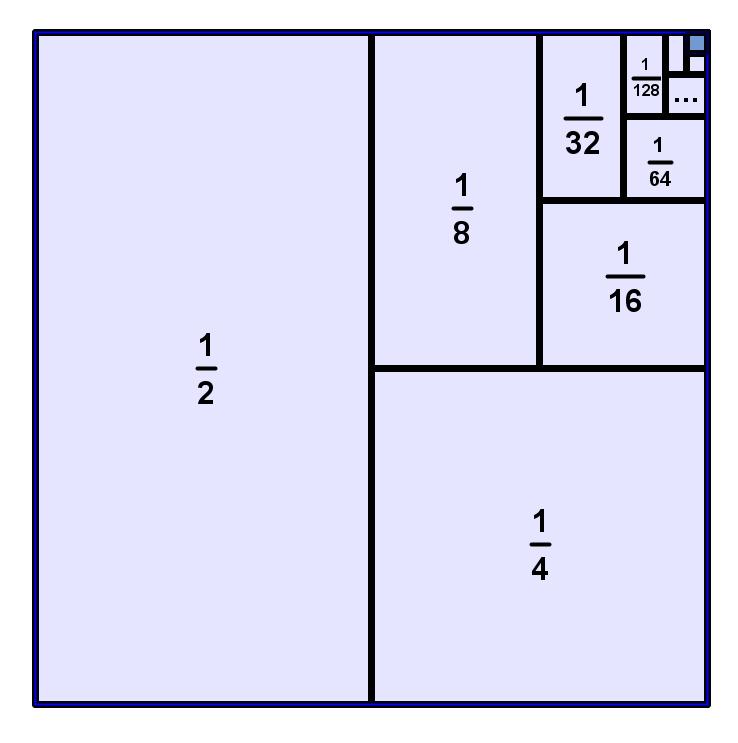
This diagram shows that the sum 1/2+1/4+1/8+... gets closer and closer to 1, the area of the entire square.