Read · 1 min
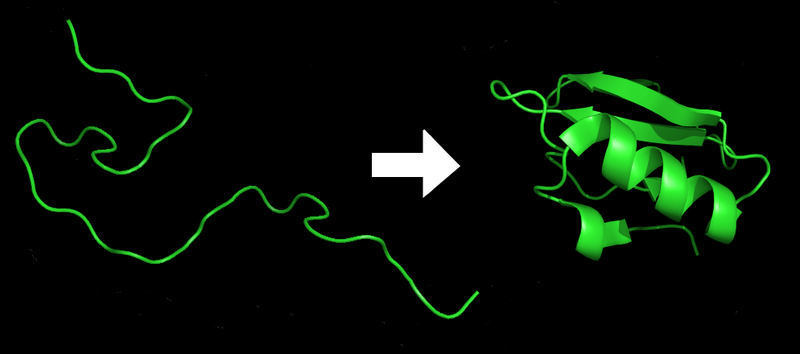
A polypeptide chain has to fold into a specific shape in order to form a functional protein. Many newly synthesized polypeptides will spontaneously fold into the right shape under the right temperature and pH conditions. Others require helper proteins called chaperones to achieve their final conformations. A big area of current research involves trying to predict the folded protein conformation given a sequence of amino acids.
Interactions between amino acids stabilize a folding protein. These interactions include hydrophobic interactions, hydrogen bonds, salt bridges, and disulfide bonds.
Hydrophobic interactions
Because a cell's cytoplasm is an aqueous environment, hydrophobic amino acids tend to cluster in the core of a protein, isolated from the polar water molecules. This effect is similar to how oil doesn't dissolve in water, but will instead form droplets on the surface.
Hydrogen bonds
Hydrogen bonds along the protein backbone stabilize secondary structures such as alpha helices and beta sheets. Side chains of polar amino acids can also form hydrogen bonds.
Salt bridges
A salt bridge is an ionic bond between a positively and a negatively charged amino acid side chain.
Disulfide bonds
The amino acid cysteine can form a covalent bond with another cysteine residue. These bonds link together the sulfur atoms on each cysteine side chain.