Interactive · 1 question

In the previous lesson, we talked about even and odd functions. We learned how to figure out whether a function is even or odd by graphing. We know that if a function is symmetrical about the -axis, it is an even function. If a graph is symmetrical about the line , then the function is odd.
In this lesson, we will learn how to algebraically determine if functions are even or odd.
Even Functions
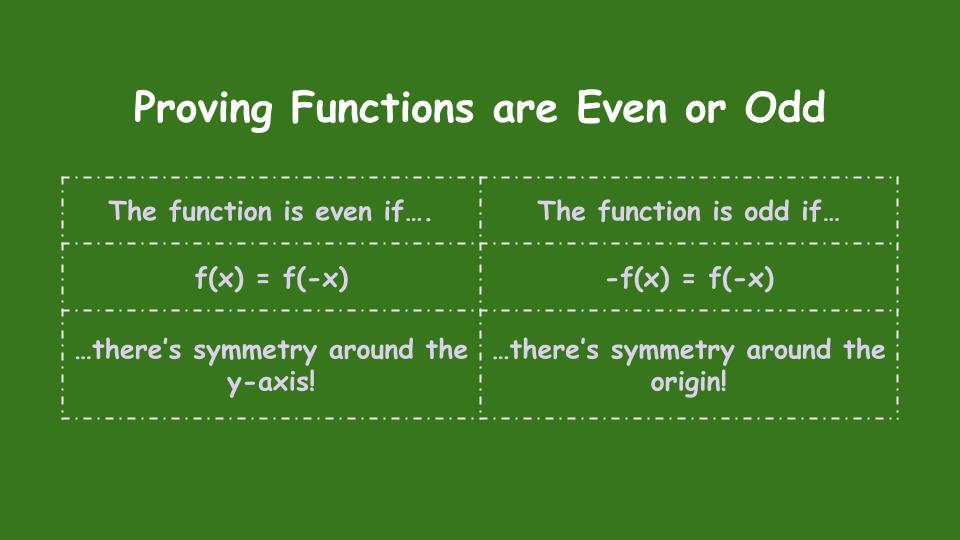
To review, we know that for even functions:
That is essentially saying that if you plug in or into an equation, if the statement is true, the function is even. If the statement is false, the function is not even.
Let's look at an example!
Example
Say we have the function . Is this function an even function?
This statement is true! Therefore, is an even function. We can also see this concept algebraically if we plug in a value for in both the original function and the test function. Say .
Odd Functions
To review, we know that for odd functions: .
Odd functions are symmetric around the origin.
Example
Let's look at the equation . Algebraically, we'll find that:
Therefore, this function is an odd function! Let's try to plug in a value for , say .
We have confirmed that this function is an odd function!
Now, it's your turn! Do the practice problem on your own.
Determine if the following function is even, odd, or neither.
Solution
First, let's check if the function is even! We want to see if is true. We can plug in .
The statement is true! So we can say that this function is even.
However, let's still check if the function is odd. We want to see if is true for the function. We can plug in .
Since , we can say that this function is not an odd function.
Therefore, the answer is even!