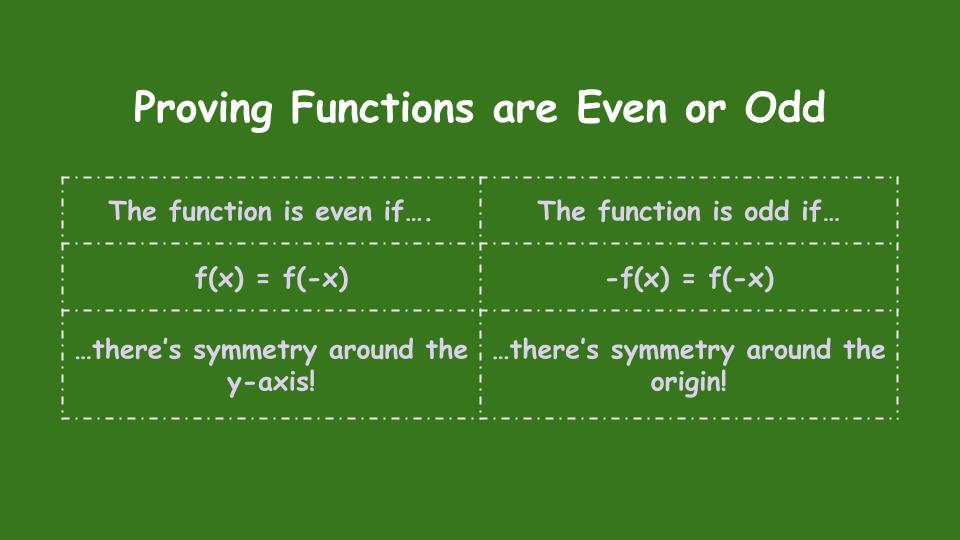
Proving Functions are Even or Odd Algebraically

Before this, knowEven and Odd Functions

Interactive · 1 question

In the previous lesson, we talked about even and odd functions. We learned how to figure out whether a function is even or odd by graphing. We know that if a function is symmetrical about the yy-axis, it is an even function. If a graph is symmetrical about the line y=xy=x, then the function is odd.

In this lesson, we will learn how to algebraically determine if functions are even or odd.

Even Functions

To review, we know that for even functions: f(x)=f(−x)f(x)=f(-x)

That is essentially saying that if you plug in xx or −x-x into an equation, if the statement is true, the function is even. If the statement is false, the function is not even.

Let's look at an example!

Example

Say we have the function f(x)=x2+4f(x)=x^2+4. Is this function an even function?

(x)2+4=(−x)2+4x2+4=x2+4✓\begin{align} (x)^2+4&=(-x)^2+4\\ x^2+4&=x^2+4 \\ \checkmark\\ \end{align}

This statement is true! Therefore, f(x)=x2+4f(x)=x^2+4 is an even function. We can also see this concept algebraically if we plug in a value for xx in both the original function and the test function. Say x=2x=2.

(2)2+4=(−2)2+44+4=4+48=8✓\begin{align} (2)^2+4&=(-2)^2+4\\ 4+4&=4+4\\ 8&=8\\ \checkmark\\ \end{align}

Odd Functions

To review, we know that for odd functions: −f(x)=f(−x)-f(x)=f(-x).

Odd functions are symmetric around the origin.

Example

Let's look at the equation f(x)=3x3−xf(x)=3x^3-x. Algebraically, we'll find that:

−[3x3−x]=3(−x)3−(−x)−3x3+x=−3x3+x✓\begin{align} -[3x^3-x]&=3(-x)^3-(-x)\\ -3x^3+x&=-3x^3+x\\ \checkmark\\ \end{align}

Therefore, this function is an odd function! Let's try to plug in a value for xx, say x=3x=3.

−[3(3)3−(3)]=3(−3)3−(−3)−[3(27)−(3)]=3(−27)−(−3)−[81−3]=−81+3−78=−78✓\begin{align} -[3(3)^3-(3)]&=3(-3)^3-(-3)\\ -[3(27)-(3)]&=3(-27)-(-3)\\ -[81-3]&=-81+3\\ -78&=-78\\ \checkmark\\ \end{align}

We have confirmed that this function is an odd function!

Now, it's your turn! Do the practice problem on your own.

Determine if the following function is even, odd, or neither.

f(x)=x4+2f(x)=x^4+2
Choose one answer

Video

(Video) How to Determine if a Function is Even or Odd

by Brian McLogan

In this video by Brian McLogan, you will learn how to algebraically determine whether a function is even or odd.

Summary

First, we need to remember how to determine if a function is even or odd, in general. If a function is even, it is symmetrical with the yy-axis. If a function is odd, it's symmetrical with the origin.

For the following function, let's try to determine if it's even or odd algebraically, since we don't have a graph.

f(x)=x6−2x2+3f(x) = x^6 - 2x^2 +3

To determine if a function is even algebraically, the following must be true: f(−x)=f(x)f(-x)=f(x). To determine if a function is odd algebraically, the following must be true: f(−x)=−f(x)f(-x)=-f(x). If neither are true, then the function is neither even nor odd.

f(−x)=(−x)6−2(−x)2+3f(−x)=x6−2x+3\begin{align} f(-x) &= (-x)^6-2(-x)^2+3 \\ f(-x) &= x^6-2x+3\\ \end{align}

We plugged in −x-x for xx, and we got back the original function. So, the function is even!

Illustrated · 1 min

Algebraically Determining if a Function is Even or Odd

If you follow this rule, you will be able to determine if a function is even or odd. If a function doesn't fall into either of these categories, it is neither even nor odd.

Proving Functions are Even or Odd
The function is even if f(x)=f(-x) ...there's symmetry around the y-axis!
The function is odd if -f(x)=f(-x) ...there's symmetry around the origin!

Image source: by Anusha Rahman

If you encounter a situation where you need to figure out if a function is even or odd, this algebraic method will be helpful for you.

In the next lesson, you will learn about the sum of even and odd functions.

Type a concept, like “slope” or “photosynthesis”.

↑ ↓ to choose · Enter to openSearch explanations and problems