Pumps (Active Transport) — Definition & Types

Illustrated · 2 min

Working Against the Concentration Gradient

Pumps are a kind of active transport which pump ions and molecules against their concentration gradient. Active transport requires energy input in the form of ATP. Much like passive diffusion, protein pumps are specific for certain molecules.

A very important example of this is the sodium-potassium pump, which you can see below.

The sodium-potassium pump

Image source: By Clod94 CC BY-SA 4.0, via Wikimedia Commons

The sodium-potassium pump is one of the most significant transport proteins. It is the protein that allows your nerves to pass electrical charges so they function.

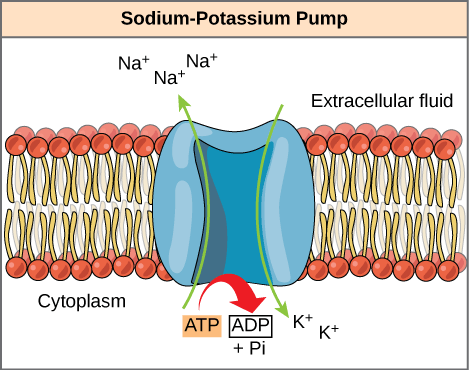
The sodium-potassium pump works by transporting sodium and potassium against their concentration gradients. This basically means that it pumps these ions from areas of low concentrations (few ions) to areas of high concentration (many ions). The protein channels that undergo passive transport work against the pump, allowing sodium ions to enter the cell constantly, so the pumps work to remove the excess ions.
The sodium-potassium pump

Image source: By CNX OpenStax CC BY 4.0, via Wikimedia Commons

First, three sodium ions from inside of the cell bind to the sodium-potassium pump. The pump is then smacked with an ATP molecule, which sticks a phosphate group to the pump and becomes ADP. This provides the energy needed for the pump to change shape and open towards the outside of the cell, where the sodium ions can detach and leave the cell.

While the pump is open to the outside of the cell, two potassium ions bind to the inside of the protein. This causes the phosphate group donated from ATP to fall off the protein, causing it to become the original shape again.

The two potassium ions detach and enter the cell. Three more sodium ions bind to the pump on the outside and the cycle continues on.

Vocabulary Review:\color{#8925AE}{\text{Vocabulary Review:}}

Plasma Membrane\color{#8925AE}{\text{Plasma Membrane}} : A semi-permeable phospholipid bilayer

Active Transport\color{#8925AE}{\text{Active Transport}} : Moving materials across the cell membrane. It requires energy

Pumps\color{#8925AE}{\text{Pumps}} : Proteins embedded in the plasma membrane that only allow specific materials to pass through

Video

(Video) Active Transport

by Teacher's Pet

Active transport is transport that takes energy. This video explains how pumps in the cell membrane use energy to move molecules in and out of cells. It also shows one of the most well-known examples: the sodium-potassium pump.

Illustrated · 2 min

What Is Active Transport?

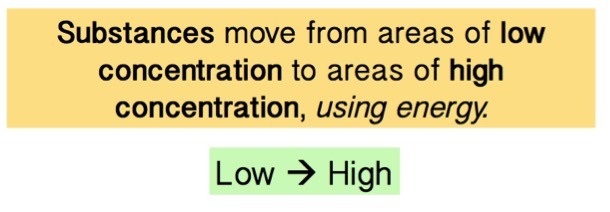
Active transport is a process in which substances move from areas of low concentration to high concentration. The word "active" tells us that this type of transport requires energy to occur; it doesn't just happen on its own.

Think of active transport as the opposite of passive transport.

Pumps move substances from areas of low concentration to areas of high concentration.

Image source: By Hannah Bonville

Before we get into the details, let's have a little refresher on concentration.

Concentration is a way for us to measure how crowded one area is with a given substance compared to another area. It's all relative.

Active transport moves substances from areas of low concentration to high concentration.

Image source: By LadyofHats (modified by expii) [Public domain], via Wikimedia Commons

A difference in concentration across a membrane is called a concentration gradient.

Remember though: in active transport, substances are being forced across the membrane from an area of low concentration to an area of high concentration.

In other words, the substance is being pushed into an area that's already crowded with it.

One of the major ways active transport occurs is through pumps.

An image of a water pump

Image source: By Pixabay user Nemo (modified by expii) CC0, via Wikimedia Commons

The pumps used in active transport are like the water pump pictured above. The pump in the picture requires you to push down on the handle (apply energy) in order to produce a rush of water. You're forcing water from one location to another through the use of energy.

Sodium-Potassium Pump

One important type of protein pump found in the cell membrane is called a sodium-potassium pump.

This type of protein pump moves ions across the cell membrane. Ions are charged particles. In this case, the pump moves sodium ions (Na+^+) out of the cell and potassium ions (K+^+) into the cell.

Sodium-potassium pump

Image source: By Hannah Bonville

Let's take a closer look at the sodium-potassium pump pictured above.

There is a high concentration of sodium ions (Na+^+) outside the cell membrane. Even so, the protein pump keeps forcing more and more sodium ions into that space. Because the movement of molecules is "forced", it requires energy (ATP).

The same is true with the potassium ions (K+^+). There's a high concentration of them inside the cell. Despite this, the protein pumps more and more potassium ions in.

More specifically, one ATP molecule gets three sodium ions pumped out and two potassium ions pumped in. Think of the ATP like the price the cell pays to move these ions around.

Below, there's another image of a sodium-potassium pump. It offers a little more detail on the inner workings of the process of active transport.

Sodium-potassium pump

Image source: By Clod94 CC BY-SA 4.0, via Wikimedia Commons

Key Vocabulary:

  1. Active transport
  2. Pump
  3. Ion
  4. Concentration gradient
  5. ATP

Type a concept, like “slope” or “photosynthesis”.

↑ ↓ to choose · Enter to openSearch explanations and problems