Illustrated · 3 min
Pure vs. Applied Chemistry
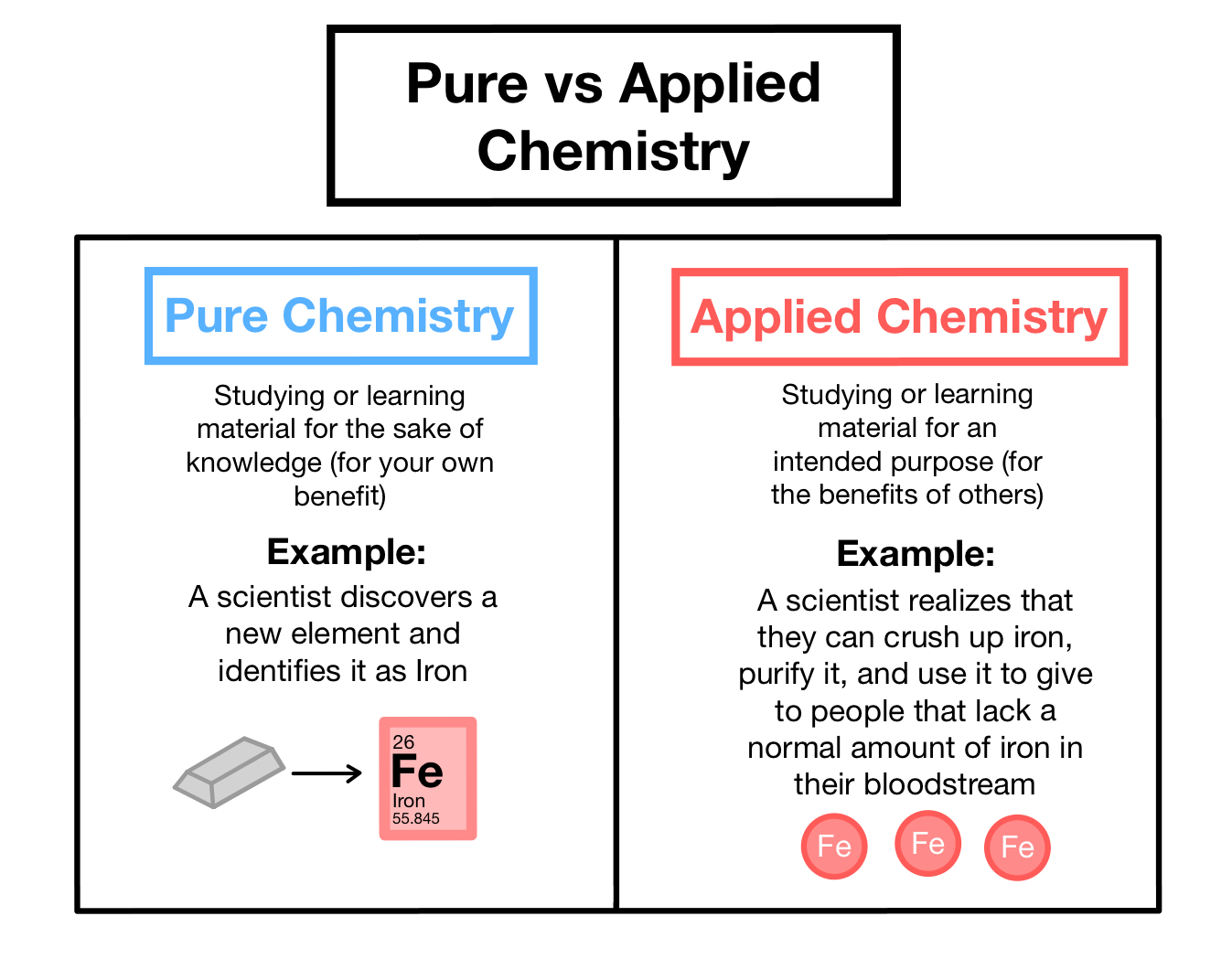
- Overall, pure chemistry is the understanding of what something is, and applied chemistry is using that knowledge to achieve a goal (such as learning about the human anatomy to figure out ways to become a better surgeon)
What is Pure Chemistry?
-
Pure chemistry is considered the basics. Only understanding why or what something is rather than what you can do with something
-
Pure chemistry ask, “why is this that way” or “how does this work” and works towards answering that question. Once that question is answered, you move on to the next thing. There’s no next step
-
Example of pure chemistry: Learning everything about mushrooms (such as the name, how/where they grow, and what they are made up of), but not applying that knowledge towards what you can do WITH the mushroom.
-
Note: Pure chemistry is also referred to as pure research.
What Branches of Chemistry are Pure Chemistry?
-
Theoretical chemists come the closest to pure chemistry. They use quantum mechanics to study atoms and chemical bonding. They want to know about atomic orbitals, their shapes, and how they overlap in covalent bonds. Often, they use computer modeling based on advanced math and physics.
-
When we studied the origins of chemistry, we saw a lot of pure research. Multiple famous scientists simply wanted to know "why something was the way it was." Many of the early experiments are considered physical chemistry. These chemists studied how gases behave. They learned about their expansion and compression, combustion, and diffusion. Soon they were developing laws for real and ideal gases. Now, we apply their laws every day! It's how our cars drive!
-
The early work of nuclear chemists was pure research. They didn't know that atoms are made of protons, neutrons, and electrons. But they kept wanting to learn more! Now we can break and fuse atoms in unique nuclear reactions. We have come a long way!
What is Applied Chemistry
-
Applied chemistry is the process of using previous knowledge to achieve a goal.
-
Think of applied chemistry as researching and using knowledge to help (or potentially hurt) people or the environment
-
Example: Scientists at Pfizer researched the COVID-19 virus. They used their knowledge of the virus to make a COVID-19 vaccine
What Branches of Chemistry are Applied Chemistry?
-
Organic chemistry is the study of carbon compounds. We use it every day! Often, we don't even know it. Organic chemists used synthesis reactions to develop your clothes, your phone's touchscreen, and non-stick cookware!
-
Inorganic chemists study metals. They work to develop new alloys or transition metal compounds. These new materials have applications in electronics, energy, construction, and manufacturing.
-
Analytical chemists study the composition of materials. Electrons have different energy levels, so they can absorb energy in specific amounts. When analytical chemists shine different wavelengths of light through a sample, the different elements absorb and emit different wavelengths. Using these differences, analytical chemists can determine what substances are in a sample.
-
Environmental chemists apply a broad range of chemistry to environmental systems. Acids and bases are paramount in the ocean, for example regarding ocean acidification. Phase changes apply to pollution. Unique chemical reactions happen in the atmosphere.

Image source: Caroline Monahan