
Interactive · 4 questions
+6 contributors





Quadratic Word Problems
Let's look at pretty common types of word problems that use quadratic functions. Recall that quadratic expressions follow this general form: In a quadratic expression, and are coefficients (numbers in front of the variable ), and is constant (a number by itself). It's important to remember that . It's possible for and/or , but they don't have to.
Example 1: Word problems involving area
Many quadratic word problems use the area of a rectangle. Here is a graphic to get you started
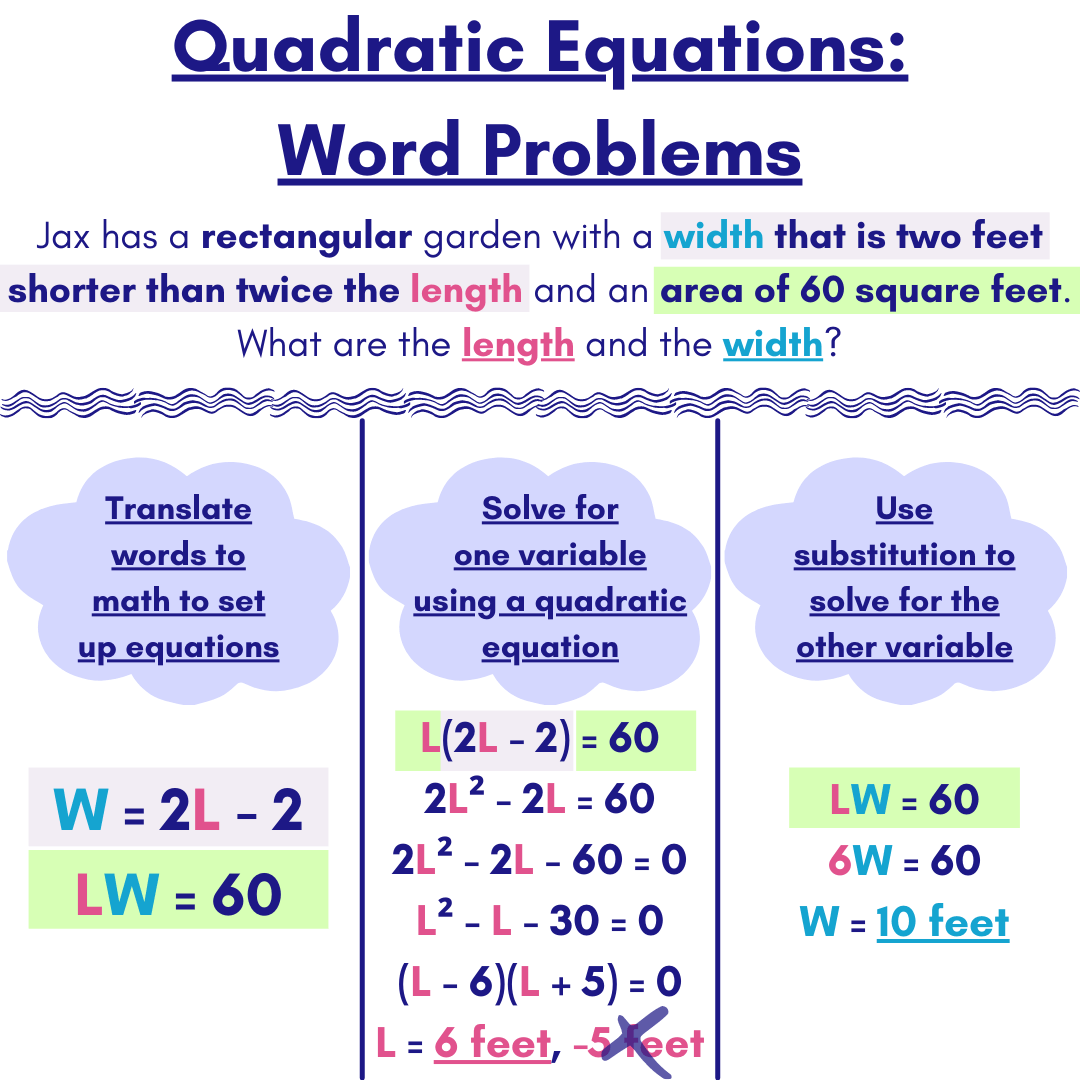
Image source: By Caroline Kulczycky
Here is another example.
Singh knows the total area of his garden is m, but he doesn't know the length or width. Use the diagram below to find the length and width in meters (m).

Recall that the formula for area of a rectangle is . So, let's plug the values from Singh's garden into that formula, and set it equal to (the area).
Now, let's multiply out this equation and get it in the standard quadratic form (written at the top of this explanation):
Once we multiply the equation out and rearrange it, what does it look like (in quadratic form)?
Great! How did we do this? Remember, how to multiply a polynomial by a monomial. Then, we moved everything to the right side.
The next thing we need to do is solve for . Remember that, when working with quadratic equations, we can solve for by factoring.
Which of these choices correctly factors the expression? ()
So, this gives us two possible values for that make the left side of the equation equal to . These two possible values are: If we look back at the original diagram, the width of Singh's garden is written as .
Try plugging in both possible values for into . Notice that when we plug in , we find that the width of the garden is . Unless we're in Narnia, that's not possible. We can't have a negative width.
So, the value of must be the other option, .
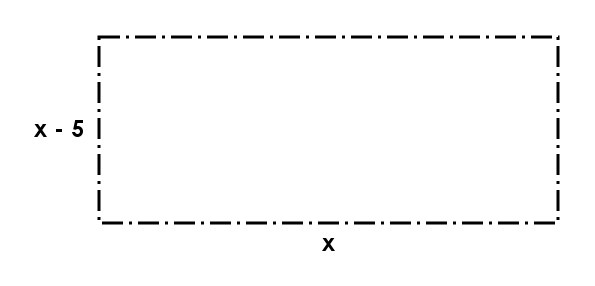
If , then we know that the length of Singh's garden () is meters.
If , then we know that the width of Singh's garden () is meters.
Great job! In summary, what we did was:
- Set up a quadratic equation from the image.
- Solve the quadratic equation.
- Check the possible solutions that will accurately answer the original question.
We'll use this same pattern when we tackle future quadratic word problems!
Example 2
Jill sells hats. She has come up with a formula to figure out how much demand there is for the hats based on the price: where is the demand and is the price in dollars. What should each hat cost for the demand to be hats?
This word problem gives us a quadratic function to use. We're told that the demand needs to be for hats. This means that, in our formula, . Let's plug that in.
Now we need to solve for , the price per hat. Because this is a quadratic equation, we need to:
- Set one side equal to
- Factor the equation to find possible values for So, we're left with two prices per hat: or .
Obviously, isn't going to work since prices are always positive. So, we can say and that Jill should charge per hat in order for the demand to be for hats.
If we want to double check our work, we can plug in our answer () back into the original equation ().
In these two examples, we saw word problems dealing with area and price. You can also use these methods to solve problems with consecutive integers and other types of problems.


