Illustrated · 1 min

A common question in math when learning quadratics is how to get a quadratic equation from three given points. Unless otherwise specified, assume that all questions are asking for the quadratic equation in standard form.

ax2+bx+c=0ax^2+bx+c=0

At its core, these types of problems are asking you to use your math intuition to plug in points in the best order possible so you can find a,b,and ca, b, \text{and } c. That sounds scary, but with enough practice, you'll be able to handle these types of problems!

Some rules to consider for these types of problems:

  • Plug in any intercepts first. With intercepts, either the xx or yy coordinate is 00, so you will be able to eliminate variables.

  • Plot the points, whether on paper or in your head, to get an idea for what the quadratic function will look like.

  • Review your rules and tips for solving systems of equations.

The best way to learn how to write quadratic equations from three given points is to walk through an example!

Example

Given these three points: (0,7),(−4,3),(1,18)(0,7), (-4,3), (1,18), write a quadratic equation.

First, plug in the intercept!

ax2+bx+c=ya(0)2+b(0)+c=7c=7\begin{align} ax^2+bx+c&=y\\ a(0)^2+b(0)+c &=7\\ c &= 7\\ \end{align}

Now, we know that c=7c=7, so our new equation looks like: ax2+bx+7=yax^2+bx+7=y.

We're going to use a system of equations to solve the problem. Let's plug in the second point, (−4,3)(-4,3).

ax2+bx+7=ya(−4)2+b(−4)+7=316a−4b=−44a−b=−1\begin{align} ax^2+bx+7 &= y\\ a(-4)^2 +b(-4) +7 &= 3\\ 16a -4b &= -4\\ 4a-b&=-1\\ \end{align}

Let's plug in the third point, (1,18)(1,18), into our equation.

ax2+bx+7=ya(1)2+b(1)+7=18a+b=11\begin{align} ax^2+bx+7 &= y\\ a(1)^2+b(1)+7 &= 18\\ a +b &=11\\ \end{align}

Now, we have two equations that we can use in a system of equations. Let's set the second equation equal to bb.

a+b=11b=11−a\begin{align} a +b &=11\\ b &= 11-a\\ \end{align}

Plug in this second equation into the first equation.

4a−b=−14a−(11−a)=−14a−11+a=−15a=10a=2\begin{align} 4a-b&=-1\\ 4a-(11-a) &=-1\\ 4a-11+a &= -1\\ 5a &=10\\ a&=2\\ \end{align}

Now that we've solved for aa, we can solve for bb.

b=11−ab=11−2b=9\begin{align} b &= 11-a\\ b &= 11-2\\ b &= 9\\ \end{align}

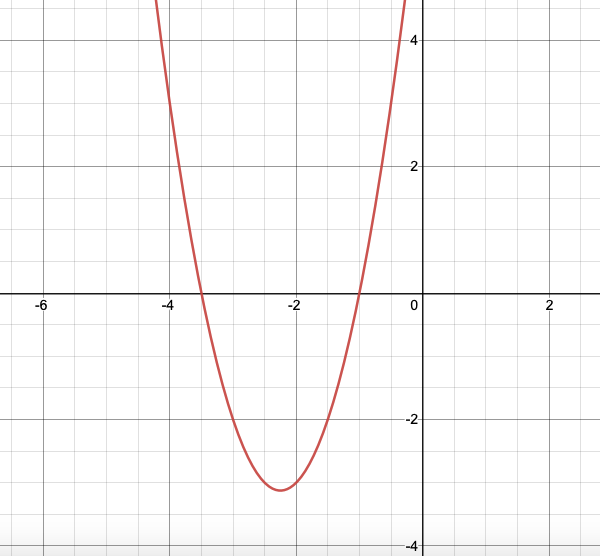
We've found that a=2a=2, b=9b=9, and c=7c=7. So, our quadratic equation is: y=2x2+9x+7y=2x^2 + 9x +7

Graph of y=2x^2 + 9x +7

Made using Desmos

Video · + 1 min read

(Video) Write the Equation of a Parabola Given Three Points

by Brian McLogan

In this video by Brian McLogan, you will be walked through an example of how to find the equation of a parabola using three points.

Summary

If we are given three points, we are going to plug in the values for xx and yy into the standard form of the quadratic.

Let's say we are given the three points: (0,3)(0,3), (1,2)(1,2), and (2,3)(2,3). Plugging these points into the standard form, we get:

3=a(0)2+b(0)+c2=a(1)2+b(1)+c3=a(2)2+b(2)+c\begin{align} 3 &= a(0)^2 + b(0) +c \\ 2 &= a(1)^2 + b(1) + c \\ 3 &= a(2)^2 +b(2) +c \\ \end{align}

If we simplify the first equation, we will notice that the first two terms on the right side cancel out, so c=3c=3.

The second equation simplifies to: a+b+ca + b + c.

The third equation simplifies to: 4a+2b+c4a + 2b + c.

Because we know what cc is, we can replace cc with 33 in the last two equations, which will then give us a system of equations. Our system looks like:

−1=a+b0=4a+2b\begin{align} -1 &= a+b \\ 0 &= 4a + 2b \\ \end{align}

If we solve using elimination, we will find that a=1a=1 and b=−2b=-2.

We can now write the equation of the line!

y=1x2−2x+3y=1x^2 -2x + 3

Illustrated · 1 min

Quadratic from Three Points

In this lesson, we're going to learn about how to find the equation of a quadratic curve (a parabola) when you are given three points on the curve.

The standard form of a quadratic equation is: y=ax2+bx+cy=ax^2+bx+c.

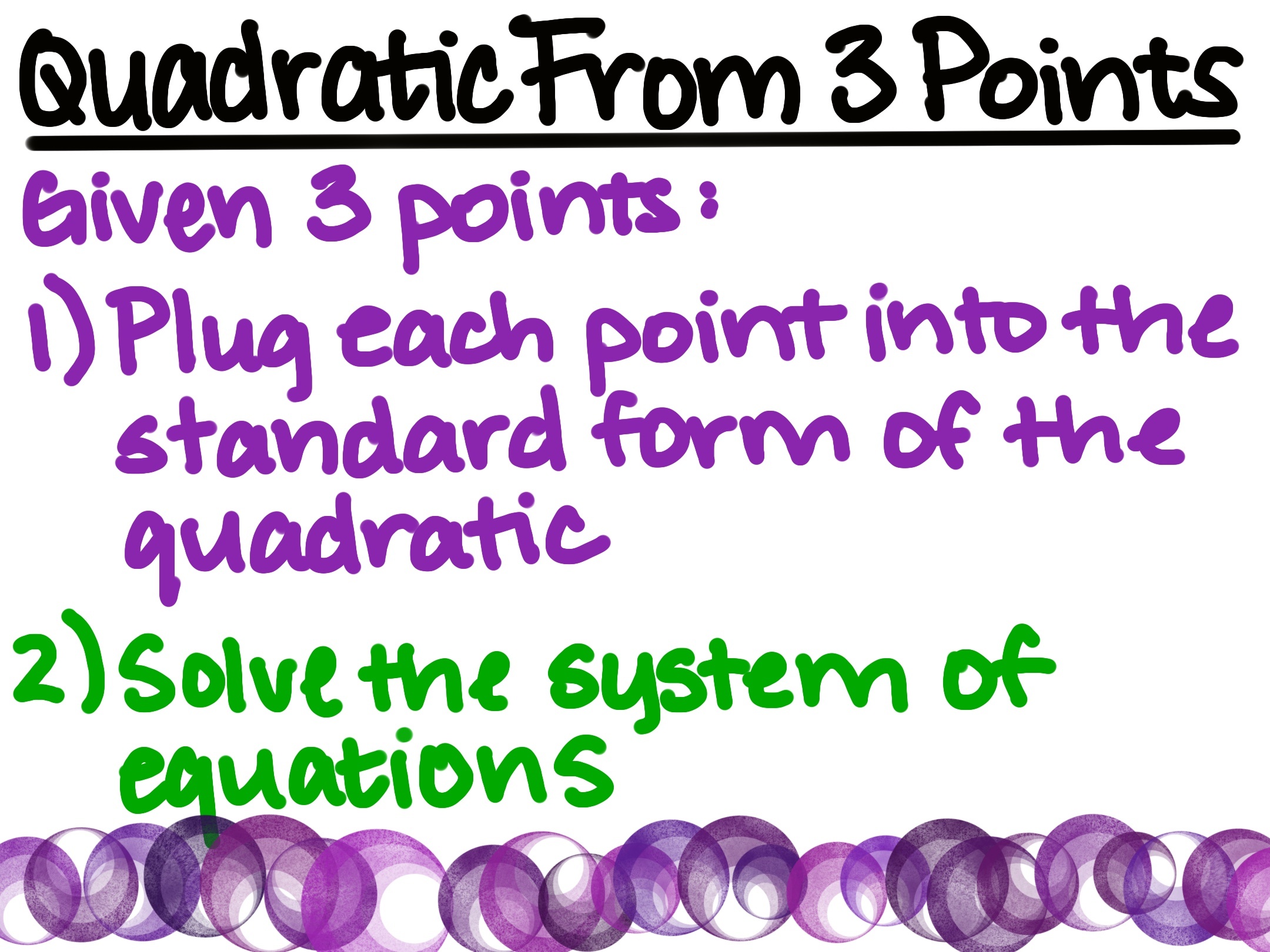
Quadratic From 3 Points
Given 3 points:
1) Plug each point into the standard form of the quadratic
2) Solve the system of equations

Image source: by Anusha Rahman

Step 1: Understand the Problem

Suppose we have three points, and we want to find the equation of the quadratic that passes through them. Let’s call the points:

  • Point 1: (x1,y1)(x_1, y_1)
  • Point 2: (x2,y2)(x_2, y_2)
  • Point 3: (x3,y3)(x_3, y_3)

Each of these points will give us an equation that we can use to find a,ba, b, and cc.

Step 2: Set Up the System of Equations

We know that the quadratic equation is: y=ax2+bx+cy=ax^2+bx+c

Now, since we have three points, we can plug each point into the equation. This will give us three separate equations to solve for a,ba, b, and cc.

  • For point 1: y1=a(x1)2+b(x1)+cy_1=a(x_1)^2+b(x_1)+c
  • For point 2: y2=a(x2)2+b(x2)+cy_2=a(x_2)^2+b(x_2)+c
  • For point 3: y3=a(x3)2+b(x3)+cy_3=a(x_3)^2+b(x_3)+c

So now we have a system of three equations with three unknowns: a,b,a, b, and cc.

Type a concept, like “slope” or “photosynthesis”.

↑ ↓ to choose · Enter to openSearch explanations and problems