Illustrated · 1 min

+1 contributors

Factor Theorem
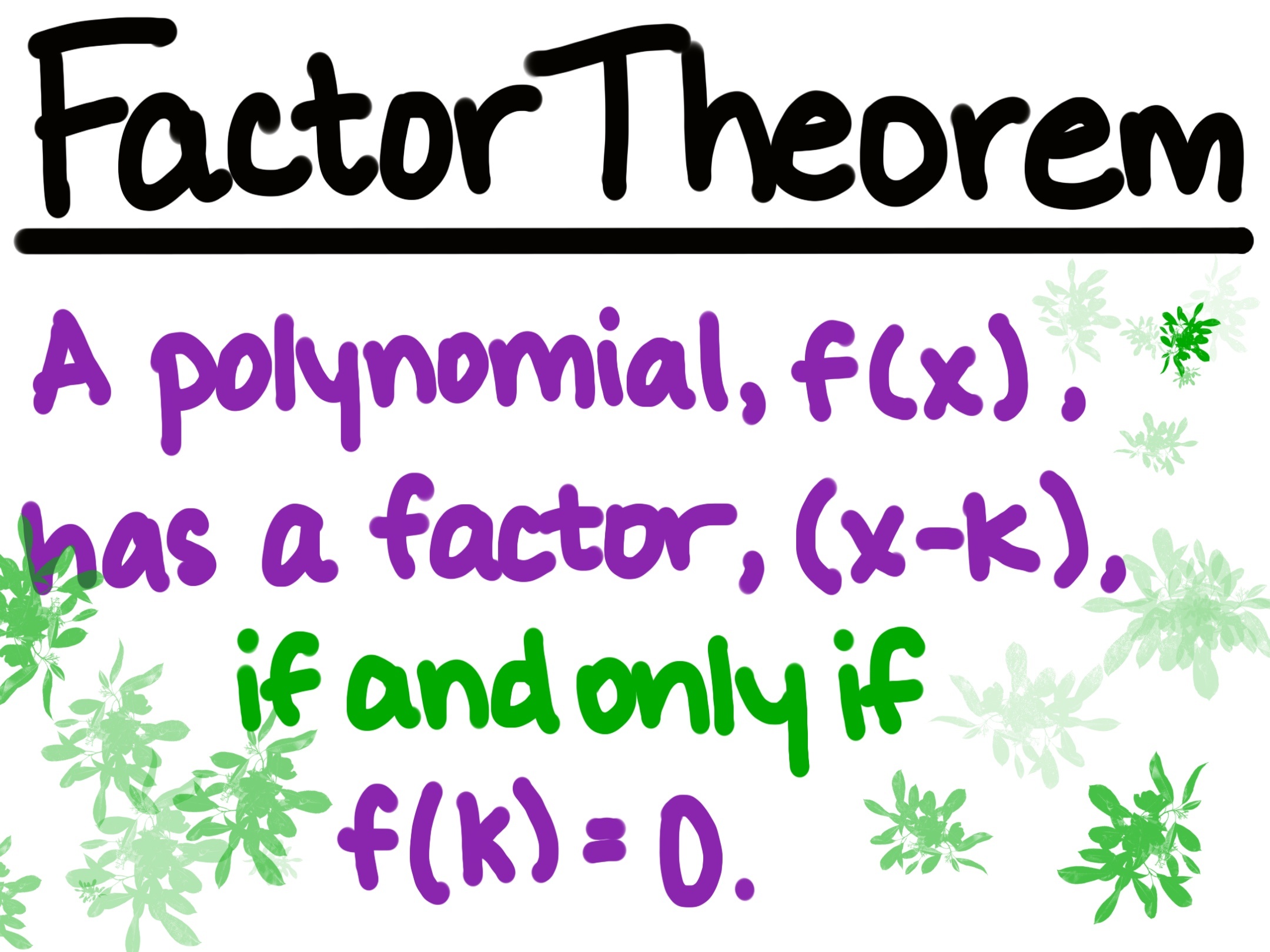
The word "factor" is thrown around a lot in algebra. We most commonly see it when dealing with quadratics. Think about how many problems have had you simplify something like into . We use this process when we solve quadratics because of the factor theorem which states:
"A polynomial, , has a factor, , if and only if ".
Let's look at the phrase "if and only if". This is something that is seen in many mathematical theorems and can be thought of as "event can only happen if event happens". For this theorem, it means that factors in polynomials will only be valid in the the form of .
Keep in mind, this kind of functions as the alternative to polynomial long division or synthetic division, where we divide a polynomial by a factor.
Factor Theorem and Standard Form
Let's look at the equation again. This is a polynomial of degree . We know that this factors out to . Through this factorization we also know that the solutions to this equation are and . This process works because we are setting them equal to . We could've also used the quadratic formula.
Let's say that we were instead looking at . We could factor the left side of the equation in the same way, but the resulting answers won't be the roots of the function.
We need to put the equation into standard form so we can solve for values when . The true roots of this quadratic are and . We can check this by looking at the graph of .

Made with Desmos
When we graph the equation, we think of it as , and the roots occur on the graph at and . We solve the quadratic while it is set to because we are trying to find the -values when .