Illustrated · 1 min

+4 contributors



A quadratic function is simply a function which has degree . Check out the explanations for Standard Form and Degree if you need a refresher on this terminology.
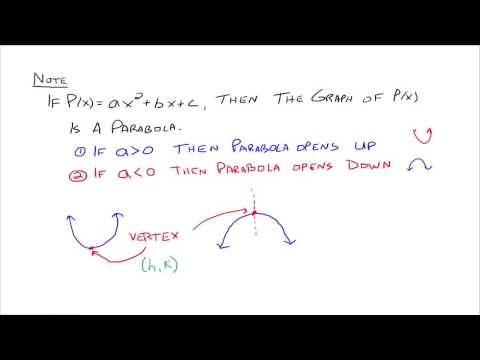
Now, when written in standard form, quadratic functions are of the form where and are constants and
Suppose we're given the function . We can write this in standard form by combining terms with the same degree:
We want to put it in standard form. We need to have the degrees in decreasing order:
So, we know .
We can use the standard form to determine many properties of the function. We'll cover this in a bit.
Sometimes we'll need to find the roots of a quadratic function. A root (or zero) of a function is a number, , such that . You may have seen this with completing the square of the quadratic formula. Graphically, this is the same as finding the -intercepts for the function.

Made using Desmos
This is a graph of in red. The blue dots represent the intercepts at and . Both of these values are also roots of as they both make .
We know that the shape of a quadratic function is a parabola, where the coordinates of the vertex is the minimum or maximum. The real roots, real numbers, are the points where the parabola crosses the x-axis.
It's important to distinguish a function from an equation. A function is something of the form , which defines the formula in terms of . An equation is when we set the formula equal to something. So is a quadratic equation, not a function.