Quaternary Consumer — Definition & Role

Before this, knowTrophic Level — Definition & Examples

Illustrated · 1 min

What Is a Quaternary Consumer?

A quaternary consumer is a consumer at the top of the food chain. As a reminder, here is an example of a standard food chain.

This is an image of a food chain with five organism. First there is grass. The grass then has an arrow pointing from it to the next organism, the mouse. The mouse then has an arrow pointing to a python. The python is followed by a monkey, and lastly a leopard.

The grass is the producer, which is eaten by the mouse (the primary consumer). The python (a secondary consumer) then eats the mouse. The monkey is a tertiary consumer that eats the python. Finally, the leopard (the quaternary consumer) eats the monkey.

Image source: By Mario Janakis

In this example, the leopard is the quaternary (fourth level) consumer. No other species eats the leopard, so it is at the top of the food chain.

What Is a Consumer?

A consumer is any animal that gets its energy from consuming another organism. The food chain can be divided into two groups: producers and consumers. Producers are autotrophs who produce their own food. Consumers are heterotrophs that eat producers and other consumers. The quaternary consumer eats tertiary consumers, which eat secondary consumers, which eat the primary consumers. Primary consumers eat producers (mostly plants) and other organic substances.

So What Makes These Consumers Special?

Because they are at the top of the food chain, they are usually larger animals. Since they are larger they also need to eat a lot of food to stay alive, so usually there are less quaternary consumers in an ecosystem than other animals. Going back to the first example, an ecosystem would have way more mice than it would have leopards. Otherwise, the leopards would not be able to sustain themselves.

These top-tier consumers receive very little of the original energy in a food chain. Remember that with each step of the food chain, only 10% of the energy from the organism being eaten is transferred to the organism eating it. For this reason, higher level consumers have to eat large quantities of food to stay alive. The diagram below demonstrates these energy transformations.

This is an image of a pyramid labeled "energy pyramid". Next to the pyramid there is a sun pointing to the bottom of the pyramid labeled "sun's energy". The pyramid is split into five different categories that get smaller as we move up the pyramid. At the base of the pyramid there are the primary producers with 100% of the energy, followed by primary consumers with 10% of the energy, then secondary consumers with 1% of the energy, then third level consumers with .1% of the energy, and lastly apex predators with .01%. At every level of the pyramid there is also an arrow pointing away from the pyramid and to the label "energy lost as heat" to indicate where the remaining 90% of the energy goes in-between energy levels.

This diagram shows how energy moves across a food chain. \\ Image source: By Swiggity.Swag.YOLO.Bro CC BY-SA 4.0, via Wikimedia Commons

What Are Some Other Examples?

Humans are quaternary consumers. Typically, humans are referred to as "apex predators". The phrase apex predator means a top predator in the food chain.

Illustrated · 1 min

The Top of the Pyramid

An energy pyramid showing the quaternary consumers at the top

Image source: By Gabi Slizewska

The quaternary consumer tends to be the last member of a food chain and represents the highest level of an energy pyramid. Therefore, these consumers don't really have any natural predators, making them apex predators.

These organisms are predators who are usually carnivores that feed on the tertiary consumers in a food chain. They can also be omnivores and feed on producers and the other consumers in a food web.

In a food chain, the quaternary consumers are the fifth member, and in an energy pyramid, they are in the fourth trophic level from the bottom.

Illustrated · 1 min

What Is an Apex Predator?

An apex predator is a consumer four steps up the food chain and is usually the topmost end of the food chain. The chain in this example goes producer plants, then bugs, then mice, then snakes, and then hawks.

The image shows a food pyramid with plants at the bottom, the bugs, then mice, then snakes, then a hawk.

Image source: By Sarah Morgan

Since apex predators are at the top of the food chain, they receive less energy from the food they eat compared to those at the bottom, like primary consumers. Because of this, the populations of apex predators are usually the smallest out of the populations in the food chain.

Illustrated · 1 min

We're at the Top of the Food Chain

The biggest and baddest predators, the ones at the top of the food chain, are called quaternary consumers. The much cooler, much scarier name for this role in the food chain is apex predator. Quaternary consumers are the predators that eat all the other levels of the food chain but are rarely ever eaten themselves. Humans are up here, along with lions, tigers, and bears. Oh my.

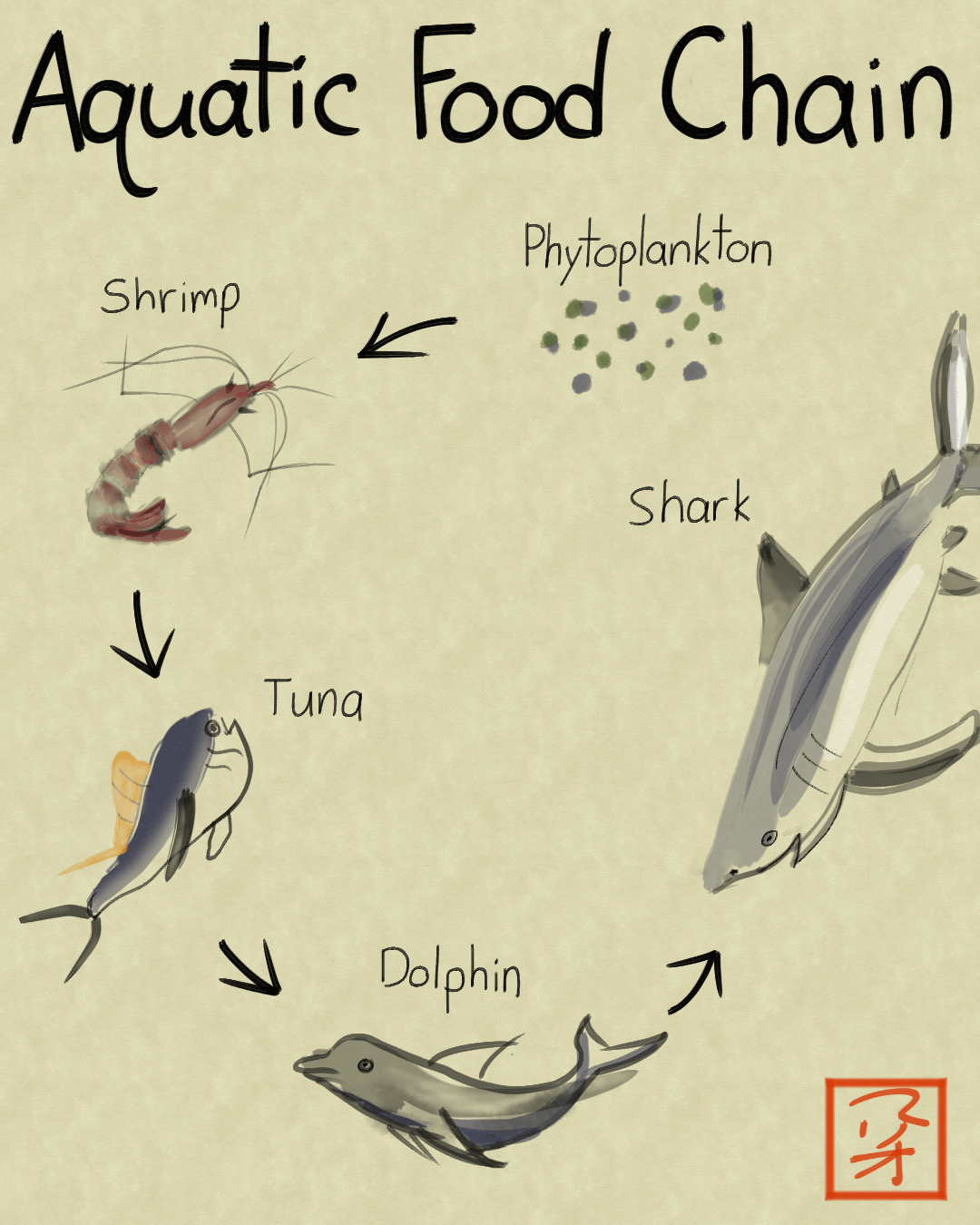
The shark in the food chain shown below is an apex predator.

This is an example of an aquatic food chain. It is painted like a Chinese brush painting. Organisms are arranged in a circle with arrows pointing around the circle counter-clockwise. First is phytoplankton. They are eaten by shrimp. The shrimp are eaten by tuna. The tuna are eaten by dolphins. The dolphins are eaten by a shark.

Image source: By Mario Janakis

Apex predators require a lot of energy to survive, so they have to eat a lot of other organisms. It's difficult for some ecosystems to support a predator that requires so much food. As such, not all food chains will even extend this far.

Vocabulary Review:\color{#8925AE}{\text{Vocabulary Review:}}

Food Chain\color{#8925AE}{\text{Food Chain}} : How energy passes through an ecosystem through organisms eating and being eaten

Producer\color{#8925AE}{\text{Producer}} : Organisms that produce their own food through photosynthesis or chemosynthesis

Consumer\color{#8925AE}{\text{Consumer}} : Organisms that consume other organisms for energy

Decomposer\color{#8925AE}{\text{Decomposer}} : Organisms that break down waste and matter when organisms die

Video

(Video) Ecosystem Ecology: Links in the Chain

by CrashCourse

In this video, Hank explains how energy and nutrients are cycled through a food chain.

Believe it or not, we humans are quaternary consumers. We are at the top of the food chain. Top-level consumers are typically predators who have a lot of prey but are usually not preyed upon themselves. Some other examples of this type of consumer are lions and tigers.

Type a concept, like “slope” or “photosynthesis”.

↑ ↓ to choose · Enter to openSearch explanations and problems