Quotient Rule for Derivatives

Before this, knowDerivative of Reciprocal (1/f)

Interactive · 2 questions

The Quotient Rule gives us an easy way to find the derivative of the quotient of two functions ff and gg, or fg\frac{f}{g}. The rule can be derived from a new/old friend, the Product Rule.

What functions could we use in the Product Rule that would ultimately be the same as finding ddxfg\frac{d}{dx}\frac{f}{g}?

Choose one answer

Interactive · 1 question

Quotient Rule

Now that we know the product rule, a natural question that follows is, how do we find the derivative of a quotient of two functions. More formally, given two functions f(x)f(x) and g(x),g(x), can we get an explicit formula for [f(x)g(x)]′\left[\frac{f(x)}{g(x)}\right]'? Such a formula would allow us to now find derivatives of functions like 1ln⁡x\frac {1}{\ln x} or tan⁡x\tan x. It would definitely be useful.

Well, great... But we have no idea where to start to derive this formula. So what do we do?

Choose one answer

Video · + 1 min read

(Videos) Using Chain, Product, and Quotient Rules to Find Derivatives

by PatrickJMT

Here's a video by patrickJMT showing you how to use the chain, product, and quotient rules to find the derivatives of functions.

Recall the chain, product, and quotient rules: [f(g(x))]′=f′(g(x))⋅g′(x)[f(x)g(x)]′=f′(x)g(x)+g′(x)f(x)[f(x)g(x)]′=f′(x)g(x)−g′(x)f(x)[g(x)]2\begin{align} [f(g(x))]'&=f'(g(x))\cdot g'(x)\\ [f(x)g(x)]'&=f'(x)g(x)+g'(x)f(x)\\ \bigg[\frac{f(x)}{g(x)}\bigg]'&=\frac{f'(x)g(x)-g'(x)f(x)}{[g(x)]^2} \end{align}

The first problem he finds the derivative of is: f(x)=(2x13−6x53)3⋅(4x2−5x)13f(x)=(2x^{\frac13}-6x^{\frac53})^3\cdot(4x^2-5x)^{\frac13}

I like to calculate each pieces derivative separately and then plug them into the formula after. It helps me keep things organized.

So I'll start by finding the derivative of the first part. f1(x)=(2x13−6x53)3f_1(x)=(2x^{\frac13}-6x^{\frac53})^3 Here's where we use the chain rule. Take the derivative of the outside and then multiply it by the derivative of the inside. f1′(x)=3(2x13−6x53)3−1⋅(2x13−6x53)′=3(2x13−6x53)2⋅[2(13x13−1)−6(53x53−1)]=3(2x13−6x53)2⋅(23x−2310x23)\begin{align} f_1'(x)&=\color{red}{3}(2x^{\frac13}-6x^{\frac53})^{\color{red}{3-1}}\color{red}{\cdot(2x^{\frac13}-6x^{\frac53})'}\\ &=3(2x^{\frac13}-6x^{\frac53})^2\cdot[2(\color{red}{\frac13}x^{\color{red}{\frac13-1}})-6(\color{red}{\frac53}x^{\color{red}{\frac53-1}})]\\ &=\boxed{3(2x^{\frac13}-6x^{\frac53})^2\cdot\bigg(\frac23x^{-\frac23}10x^{\frac23}\bigg)} \end{align}

Now let's find the derivative of the second part. f2(x)=(4x2−5x)13f_2(x)=(4x^2-5x)^{\frac13} Again, we need to use the chain rule. f2′(x)=13(4x2−5x)13−1⋅(4x2−5x)′=13(4x2−5x)−23⋅[4(2x2−1)−5(1x1−1)]=13(4x2−5x)−23⋅(8x−5)\begin{align} f_2'(x)&=\color{red}{\frac13}(4x^2-5x)^{\color{red}{\frac13-1}}\color{red}{\cdot(4x^2-5x)'}\\ &=\frac13(4x^2-5x)^{-\frac23}\cdot[4(\color{red}{2}x^{\color{red}{2-1}})-5(\color{red}{1}x^{\color{red}{1-1}})]\\ &=\boxed{\frac13(4x^2-5x)^{-\frac23}\cdot(8x-5)} \end{align}

Now that we have all the pieces we can plug them into our product rule for derivatives formula. f′(x)=f1′(x)⋅f2(x)+f2′(x)⋅f1(x)=3(2x13−6x53)2⋅(23x−2310x23)⋅(4x2−5x)13+     +13(4x2−5x)−23⋅(8x−5)⋅(2x13−6x53)3=3(2x13−6x53)2⋅(23x−2310x23)⋅(4x2−5x)13+     +(8x−5)(2x13−6x53)33(4x2−5x)23\begin{align} f'(x)&=f_1'(x)\cdot f_2(x)+f_2'(x)\cdot f_1(x)\\ &=3(2x^{\frac13}-6x^{\frac53})^2\cdot\bigg(\frac23x^{-\frac23}10x^{\frac23}\bigg)\cdot(4x^2-5x)^{\frac13}+\\ &\ \ \ \ \ +\frac13(4x^2-5x)^{-\frac23}\cdot(8x-5)\cdot(2x^{\frac13}-6x^{\frac53})^3\\ &=3(2x^{\frac13}-6x^{\frac53})^2\cdot\bigg(\frac23x^{-\frac23}10x^{\frac23}\bigg)\cdot(4x^2-5x)^{\frac13}+\\ &\ \ \ \ \ +\frac{(8x-5)(2x^{\frac13}-6x^{\frac53})^3}{3(4x^2-5x)^{\frac23}} \end{align}

Here's another example of solving a derivative using the chain and quotient rules.

The problem he looks at is: g(x)=(2x3−5x)4(4x+1)5g(x)=\frac{(2x^3-5x)^4}{(4x+1)^5}

I like to calculate each pieces derivative separately and then plug them into the formula after. It helps me keep things organized.

Let's start with the top piece's derivative. g1(x)=(2x3−5x)4g_1(x)=(2x^3-5x)^4 Here we have to take the derivative outside the parentheses and then multiply on the derivative of inside the parentheses. g1′(x)=4(2x3−5x)4−1⋅(2x3−5x)′=4(2x3−5x)3⋅(2(3x3−1)−5(1x1−1))=4(2x3−5x)3⋅(6x2−5)\begin{align} g_1'(x)&=\color{red}{4}(2x^3-5x)^{\color{red}{4-1}}\color{red}{\cdot(2x^3-5x)'}\\ &=4(2x^3-5x)^3\cdot(2(\color{red}{3}x^{\color{red}{3-1}})-5(\color{red}{1}x^{\color{red}{1-1}}))\\ &=\boxed{4(2x^3-5x)^3\cdot(6x^2-5)} \end{align}

Now let's derive the bottom piece. g2(x)=(4x+1)5g_2(x)=(4x+1)^5 Again, we use the chain rule to find this derivative. g2′(x)=5(4x+1)5−1⋅(4x+1)=5(4x+1)4⋅(4(1x1−1)+0)=5(4x+1)4⋅(4)=20(4x+1)4\begin{align} g_2'(x)&=\color{red}{5}(4x+1)^{\color{red}{5-1}}\color{red}{\cdot(4x+1)}\\ &=5(4x+1)^4\cdot(4(\color{red}{1}x^{\color{red}{1-1}})+\color{red}{0})\\ &=5(4x+1)^4\cdot(4)\\ &=\boxed{20(4x+1)^4} \end{align}

So now we can plug these into our quotient rule derivative formula. g′(x)=g1′(x)⋅g2(x)−g2′(x)⋅g1(x)(g2(x))2=4(2x3−5x)3⋅(6x2−5)⋅(4x+1)5−20(4x+1)4⋅(2x3−5x)4[(4x+1)5]2=4(2x3−5x)3⋅(6x2−5)⋅(4x+1)5−20(4x+1)4⋅(2x3−5x)4(4x+1)10=4(4x+1)4(2x3−5x)3[(6x2−5)⋅(4x+1)−5(2x3−5x)](4x+1)10=4(2x3−5x)3[(6x2−5)⋅(4x+1)−5(2x3−5x)](4x+1)6=4(2x3−5x)3[24x3−20x+6x2−5−10x3+25x](4x+1)6=4(2x3−5x)3[14x3+6x2+5x−5](4x+1)6\begin{align} g'(x)&=\frac{g_1'(x)\cdot g_2(x)-g_2'(x)\cdot g_1(x)}{(g_2(x))^2}\\ &=\frac{4(2x^3-5x)^3\cdot(6x^2-5)\cdot(4x+1)^5-20(4x+1)^4\cdot(2x^3-5x)^4}{[(4x+1)^5]^2}\\ &=\frac{4(2x^3-5x)^3\cdot(6x^2-5)\cdot(4x+1)^5-20(4x+1)^4\cdot(2x^3-5x)^4}{(4x+1)^{10}}\\ &=\frac{4(4x+1)^4(2x^3-5x)^3[(6x^2-5)\cdot(4x+1)-5(2x^3-5x)]}{(4x+1)^{10}}\\ &=\frac{4(2x^3-5x)^3[(6x^2-5)\cdot(4x+1)-5(2x^3-5x)]}{(4x+1)^{6}}\\ &=\frac{4(2x^3-5x)^3[24x^3-20x+6x^2-5-10x^3+25x]}{(4x+1)^{6}}\\ &=\boxed{\frac{4(2x^3-5x)^3[14x^3+6x^2+5x-5]}{(4x+1)^{6}}} \end{align}

Here's a third video where he works through another derivative problem involving chain rule.

The problem he looks at this time is: h(x)=(x+1)2x−(2x3+1)2−5xh(x)=\frac{(x+1)^2}{x}-\bigg(\frac{2}{x^3+1}\bigg)^2-5x He first simplifies this problem before taking the derivative in order to make it easier. =x2+2x+1x−4(x3+1)2−5x=x+2+x−1−4(x3+1)−2−5x\begin{align} &=\frac{x^2+2x+1}{x}-\frac{4}{(x^3+1)^2}-5x\\ &=x+2+x^{-1}-4(x^3+1)^{-2}-5x \end{align} Now we can take the derivative. h′(x)=1+0+(−1x−2)−4[−2(x3+1)−3]⋅(3x2)−5=1−x−2+8(x3+1)−3(3x2)−5=−4−1x2+24x2(x3+1)3\begin{align} h'(x)&=1+0+(-1x^{-2})-4[-2(x^3+1)^{-3}]\cdot(3x^2)-5\\ &=1-x^{-2}+8(x^3+1)^{-3}(3x^2)-5\\ &=\boxed{-4-\frac{1}{x^2}+\frac{24x^2}{(x^3+1)^3}} \end{align}

Video

(Video) The Quotient Rule

by PatrickJMT

Here's a video by patrickJMT showing you how to use the quotient rule to find derivatives.

The quotient rule is similar to the product rule except we subtract instead of add and we square the denominator. [f(x)g(x)]′=f′(x)g(x)−f(x)g′(x)[g(x)]2\bigg[\frac{f(x)}{g(x)}\bigg]'=\frac{f'(x)g(x)-f(x)g'(x)}{[g(x)]^2}

The first problem he looks at is: y=x2+1x5+xy=\frac{x^2+1}{x^5+x} So to find the derivative we do exactly what the formula tells us to do. y′=(x2+1)′(x5+x)−(x2+1)(x5+x)′(x5+x)2=(2x)(x5+x)−(x2+1)(5x4)(x5+x)2\begin{align} y'&=\frac{\color{red}{(x^2+1)'}(x^5+x)-(x^2+1)\color{red}{(x^5+x)'}}{(x^5+x)^2}\\ &=\boxed{\frac{(2x)(x^5+x)-(x^2+1)(5x^4)}{(x^5+x)^2}} \end{align}

The second problem he solves is: y=tan⁡xx32+5xy=\frac{\tan x}{x^{\frac32}+5x} If you haven't learned how to take the derivative of trig functions, you can click here! y′=(tan⁡x)′(x32+5x)−(tan⁡x)(x32+5x)′(x32+5x)2=(sec⁡2x)(x32+5x)−(tan⁡x)(32x12+5)(x32+5x)2\begin{align} y'&=\frac{\color{red}{(\tan x)'}(x^{\frac32}+5x)-(\tan x)\color{red}{(x^{\frac32}+5x)'}}{(x^{\frac32}+5x)^2}\\ &=\boxed{\frac{(\sec^2x)(x^{\frac32}+5x)-(\tan x)(\frac32x^{\frac12}+5)}{(x^{\frac32}+5x)^2}} \end{align}

Video

(Videos) Using Chain, Product, and Quotient Rule to Find Derivatives

by PatrickJMT

Here's a video by patrickJMT showing you how to find the derivative of functions where you need to use multiple rules.

Recall the chain, product and quotient rules. [f( g(x) )]′=f′( g(x) )⋅g′(x)[f(x)g(x)]=f′(x)g(x)+f(x)g′(x)[f(x)g(x)]′=f′(x)g(x)−f(x)g′(x)[g(x)]2[f(\ g(x)\ )]'=f'(\ g(x)\ )\cdot g'(x)\\ [f(x)g(x)]=f'(x)g(x)+f(x)g'(x)\\ \bigg[\frac{f(x)}{g(x)}\bigg]'=\frac{f'(x)g(x)-f(x)g'(x)}{[g(x)]^2}

The first function he looks at is: f(x)=x4(5x−1)3f(x)=x^4(5x-1)^3 We have a chain rule inside a product rule for this one. f′(x)=(x4)′(5x−1)3+(x4)[(5x−1)3]′=4x3(5x−1)3+(x4)[3(5x−1)2⋅(5x−1)′]=4x3(5x−1)3+(x4)[3(5x−1)2(5)]=4x3(5x−1)3+15x4(5x−1)2=x3(5x−1)2[4(5x−1)+15x]=x3(5x−1)2[20x−4+15x]=x3(5x−1)2[35x−4]\begin{align} f'(x)&=\color{red}{(x^4)'}(5x-1)^3+(x^4)\color{red}{[(5x-1)^3]'}\\ &=4x^3(5x-1)^3+(x^4)[3(5x-1)^2\cdot\color{red}{(5x-1)'}]\\ &=4x^3(5x-1)^3+(x^4)[3(5x-1)^2(5)]\\ &=4x^3(5x-1)^3+15x^4(5x-1)^2\\ &=x^3(5x-1)^2[4(5x-1)+15x]\\ &=x^3(5x-1)^2[20x-4+15x]\\ &=\boxed{x^3(5x-1)^2[35x-4]} \end{align}

Here's another example of finding a derivative when you have to use both the product rule and the chain rule.

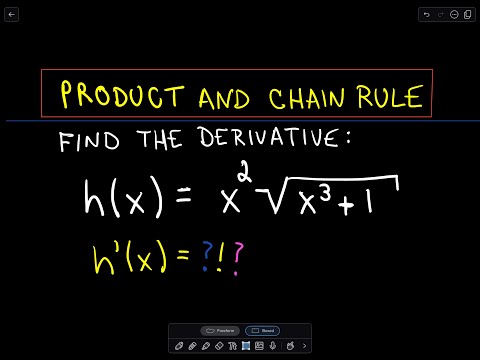
The problem he looks at is: h(x)=x2x3+1h(x)=x^2\sqrt{x^3+1} Let's rewrite this so there's no square root symbol. h(x)=x2(x3+1)12h(x)=x^2(x^3+1)^{\frac12} So as you might be able to see, we have a chain rule inside a product rule again. h′(x)=(x2)′(x3+1)12+(x2)[(x3+1)12]′=(2x)(x3+1)12+(x2)[12(x3+1)−12(x3+1)′]=2x(x3+1)12+x2[12(x3+1)−12(3x2)]=2x(x3+1)12+32x4(x3+1)−12=x(x3+1)−12[2(x3+1)+32x3]=x[2(x3+1)+32x3](x3+1)12=x[2x3+2+32x3](x3+1)12=x(72x3+2)x3+1\begin{align} h'(x)&=\color{red}{(x^2)'}(x^3+1)^{\frac12}+(x^2)\color{red}{[(x^3+1)^{\frac12}]'}\\ &=(2x)(x^3+1)^{\frac12}+(x^2)[\frac12(x^3+1)^{-\frac12}\color{red}{(x^3+1)'}]\\ &=2x(x^3+1)^{\frac12}+x^2[\frac12(x^3+1)^{-\frac12}(3x^2)]\\ &=2x(x^3+1)^{\frac12}+\frac32x^4(x^3+1)^{-\frac12}\\ &=x(x^3+1)^{-\frac12}[2(x^3+1)+\frac32x^3]\\ &=\frac{x[2(x^3+1)+\frac32x^3]}{(x^3+1)^{\frac12}}\\ &=\frac{x[2x^3+2+\frac32x^3]}{(x^3+1)^{\frac12}}\\ &=\boxed{\frac{x(\frac72x^3+2)}{\sqrt{x^3+1}}} \end{align}

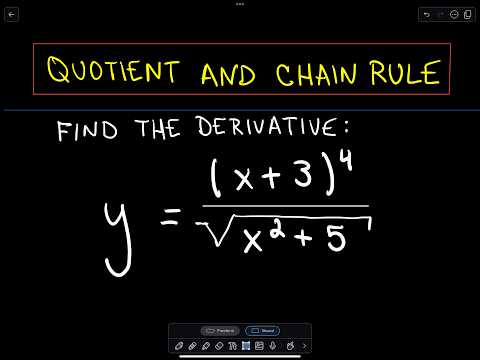
Here's one final example where we need to use both the quotient and chain rule. The problem he looks at is: y=(x+3)4x2+5y=\frac{(x+3)^4}{\sqrt{x^2+5}} As always, rewrite the function to remove the square root symbol. y=(x+3)4(x2+5)12y=\frac{(x+3)^4}{(x^2+5)^{\frac12}} So here we have two chain rules inside a quotient rule. y′=[(x+3)4]′(x2+5)12−(x+3)4[(x2+5)12]′[(x2+5)12]2=[4(x+3)3(x+3)′](x2+5)12−(x+3)4[12(x2+5)−12(x2+5)′]x2+5=[4(x+3)3(1)](x2+5)12−(x+3)4[12(x2+5)−12(2x)]x2+5=4(x+3)3(x2+5)12−x(x+3)4(x2+5)−12x2+5=(x+3)3[4(x2+5)−x(x+3)]x2+5=(x+3)3(4x2+20−x2−3x)(x2+5)(x2+5)12=(x+3)3(3x2−3x+20)(x2+5)32\begin{align} y'&=\frac{\color{red}{[(x+3)^4]'}(x^2+5)^{\frac12}-(x+3)^4\color{red}{[(x^2+5)^{\frac12}]'}}{[(x^2+5)^{\frac12}]^2}\\ &=\frac{[4(x+3)^3\color{red}{(x+3)'}](x^2+5)^{\frac12}-(x+3)^4[\frac12(x^2+5)^{-\frac12}\color{red}{(x^2+5)'}]}{x^2+5}\\ &=\frac{[4(x+3)^3(1)](x^2+5)^{\frac12}-(x+3)^4[\frac12(x^2+5)^{-\frac12}(2x)]}{x^2+5}\\ &=\frac{4(x+3)^3(x^2+5)^{\frac12}-x(x+3)^4(x^2+5)^{-\frac12}}{x^2+5}\\ &=\frac{(x+3)^3[4(x^2+5)-x(x+3)]}{x^2+5}\\ &=\frac{(x+3)^3(4x^2+20-x^2-3x)}{(x^2+5)(x^2+5)^{\frac12}}\\ &=\boxed{\frac{(x+3)^3(3x^2-3x+20)}{(x^2+5)^{\frac32}}}\\ \end{align}

Illustrated · 2 min

(Video) Solving Every Derivative Ever

by PatrickJMT

Okay, maybe it's not EVERY derivative ever but here's a video by patrickJMT going over different derivatives for a whopping 35 minutes.

Let's have a season recap of some formulas before we go in. ddxxn=nxn−1ddxcot⁡x=−csc⁡2xddxk=0ddxsec⁡x=sec⁡xtan⁡xddxsin⁡x=cos⁡xddxex=exddxcos⁡x=−sin⁡xddxax=axln⁡addxtan⁡x=sec⁡2xddxln⁡x=1xddxcsc⁡x=−csc⁡xcot⁡xddxlog⁡ax=1xln⁡a\begin{alignat}{2} & \frac{d}{dx}x^n=nx^{n-1} \quad && \frac{d}{dx}\cot x=-\csc^2 x\\ & \frac{d}{dx}k=0 \quad && \frac{d}{dx}\sec x=\sec x \tan x\\ & \frac{d}{dx}\sin x=\cos x \quad && \frac{d}{dx}e^x=e^x\\ & \frac{d}{dx}\cos x=-\sin x \quad && \frac{d}{dx}a^x=a^x\ln a\\ &\frac{d}{dx}\tan x=\sec^2x \quad && \frac{d}{dx}\ln x=\frac1x\\ &\frac{d}{dx}\csc x=-\csc x\cot x \quad &&\frac{d}{dx}\log_ax=\frac1{x\ln a} \end{alignat}

Also let's recap the product, quotient, and chain rule. [f(x)g(x)]′=f′(x)g(x)+f(x)g′(x)[f(x)g(x)]′=f′(x)g(x)−f(x)g′(x)[g(x)]2[f( g(x) )]′=f′( g(x) )⋅g′(x)\begin{align} [f(x)g(x)]'&=f'(x)g(x)+f(x)g'(x)\\ \bigg[\frac{f(x)}{g(x)}\bigg]'&=\frac{f'(x)g(x)-f(x)g'(x)}{[g(x)]^2}\\ [f(\ g(x)\ )]'&=f'(\ g(x)\ )\cdot g'(x) \end{align}

Problem 1

y=x2+3x+4y′=2x2−1+3(1x1−1)+0=2x+3\begin{align} y&=x^2+3x+4\\ y'&=2x^{2-1}+3(1x^{1-1})+0\\ &=\boxed{2x+3} \end{align}

Problem 2

y=5t−23y′=5(−23t−23−1)=−103t−53=−103t53\begin{align} y&=5t^{-\frac23}\\ y'&=5(-\frac23t^{-\frac23-1})\\ &=-\frac{10}3t^{-\frac53}\\ &=\boxed{-\frac{10}{3t^{\frac53}}} \end{align}

Problem 3

y=3x−1x=3x−1x12=3xx12−1x12=3x12−x−12y′=3(12x−12)−(−12x−32)=32x12+12x32=3x+12x32\begin{align} y&=\frac{3x-1}{\sqrt x}\\ &=\frac{3x-1}{x^{\frac12}}\\ &=\frac{3x}{x^{\frac12}}-\frac{1}{x^{\frac12}}\\ &=3x^{\frac12}-x^{-\frac12}\\ y'&=3(\frac12x^{-\frac12})-(-\frac12x^{-\frac32})\\ &=\frac{3}{2x^{\frac12}}+\frac{1}{2x^{\frac32}}\\ &=\boxed{\frac{3x+1}{2x^{\frac32}}} \end{align}

Problem 4

y=(x+4)(x−4)=x2−4x+4x−16=x2−16y′=2x2−1−0=2x\begin{align} y&=(x+4)(x-4)\\ &=x^2-4x+4x-16\\ &=x^2-16\\ y'&=2x^{2-1}-0\\ &=\boxed{2x} \end{align}

Problem 5

y=x−1x+1=x12−1x12+1y′=(x12−1)′(x12+1)−(x12−1)(x12+1)′(x12+1)2=12x−12(x12+1)−(x12−1)(12x−12)(x12+1)2=12x−12[(x12+1)−(x12−1)](x12+1)2=(x12+1)−(x12−1)2x(x12+1)2=22x(x12+1)2=1x(x12+1)2\begin{align} y&=\frac{\sqrt x-1}{\sqrt x+1}\\ &=\frac{x^{\frac12}-1}{x^{\frac12}+1}\\ y'&=\frac{\color{red}{(x^{\frac12}-1)'}(x^{\frac12}+1)-(x^{\frac12}-1)\color{red}{(x^{\frac12}+1)'}}{(x^{\frac12}+1)^2}\\ &=\frac{\frac12x^{-\frac12}(x^{\frac12}+1)-(x^{\frac12}-1)(\frac12x^{-\frac12})}{(x^{\frac12}+1)^2}\\ &=\frac{\frac12x^{-\frac12}[(x^{\frac12}+1)-(x^{\frac12}-1)]}{(x^{\frac12}+1)^2}\\ &=\frac{(x^{\frac12}+1)-(x^{\frac12}-1)}{2\sqrt x(x^{\frac12}+1)^2}\\ &=\frac{2}{2\sqrt x(x^{\frac12}+1)^2}\\ &=\boxed{\frac{1}{\sqrt x(x^{\frac12}+1)^2}} \end{align}

Problem 6

y=2x−x⋅xx2=2x−x32x2=2xx2−x32x2=2x−1x12=2x−1−x−12y′=2(−1x−2)−(−12x32)=12x32−2x2\begin{align} y&=\frac{2x-\sqrt{x}\cdot x}{x^2}\\ &=\frac{2x-x^{\frac32}}{x^2}\\ &=\frac{2x}{x^2}-\frac{x^{\frac32}}{x^2}\\ &=\frac{2}{x}-\frac{1}{x^{\frac12}}\\ &=2x^{-1}-x^{-\frac12}\\ y'&=2(-1x^{-2})-(-\frac12x^{\frac32})\\ &=\boxed{\frac{1}{2x^{\frac32}}-\frac{2}{x^2}} \end{align}

Problem 7

y=(sin⁡x)(x12)y′=(sin⁡x)′(x12)+(sin⁡x)(x12)′=(cos⁡x)(x12)+(sin⁡x)(12x−12)=xcos⁡x+sin⁡x2x\begin{align} y&=(\sin x)(x^{\frac12})\\ y'&=\color{red}{(\sin x)'}(x^{\frac12})+(\sin x)\color{red}{(x^{\frac12})'}\\ &=(\cos x)(x^{\frac12})+(\sin x)(\frac12x^{-\frac12})\\ &=\boxed{\sqrt{x}\cos x+\frac{\sin x}{2\sqrt x}} \end{align}

Problem 8

y=(sin⁡x)(cos⁡x)y′=(sin⁡x)′(cos⁡x)+(sin⁡x)(cos⁡x)=(cos⁡x)(cos⁡x)+(sin⁡x)(−sin⁡x)=cos⁡2x−sin⁡2x=cos⁡(2x)\begin{align} y&=(\sin x)(\cos x)\\ y'&=\color{red}{(\sin x)'}(\cos x)+(\sin x)\color{red}{(\cos x)}\\ &=(\cos x)(\cos x)+(\sin x)(-\sin x)\\ &=\cos^2x-\sin^2x\\ &=\boxed{\cos(2x)} \end{align}

Problem 9

y=sin⁡(cos⁡x)y′=cos⁡(cos⁡x)⋅[cos⁡x]′=cos⁡(cos⁡x)⋅(−sin⁡x)=−sin⁡xcos⁡(cos⁡x)\begin{align} y&=\sin(\cos x)\\ y'&=\cos(\cos x)\cdot\color{red}{[\cos x]'}\\ &=\cos(\cos x)\cdot(-\sin x)\\ &=\boxed{-\sin x\cos(\cos x)} \end{align}

Problem 10

y=sec⁡[(1+x2)12]y′=sec⁡[(1+x2)12]⋅tan⁡[(1+x2)12]⋅[(1+x2)12]′=sec⁡[(1+x2)12]⋅tan⁡[(1+x2)12]⋅12(1+x2)−12⋅(1+x2)′=sec⁡[(1+x2)12]⋅tan⁡[(1+x2)12]⋅12(1+x2)−12⋅(2x)=xsec⁡[(1+x2)12]tan⁡[(1+x2)12]1+x2\begin{align} y&=\sec[(1+x^2)^{\frac12}]\\ y'&=\sec[(1+x^2)^{\frac12}]\cdot\tan[(1+x^2)^{\frac12}]\cdot\color{red}{[(1+x^2)^{\frac12}]'}\\ &=\sec[(1+x^2)^{\frac12}]\cdot\tan[(1+x^2)^{\frac12}]\cdot\frac12(1+x^2)^{-\frac12}\cdot\color{red}{(1+x^2)'}\\ &=\sec[(1+x^2)^{\frac12}]\cdot\tan[(1+x^2)^{\frac12}]\cdot\frac12(1+x^2)^{-\frac12}\cdot(2x)\\ &=\boxed{\frac{x\sec[(1+x^2)^{\frac12}]\tan[(1+x^2)^{\frac12}]}{\sqrt{1+x^2}}} \end{align}

Problem 11

y=tan⁡2[sin⁡(θ3)]y′=2tan⁡[sin⁡(θ3)]⋅[ tan⁡[sin⁡(θ3)] ]′=2tan⁡[sin⁡(θ3)]⋅sec⁡2[sin⁡(θ3)]⋅[sin⁡(θ3)]′=2tan⁡[sin⁡(θ3)]⋅sec⁡2[sin⁡(θ3)]⋅cos⁡(θ3)⋅(θ3)′=2tan⁡[sin⁡(θ3)]⋅sec⁡2[sin⁡(θ3)]⋅cos⁡(θ3)⋅3θ2=6θ2tan⁡[sin⁡(θ3)]sec⁡2[sin⁡(θ3)]cos⁡(θ3)\begin{align} y&=\tan^2[\sin(\theta^3)]\\ y'&=2\tan[\sin(\theta^3)]\cdot\color{red}{[\ \tan[\sin(\theta^3)]\ ]'}\\ &=2\tan[\sin(\theta^3)]\cdot\sec^2[\sin(\theta^3)]\cdot\color{red}{[\sin(\theta^3)]'}\\ &=2\tan[\sin(\theta^3)]\cdot\sec^2[\sin(\theta^3)]\cdot\cos(\theta^3)\cdot\color{red}{(\theta^3)'}\\ &=2\tan[\sin(\theta^3)]\cdot\sec^2[\sin(\theta^3)]\cdot\cos(\theta^3)\cdot3\theta^2\\ &=\boxed{6\theta^2\tan[\sin(\theta^3)]\sec^2[\sin(\theta^3)]\cos(\theta^3)} \end{align}

Problem 12

y=xsin⁡(3x−1)y′=(x)′[sin⁡(3x−1)]+(x)[sin⁡(3x−1)]′=(1)sin⁡(3x−1)+(x)cos⁡(3x−1)⋅(3x−1)′=sin⁡(3x−1)+(x)cos⁡(3x−1)⋅3(−1x−2)=sin⁡(3x−1)−3xcos⁡(3x−1)x2=sin⁡(3x)−3cos⁡(3x)x=xsin⁡(3x)−3cos⁡(3x)x\begin{align} y&=x\sin(3x^{-1})\\ y'&=\color{red}{(x)'}[\sin(3x^{-1})]+(x)\color{red}{[\sin(3x^{-1})]'}\\ &=(1)\sin(3x^{-1})+(x)\cos(3x^{-1})\cdot\color{red}{(3x^{-1})'}\\ &=\sin(3x^{-1})+(x)\cos(3x^{-1})\cdot3(-1x^{-2})\\\\ &=\sin(3x^{-1})-\frac{3x\cos(3x^{-1})}{x^{2}}\\ &=\sin(\frac3x)-\frac{3\cos(\frac3x)}{x}\\ &=\boxed{\frac{x\sin(\frac3x)-3\cos(\frac3x)}{x}} \end{align}

Problem 13

y=(x3+4)2(x2+1)4y′=[(x3+4)2]′(x2+1)4−(x3+4)2[(x2+1)4]′[(x2+1)4]2=2(x3+4)(x3+4)′(x2+1)4−4(x3+4)2(x2+1)3(x2+1)′(x2+1)8=6x2(x3+4)(x2+1)4−8x(x3+4)2(x2+1)3(x2+1)8=6x2(x3+4)(x2+1)4−8x(x3+4)2(x2+1)3(x2+1)8=2x(x3+4)(x2+1)3[3x(x2+1)−4(x3+4)](x2+1)8=2x(x3+4)[3x(x2+1)−4(x3+4)](x2+1)5=2x(x3+4)[(3x3+3x)−(4x3+16)](x2+1)5=2x(x3+4)(−x3+3x−16)(x2+1)5\begin{align} y&=\frac{(x^3+4)^2}{(x^2+1)^4}\\ y'&=\frac{\color{red}{[(x^3+4)^2]'}(x^2+1)^4-(x^3+4)^2\color{red}{[(x^2+1)^4]'}}{[(x^2+1)^4]^2}\\ &=\frac{2(x^3+4)\color{red}{(x^3+4)'}(x^2+1)^4-4(x^3+4)^2(x^2+1)^3\color{red}{(x^2+1)'}}{(x^2+1)^8}\\ &=\frac{6x^2(x^3+4)(x^2+1)^4-8x(x^3+4)^2(x^2+1)^3}{(x^2+1)^8}\\ &=\frac{6x^2(x^3+4)(x^2+1)^4-8x(x^3+4)^2(x^2+1)^3}{(x^2+1)^8}\\ &=\frac{2x(x^3+4)(x^2+1)^3[3x(x^2+1)-4(x^3+4)]}{(x^2+1)^8}\\ &=\frac{2x(x^3+4)[3x(x^2+1)-4(x^3+4)]}{(x^2+1)^5}\\ &=\frac{2x(x^3+4)[(3x^3+3x)-(4x^3+16)]}{(x^2+1)^5}\\ &=\boxed{\frac{2x(x^3+4)(-x^3+3x-16)}{(x^2+1)^5}} \end{align}

Problem 14

y=ln⁡(x)+x3y′=1x+3x2=3x3+1x\begin{align} y&=\ln(x)+x^3\\ y'&=\frac1x+3x^2\\ &=\boxed{\frac{3x^3+1}{x}} \end{align}

Problem 15

y=x2exy′=(x2)′ex+x2(ex)′=2xex+x2ex=xex(x+2)\begin{align} y&=x^2e^x\\ y'&=\color{red}{(x^2)'}e^x+x^2\color{red}{(e^x)'}\\ &=2xe^x+x^2e^x\\ &=\boxed{xe^x(x+2)} \end{align}

Problem 16

y=et⋅cos⁡(2t)y′=et⋅cos⁡(2t)⋅[t⋅cos⁡(2t)]′=et⋅cos⁡(2t)⋅[(t)′cos⁡(2t)+t[cos⁡(2t)]′]=et⋅cos⁡(2t)⋅[cos⁡(2t)−tsin⁡(2t)⋅(2t)′]=et⋅cos⁡(2t)⋅[cos⁡(2t)−2tsin⁡(2t)]\begin{align} y&=e^{t\cdot\cos(2t)}\\ y'&=e^{t\cdot\cos(2t)}\cdot\color{red}{[t\cdot\cos(2t)]'}\\ &=e^{t\cdot\cos(2t)}\cdot[\color{red}{(t)'}\cos(2t)+t\color{red}{[\cos(2t)]'}]\\ &=e^{t\cdot\cos(2t)}\cdot[\cos(2t)-t\sin(2t)\cdot\color{red}{(2t)'}]\\ &=\boxed{e^{t\cdot\cos(2t)}\cdot[\cos(2t)-2t\sin(2t)]} \end{align}

Problem 17

y=cos⁡(eπx)y′=−sin⁡(eπx)⋅(eπx)′=−sin⁡(eπx)⋅eπx(πx)′=−πeπxsin⁡(eπx)\begin{align} y&=\cos(e^{\pi x})\\ y'&=-\sin(e^{\pi x})\cdot\color{red}{(e^{\pi x})'}\\ &=-\sin(e^{\pi x})\cdot e^{\pi x}\color{red}{(\pi x)'}\\ &=\boxed{-\pi e^{\pi x}\sin(e^{\pi x})} \end{align}

Problem 18

y=(1+2e3x)12y′=12(1+2e3x)−12⋅(1+2e3x)′=12(1+2e3x)−12⋅2e3x⋅(3x)′=3e3x1+2e3x\begin{align} y&=(1+2e^{3x})^{\frac12}\\ y'&=\frac12(1+2e^{3x})^{-\frac12}\cdot\color{red}{(1+2e^{3x})'}\\ &=\frac12(1+2e^{3x})^{-\frac12}\cdot2e^{3x}\cdot\color{red}{(3x)'}\\ &=\boxed{\frac{3e^{3x}}{\sqrt{1+2e^{3x}}}} \end{align}

Problem 19

y=5−1x=5−x−1y′=5−x−1⋅ln⁡5⋅(−x−1)′=5−x−1⋅ln⁡5⋅(x−2)=ln⁡551xx2\begin{align} y&=5^{-\frac1x}\\ &=5^{-x^{-1}}\\ y'&=5^{-x^{-1}}\cdot\ln5\cdot\color{red}{(-x^{-1})'}\\ &=5^{-x^{-1}}\cdot\ln5\cdot(x^{-2})\\ &=\boxed{\frac{\ln5}{5^{\frac1x}x^2}} \end{align}

Problem 20

y=ln⁡(x4sin⁡2x)y′=1x4sin⁡2x⋅[x4sin⁡2x]′=1x4sin⁡2x⋅[(x4)′sin⁡2x+x4(sin⁡2x)′]=4x3sin⁡2x+2x4sin⁡x⋅(sin⁡x)′x4sin⁡2x=4x3sin⁡2x+2x4sin⁡xcos⁡xx4sin⁡2x=2x3sin⁡x(2sin⁡x+xcos⁡x)x4sin⁡2x=2(2+xcos⁡x)xsin⁡x=4x+2cot⁡x\begin{align} y&=\ln(x^4\sin^2x)\\ y'&=\frac{1}{x^4\sin^2x}\cdot\color{red}{[x^4\sin^2x]'}\\ &=\frac{1}{x^4\sin^2x}\cdot[\color{red}{(x^4)'}\sin^2x+x^4\color{red}{(\sin^2x)'}]\\ &=\frac{4x^3\sin^2x+2x^4\sin x\cdot\color{red}{(\sin x)'}}{x^4\sin^2x}\\ &=\frac{4x^3\sin^2x+2x^4\sin x\cos x}{x^4\sin^2x}\\ &=\frac{2x^3\sin x(2\sin x+x\cos x)}{x^4\sin^2x}\\ &=\frac{2(2+x\cos x)}{x\sin x}\\ &=\boxed{\frac4x+2\cot x} \end{align}

Problem 21

y=ln⁡5x−12x+3=ln⁡(5x−12x+3)12=12[ln⁡(5x−12x+3)]=12[ln⁡(5x−1)−ln⁡(2x+3)]y′=12[15x−1⋅(5x−1)′−12x+3⋅(2x+3)′]=12[55x−1−22x+3]=12[5(2x+3)−2(5x−1)(5x−1)(2x+3)]=12[10x+15−−10x+210x2+13x−3]=12[1710x2+13x−3]=1720x2+26x−6\begin{align} y&=\ln\sqrt{\frac{5x-1}{2x+3}}\\ &=\ln\bigg(\frac{5x-1}{2x+3}\bigg)^{\frac12}\\ &=\frac12\bigg[\ln\bigg(\frac{5x-1}{2x+3}\bigg)\bigg]\\ &=\frac12[\ln(5x-1)-\ln(2x+3)]\\ y'&=\frac12[\frac{1}{5x-1}\cdot\color{red}{(5x-1)'}-\frac{1}{2x+3}\cdot\color{red}{(2x+3)'}]\\ &=\frac12\bigg[\frac{5}{5x-1}-\frac{2}{2x+3}\bigg]\\ &=\frac12\bigg[\frac{5(2x+3)-2(5x-1)}{(5x-1)(2x+3)}\bigg]\\ &=\frac12\bigg[\frac{10x+15--10x+2}{10x^2+13x-3}\bigg]\\ &=\frac12\bigg[\frac{17}{10x^2+13x-3}\bigg]\\ &=\boxed{\frac{17}{20x^2+26x-6}} \end{align}

Problem 22

y=t3−3ty′=3t2−3t⋅ln⁡3=3t2−3tln⁡3\begin{align} y&=t^3-3^t\\ y'&=3t^2-3^t\cdot\ln3\\ &=\boxed{3t^2-3^t\ln3} \end{align}

Problem 23

y=ln⁡(sec⁡x+tan⁡x)y′=1sec⁡x+tan⁡x⋅[sec⁡x+tan⁡x]′=1sec⁡x+tan⁡x⋅[sec⁡x⋅tan⁡x+sec⁡2x]=sec⁡xtan⁡x+sec⁡2xsec⁡x+tan⁡x\begin{align} y&=\ln(\sec x+\tan x)\\ y'&=\frac{1}{\sec x+\tan x}\cdot\color{red}{[\sec x+\tan x]'}\\ &=\frac{1}{\sec x+\tan x}\cdot[\sec x\cdot\tan x+\sec^2x]\\ &=\boxed{\frac{\sec x\tan x+\sec^2x}{\sec x+\tan x}} \end{align}

Problem 24

y=log⁡10(2xx−1)=log⁡10(2x)−log⁡10(x−1)y′=12xln⁡10⋅(2x)′−1(x−1)ln⁡10⋅(x−1)′=22xln⁡10−1(x−1)ln⁡10=1xln⁡10−1(x−1)ln⁡10\begin{align} y&=\log_{10}\bigg(\frac{2x}{x-1}\bigg)\\ &=\log_{10}(2x)-\log_{10}(x-1)\\ y'&=\frac{1}{2x\ln10}\cdot\color{red}{(2x)'}-\frac{1}{(x-1)\ln10}\cdot\color{red}{(x-1)'}\\ &=\frac{2}{2x\ln10}-\frac{1}{(x-1)\ln10}\\ &=\boxed{\frac{1}{x\ln10}-\frac{1}{(x-1)\ln10}} \end{align}

Problem 25

y=ln⁡xx2y′=(ln⁡x)′(x2)−(ln⁡x)(x2)′[x2]2=1x(x2)−2x(ln⁡x)x4=x−2x(ln⁡x)x4=1−2ln⁡xx3\begin{align} y&=\frac{\ln x}{x^2}\\ y'&=\frac{\color{red}{(\ln x)'}(x^2)-(\ln x)\color{red}{(x^2)'}}{[x^2]^2}\\ &=\frac{\frac1x(x^2)-2x(\ln x)}{x^4}\\ &=\frac{x-2x(\ln x)}{x^4}\\\\ &=\boxed{\frac{1-2\ln x}{x^3}} \end{align}

Type a concept, like “slope” or “photosynthesis”.

↑ ↓ to choose · Enter to openSearch explanations and problems