Illustrated · 1 min

+1 contributors

Speeding Up Reactions
Enzymes are biological catalysts. Catalysts help speed up chemical reactions.

Image source: By Sylvia Freeman
But, how exactly do enzymes speed up reactions?
Well, all reactions that are catalyzed by enzymes could happen without the help of enzymes (meaning that the reaction is spontaneous). The process would just go very, very slowly.
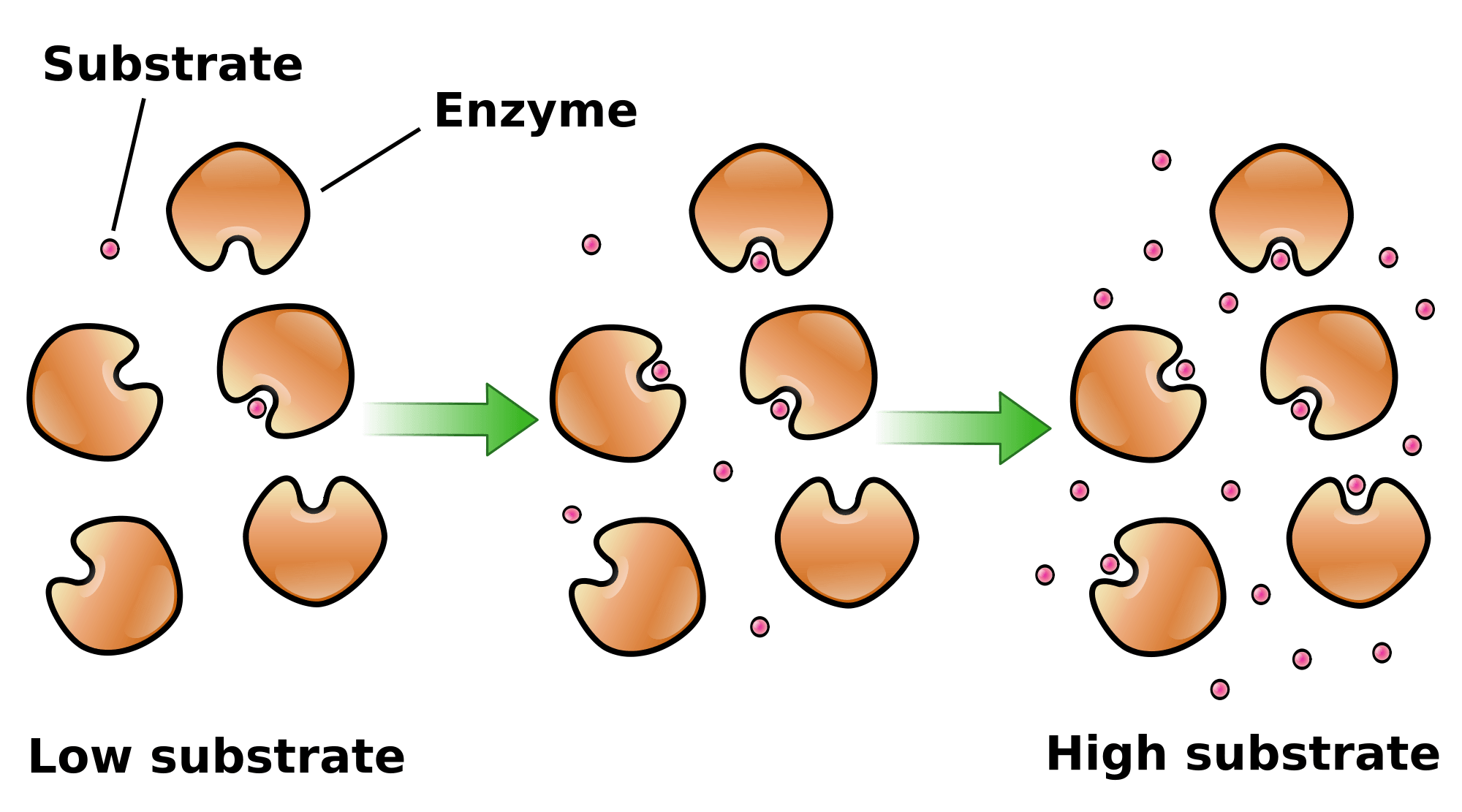
Imagine a reaction involving one compound molecule breaking apart into two smaller molecules. A specific example of this is the dimer sugar lactose being broken down into its component monomer sugars, glucose and galactose (don't worry too much about all these names). Eventually lactose would break down, but it might take hundreds of years. Remember that in a cell, molecules are just floating around, bumping into each other. For a reaction to happen, the starting molecule(s) have to collide in just the right way. Enzymes help by putting the substrate(s) in the right position to react.
Like all catalysts, enzymes increase the rate of chemical reactions by lowering the reaction's activation energy. Activation energy is the energy needed for the reaction to proceed. By definition, all catalysts, including enzymes, do their jobs without getting used up or transformed during the reaction.