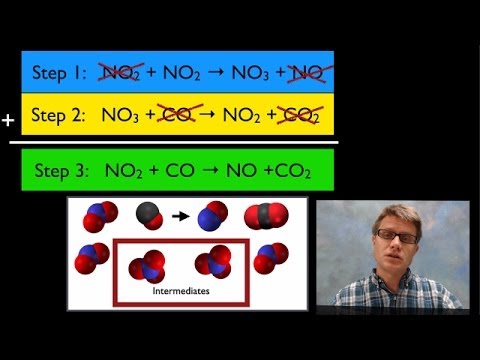
An intermediate is something that is used in the reaction but doesn't show up in the products. This makes it a bit hard to see individually, but it's still a critical part of the reaction. In this video, Mr. Andersen talks about how intermediates are used (like during glycolysis) and how we can figure out what the intermediates are in a chemical equation.
With a balanced chemical equation, we have the reactants and products. We know where we start and where we end. But, the reaction mechanism gives us the whole path. Reaction mechanisms have something unique. They have intermediates! An intermediate is a molecule that forms from an elementary step. But, it is not the end product. So, it becomes a reactant in the next elementary step. When we write the balanced chemical equation, intermediates appear on both sides. So, they cancel.
What are the reaction intermediates? Three molecules are both reactants and products. They are, CH3Cl, CH2Cl2, and CHCl3.
What is the overall reaction? We can treat reaction mechanisms as addition problems. First, add the reactants' side. Then add the products side. Anything that is on both sides is an intermediate. So we cancel them.
How do we know the intermediates? Does a chemist make it up? Thankfully, no. There are experimental methods to discover what intermediates form. Like any scientist, a chemist will propose a hypothesis. Then they'll compare it to the experiment's data. That's the scientific method!
So, what tools does a chemist use? There are some cases where we can stop the reaction at the intermediate. Think about a two-step energy diagram. The intermediate is in the well between the two hills. The difference between the well and the second peak is the second activation energy. So, if we lower the system'stemperature, we can stop the reaction. For example, we could flash freeze a system. If we cool it below the second activation energy, the reaction stops. Unfortunately, we can't freeze every chemical reaction. Even when we can, it's easier said than done.
Another option is to add a reactant that only reacts with the intermediate. We create a competing reaction. The secondary reactant will form a unique product. If we can detect that product, we know the intermediate was one of the reactants. Sometimes, the new product produces a physical change. For example, it might generate a bright color. Other times, you have to detect the new product with spectroscopy. In undergraduate chemistry, this is the most common tool. But again, it is easier said than done.
The most advanced techniques use spectroscopy. For example, some instruments contain a reaction vessel. The container sits within the spectroscope. So, as the reaction occurs, it's hit by light. Different wavelengths of light measure different things. A detector detects how the light is absorbed, emitted, or defracted. It produces a spectrum. During the reaction, the recorded spectrum changes. The computer analyzes it to determine the intermediates. Spectroscopy is the best technique. But, the instruments are expensive! Many cost hundreds of thousands of dollars. So, only specialized labs have them.
Difference between Intermediates and Transition States
Many people confuse intermediates and transition states. But, there's is a big difference! Recall an energy diagram. The transition state occurs at the peak of the hills. We've reached the activation energy. So, we have an activated complex. An activated complex means that the bonds are in the process of breaking and forming. The bonds are half-broken and half-formed. So, a transition state has high energy. But, an intermediate is a complete molecule or ion. It is reactive. So it will continue along the reaction pathway. But, it has fully formed bonds. Because the bonds have finished breaking and reforming, it has less energy. So, the intermediates are the energy diagram's wells.