Video

(Video) Chemistry 7.8 Real vs Ideal Gas
by IsaacsTEACH

In this video, you will learn why gases do not always behave like how we expect them to. In particular, real gases behave differently when they are under high pressure or low temperature.

Before this, knowSTP (Standard Temperature and Pressure) — Definition & Application
Video
by IsaacsTEACH
In this video, you will learn why gases do not always behave like how we expect them to. In particular, real gases behave differently when they are under high pressure or low temperature.
Read · 5 min
Have you ever had a day where everything was perfect? Did you get an A on a difficult test without studying? Or maybe, it was your birthday, and you got the perfect gift! Unfortunately, everyone also has days when life is hard. Sadly, this topic is the chemistry equivalent of a hard day.
So far, as we've studied the gas laws, we've assumed we've had an ideal gas. For the most part, it's an excellent assumption. Most gases will behave ideally at the temperatures and pressure we've used. However, there are conditions where a gas stop behaving ideally. We call them real gases. The real gases disobey our most cherished assumption.
Let's remind ourselves of the ideal gas assumptions. An ideal gas is a gas that obeys the kinetic molecular theory (KMT). Let's review the KMT's assumptions.
We can ignore a gas's volume. The space between gas molecules is expansive. So, their size is inconsequential.
Gases do not exert forces. There is a lot of space between gas molecules. So, we assume minimal Van der Waal's forces.
Gases move in straight lines. They only change direction from collisions with other gas particles or the container.
Gas collisions are elastic. So, the total kinetic energy is conserved. Each particle may have more or less. But, the total is constant. Inelastic collisions only conserve momentum.
A gas's average kinetic energy is proportional to its kelvin temperature.
Let's look at when KMT's assumptions no longer work.
First, what happens if we compress the system's volume? Our container compresses. So, its volume becomes smaller. According to Boyle's law, as our volume decreases, the gas pressure increases. The increase in pressure forces the gas molecules together. So, there is very little empty space between them. Suddenly the gas's volume takes up much of the container's volume. So, assumption one becomes invalid.
We must also consider phase changes. Think about a phase diagram. As the pressure increases, the gas condenses. For condensation to happen, there must be an attraction. The gas molecules undergo electrostatic interactions. That violates assumption three! So, the ideal gas law breaks down near a phase boundary.
What happens as we approach absolute zero? According to Charles' law, the gas's volume would become zero. At absolute zero (), all motion stops. But, the individual particles still have a volume. So, assumption one breaks down.
At low temperatures, gases have less kinetic energy. So, the particles experience dispersion forces. When two particles pass, they will attract. The attraction moves them together. But, their path has curved. They don't move in a straight line. So, there are fewer collisions with the container. The effect is more prominent for polar molecules with dipole interactions. The result is reduced pressure. So, at low temperatures, gases disobey assumptions two and three.
We have two conditions that stop ideal gas behavior: high pressure or low temperature. In either situation, the gas will not behave ideally.
The ideal gas law breaks down at high pressures or low temperatures. You may wonder if we can correct it? Physical chemist Johannes Deidrik Van der Waal's wondered the same thing. In 1873, he proposed an updated form of the ideal gas law: . Notice that both the pressure and volume terms are adjusted.
First, let's study the volume term. Van der Waal introduced . is the volume per one mole of gas. We multiply by the moles to find the gas's total volume. Next, we subtract the container's and gas's volumes. Now we have the space that's available for the gas to move. Notice, the result is a smaller volume than the ideal gas law.
Let's look at the pressure term. To compensate for molecular attraction, Van der Waal created . The attractive force causes a gas's path to curve. So, the pressure is less than ideal. We add the term to the measured pressure. The added pressure compensates for the decreased pressure caused by the attraction.
Van der Waal assumed that the gas does not interact with its container. We know this isn't true because of adhesion. Later, other chemists figured out how to make this adjustment.
For a mixture of gases, Dalton's law no longer works. Each type of gas experiences electrostatic interactions with the other types of gas. So, we find the and values for the total mixture. Next, we can use Van der Waal's equation to calculate , , , or for the mixture.
The equation accurately describes experimental results near the critical temperatures.
It is more accurate than the ideal gas law at lower pressures and temperatures.
It does not accurately predict the phase boundaries. Remember, the phase boundary occurs at the liquid-vapor equilibrium. Van der Waal's equation is only for gases. So, adding a liquid causes changes the equation cannot predict.
How do we know if a gas will be real or ideal? We have to calculate the compressibility factor (). The formula for the compressibility factor is .
When , the gas behaves ideally.
When , the repulsive forces cause a deviation from ideal behavior. What is causing the repulsion? The pressure is high enough that the electron clouds overlap. However, the temperature is also so large that the gas particles move past each other. They do not attract. The repulsion causes the particles to take up more volume than expected.
When , attraction causes the deviation from ideal behavior. What causes the attractive force? The temperature is low. So, the gas's kinetic energy cannot overcome the electrostatic interactions. So, attraction's effects decrease with increasing temperature increases.
Illustrated · 1 min
Real vs. Ideal Gases: Differences Between Real and Ideal Gases
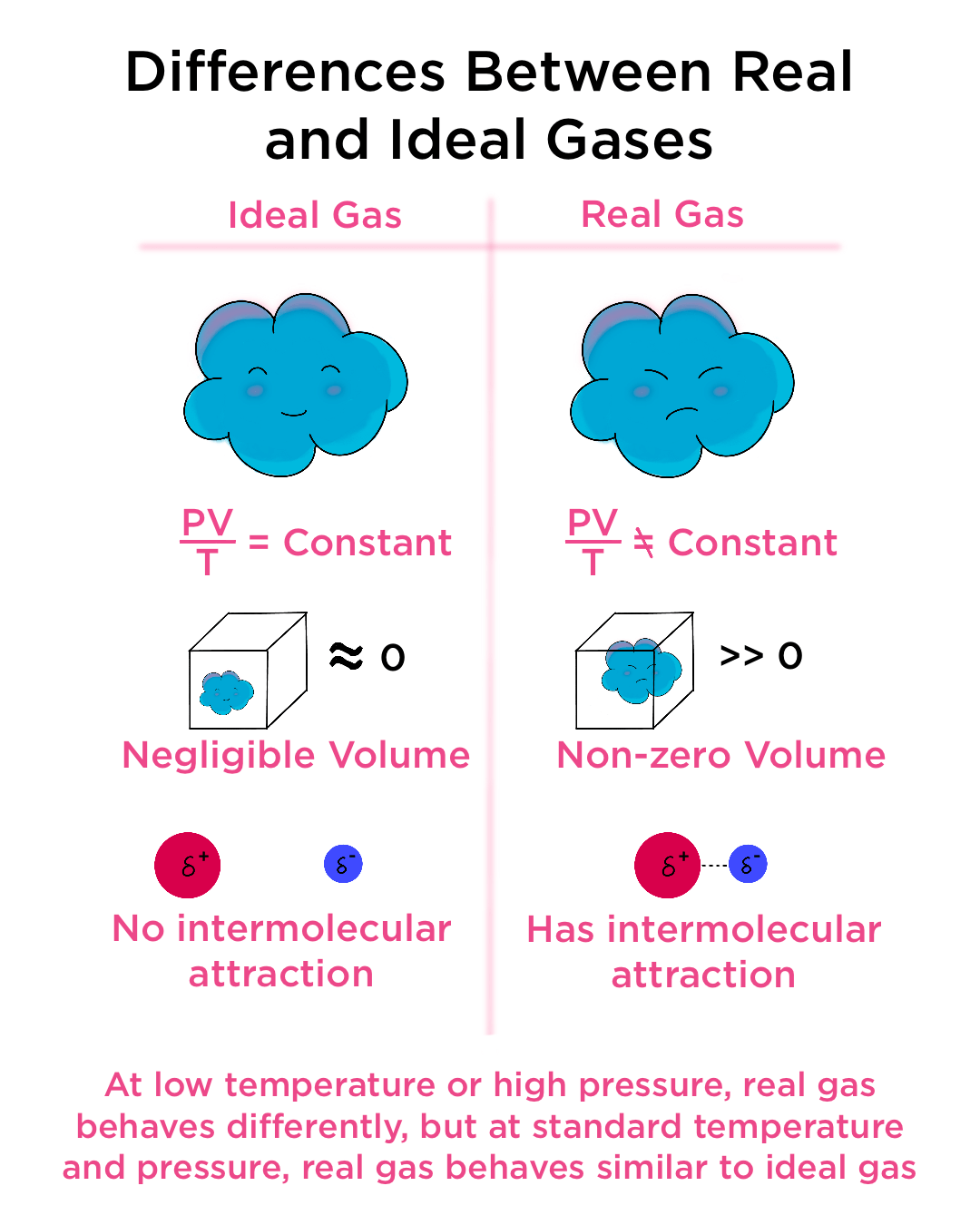
Image Source: Leo Dong