Remainder Theorem for Polynomials

Before this, knowIntro to Rational Expressions

Read · 2 min

The Remainder Theorem is related to an algorithm for polynomial division of varying degrees and finding the quotients and remainders. This algorithm is very much like the long division, the kind they teach you in school.

Let's start by going through an example step by step. We need a dividend (the polynomial being divided) and a divisor (the polynomial going into the dividend). We will be diving a polynomial by a linear polynomial.


x+3x + 3 | 4x3+x2+2x−64x^3 + x^2 + 2x - 6


In the setup above we have our dividend, 4x3+x2+2x−64x^3 + x^2 + 2x - 6, and our divisor, x+3x + 3.

Step One

The first step is to find how many times the divisor can go into the first two terms of the dividend, in this case 4x24x^2 times, and scale that divisor by that number of times.


x+3x + 3 | 4x3+x2+2x−64x^3 + x^2 + 2x - 6

−−−--- 4x3+12x24x^3 + 12x^2


Above we have our divisor, scaled by 4x24x^2, under the dividend, and now we are ready to subtract them.

Step Two

For the second step, we'll subtract the scaled divisor from the dividend, and put the divisor's scale, 4x24x^2, above the top bar as the first term of the quotient.

4x24x^2


x+3x + 3 | 4x3+x2+2x−64x^3 + x^2 + 2x - 6

−−−--- 4x3+12x24x^3 + 12x^2


−−−−−−-------11x2+2x−611x^2 + 2x - 6

Step Three

Now, we simply repeat the process for the third step.

4x2−11x4x^2 - 11x


x+3x + 3 | 4x3+x2+2x−64x^3 + x^2 + 2x - 6

−−−--- 4x3+12x24x^3 + 12x^2


−−−−−−-------11x2+2x−611x^2 + 2x - 6

−−−−−−-------11x2−33x11x^2 - 33x


−−−−−−−−−---------35x−635x - 6

We are not done at all. The polynomial 35x−635x - 6 that we obtained so far is able to be divided further! There are actually two more steps, because this dividing we have learned is not the actual Theorem, the theorem is an expression with the polynomials we find.

Step Four

So therefore this is our fourth step:

4x2−11x+354x^2 - 11x + 35


x+3x + 3 | 4x3+x2+2x−64x^3 + x^2 + 2x - 6

−−−--- 4x3+12x24x^3 + 12x^2


−−−−−−-------11x2+2x−611x^2 + 2x - 6

−−−−−−-------11x2+2x−611x^2 + 2x - 6


−−−−−−−−−--------- 35x−635x - 6

−−−−−−−−−--------- 35x2+10535x^2 + 105


−−−−−−−−−−−−-------------111111

Fifth Step

Now here we have to apply the Theorem, as the fifth and final step. We can call the polynomial at the very top of the long division problem, 4x2−11x+354x^2 - 11x + 35, qq (the quotient), the number (or sometimes polynomial) at the bottom (−111-111) rr for the remainder, and the divisor x+3x + 3 dd.

The theorem for the final quotient including the remainder part would then be qq + rr/dd.

Switching those variables in for the correct values from the example, we get:

4x2−11x+35+(−111)/(x+3)4x^2 - 11x + 35 + ( - 111)/(x + 3).

This is our answer.

You may see this theorem qq + rr/dd as quite unfamiliar, but you can try it with a simple arithmetic division problem such as 108/7108/7, and you'll recognize this.

Remember the Remainder Theorem expression ~ and be careful with polynomial long division ~ so good luck!

Looking Further

In future lessons, you will learn about Factor Theorem, which is an extension of this Theorem.
Check what you really know

If you can solve a contest problem with this idea, you know it well. If not, you know exactly what to review. These are real problems from the AMC 12 and AIME, the national math competitions for middle and high school students, each with a worked solution on LIVE by Po-Shen Loh.

Illustrated · 1 min

The Remainder Theorem

When dealing with polynomial factors, we have this new Theorem in our toolbelt!

Remainder Theorem
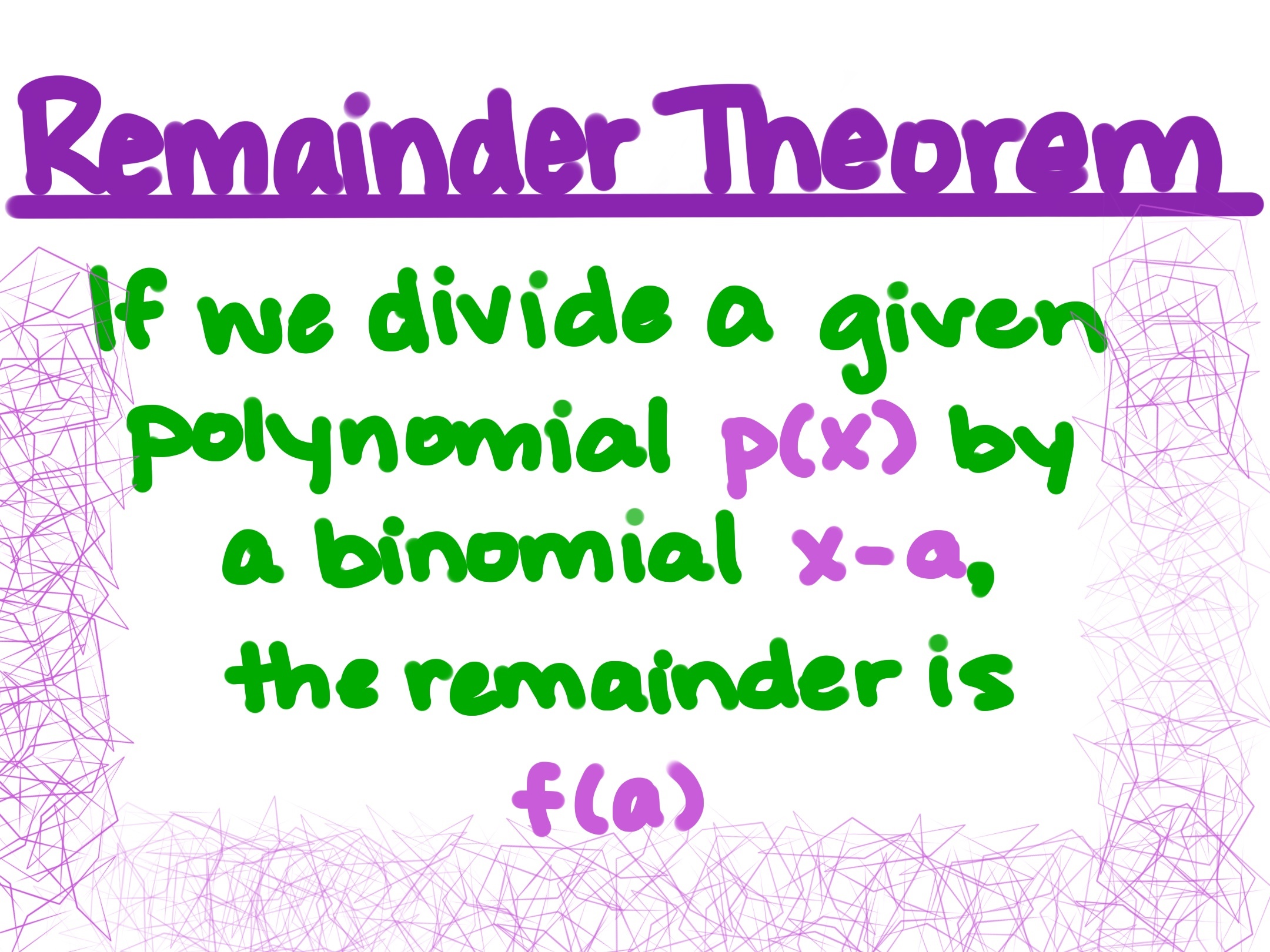
If we divide a given polynomial p(x) by a binomial x-a, the remainder is f(a)

Image source: by Anusha Rahman

If we are given a polynomial p(x)p(x), and we divide this polynomial by a binomial, x−ax-a, then the remainder after polynomial division will be f(a)f(a).

Video · + 1 min read

(Video) The Remainder Theorem

by Brian McLogan

In this video by Brian McLogan, you will learn about the Remainder Theorem and how to apply it.

Summary

If f(x) is divided by x-k, then the remainder is r=f(k)\text{If f(x) is divided by x-k, then the remainder is r=f(k)}

Example #1

f(x)=5x2+7x−24f(x) = 5x^2 + 7x -24

We are given a factor (x+3)(x+3), so let's first use synthetic division to divide the polynomial by this factor. If we do that, we get the second factor (5x−8)(5x-8) with a remainder of 00. What's cool about this Theorem is that we can also say that if k=−3k=-3, then we can evaluate the polynomial at x=−3x=-3.

f(−3)=5(−3)2+7(−3)−24=5(9)−21−24=45−21−24=0\begin{align} f(-3) &= 5(-3)^2 + 7(-3) -24 \\ &= 5(9) - 21 - 24 \\ &= 45 - 21 - 24 \\ &= 0 \end{align}

Basically, whether we divide the polynomial by the factor and get a remainder of 00, or we evaluate the polynomial for that same zero, we will also get 00.

If we want to see if a factor works, then rather than dividing, we use this Theorem to evaluate at a zero.

Example #2

Given the same polynomial, f(x)=5x2+7x−24f(x) = 5x^2 + 7x -24, see if (x−2)(x-2) is a factor. Try this example on your own first, then watch the video to check your work!

Type a concept, like “slope” or “photosynthesis”.

↑ ↓ to choose · Enter to openSearch explanations and problems

