
Illustrated · 3 min
There are many DNA repair mechanisms. Some are proofreading exonucleases, base excision repair, nucleotide excision repair, homologous recombination, direct DNA repair, nonhomologous end joining, the SOS response, translesion synthesis, and mismatch repair. The discoverers of 3 of these mechanisms won the Nobel Prize in Chemistry in 2015.
Translesion synthesis is probably the worst repair mechanism known to man. It is used when the cell has no idea how to repair the damage or is too busy fixing other sites. The enzyme, a translesion polymerase, pretty much just guesses random bases and synthesizes them across the damaged DNA. This gives the cell a fighting chance in very desperate situations. It also can introduce errors that will kill the cell.
Nonhomologus end joining (NHEJ) and Homologous recombination are processes used to repair double stranded breaks. These can occur from a lot of random processes but x-ray radiation is a common one. They are also being used in genetic engineering and synthetic biology to introduce new segments of DNA.
DNA polymerase, the enzyme responsible for synthesizing DNA during replication has both an active and passive DNA repair mechanism.
Passively, it will only catalyze the bonding of nucleotides with a specific major groove hydrogen bonding pattern to the DNA template. If it doesn't match, it will either not catalyze the reaction or the nucleotide will have already floated through the active site of the DNA polymerase. This limits the error of the polymerase to about mistake in every base pairs synthesized. Most of the errors that slip through are tautomerized versions of other DNA nucleotides.
DNA polymerase also has an active subunit that has "proofreads" the DNA and gets rid of mismatches. This is referred to as proofreading exonuclease activity. It runs in the opposite direction of DNA replication (so 3' to 5') in replicative DNA polymerase. The DNA polymerase involved in Okazaki fragment repair has both 3' to 5' and 5 to 3' proofreading exonuclease activity. Once it detects and removes a mismatch, the DNA polymerase resynthesizes over that region and continues replicating the DNA. This reduces the error rate to error in base pairs synthesized.
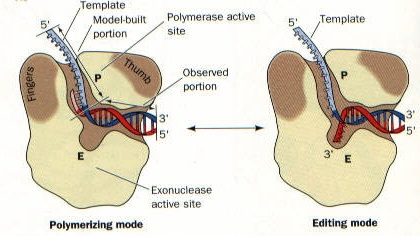
DNA Polymerase
Mismatch repair occurs after the DNA has been replicated/synthesized. It finds the mismatches by utilizing an protein that transiently bends the DNA. When it finds a point that bends more than normal, the protein stays there and waits for other proteins to assemble and arrive. The biggest challenge in mismatch repair is distinguishing which strand is the one that was wrong because it is not being actively synthesized. This is done by the proteins by comparing the methylation states of the DNA or looking at the directionality of a nearby DNA sliding clamp on the DNA. Once it has identified the wrong strand, it removes the incorrect nucleotide and a few others before resynthesizing over the gap.
Direct DNA repair is a type of repair mechanism where no bonds are physically broken. One example is photolyase which repairs pyrimidine dimers created by UV light. Other examples include the repair of O6-Methylguanine. Here is the structure of one specific photolyase.
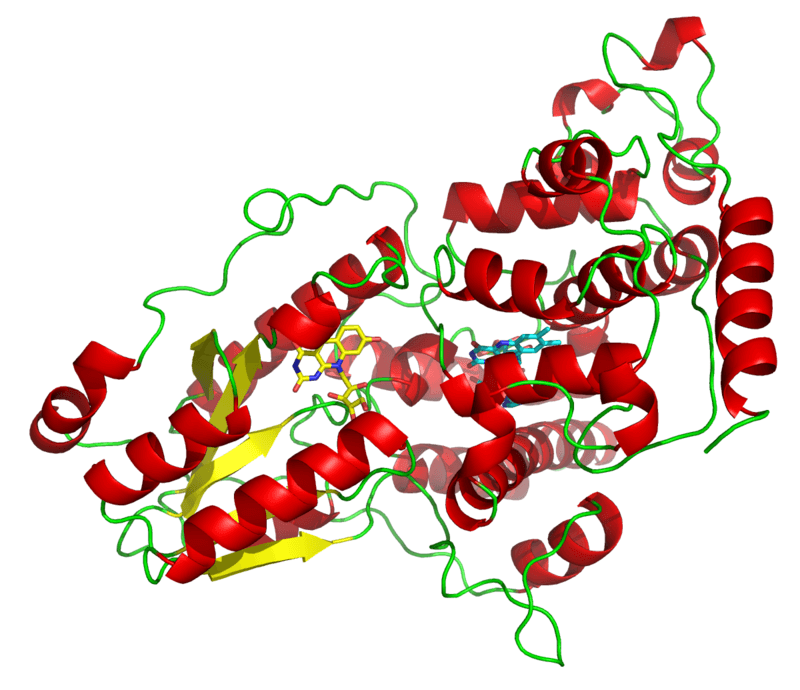
Photolysase
In Base excision repair, proteins called glycosylases first remove damaged bases (i.e. deaminated bases, RNA bases, or others). Then a endonuclease specific to places on the DNA where bases are missing (AP sites) cuts apart the phosphodiester bond. Then, an exonuclease removes the phosphodiester backbone and polymerase resynthesizes across the DNA.
Nucleotide excision repair acts at sites of bulky DNA modifications like pyrimidine dimers or an adenine paired to a guanine. It pretty much follows the same procedure as base excision repair (Recognition, Excision, DNA Synthesis, Ligation), but it works on areas with larger lesions.
Transcription Coupled Repair also occurs in cells but it is not very well understood. It is sometimes grouped into nucleotide excision repair.
There are also other passive methods for mutation prevention such as cell cycle checkpoints. One very interesting DNA repair response is the SOS Response in bacteria.


