Repeating Decimal — Definition & Examples

Before this, knowFraction to Decimal — Conversion & Practice

Interactive · 5 questions

Converting Repeating Decimals to Fractions

As with converting a non-repeating (i.e., "normal") decimal to a fraction, there are a few simple steps to follow to convert repeating decimals to fractions.

Think of a repeating decimal like a caterpillar. It's pretty gross looking, you don't really want to touch it, and it's made up of repeating parts. Same thing as a repeating decimal, at least to me.

Then, think of the fraction like a beautiful butterfly. Definitely preferable, much easier to handle. Our job is to get the caterpillar to transform into a butterfly.

Repeating decimal (note the repeating sections of the caterpillar)

Beautiful fraction (butterfly)

Image source: By Clker-Free-Vector-Images CC0, via pixabay.com

Image source: By Shemesh CC0, via publicdomainpictures.net

Let's walk through the steps of this conversion using the repeating decimal below:

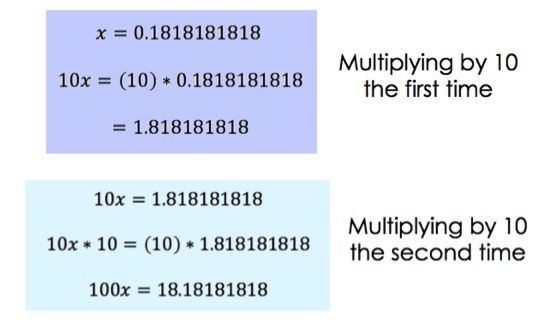
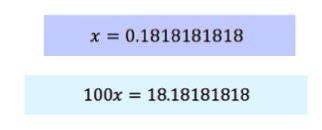
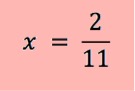
x = 0.18 with 18 repeating

Even though our decimal looks short here, you should think of it like 0.18181818181818181818...0.18181818181818181818.... Don't be fooled.

Step 2: Identify the repeating segment in your decimal.

What is the repeating segment in our decimal?

Choose one answer

Preparing for a math contest?

Working through past problems on one idea at a time is one of the most effective ways to prepare. These are real problems from the AMC 8, AMC 10, AMC 12 and AIME, the national math competitions for middle and high school students, each with a worked solution on LIVE by Po-Shen Loh.

Illustrated · 1 min

Repeating Decimals

We have learned about decimals (or decimal numbers) in general, but what about repeating decimals? Repeating decimals are those which go on forever but have a pattern. They are also called recurring decimals.

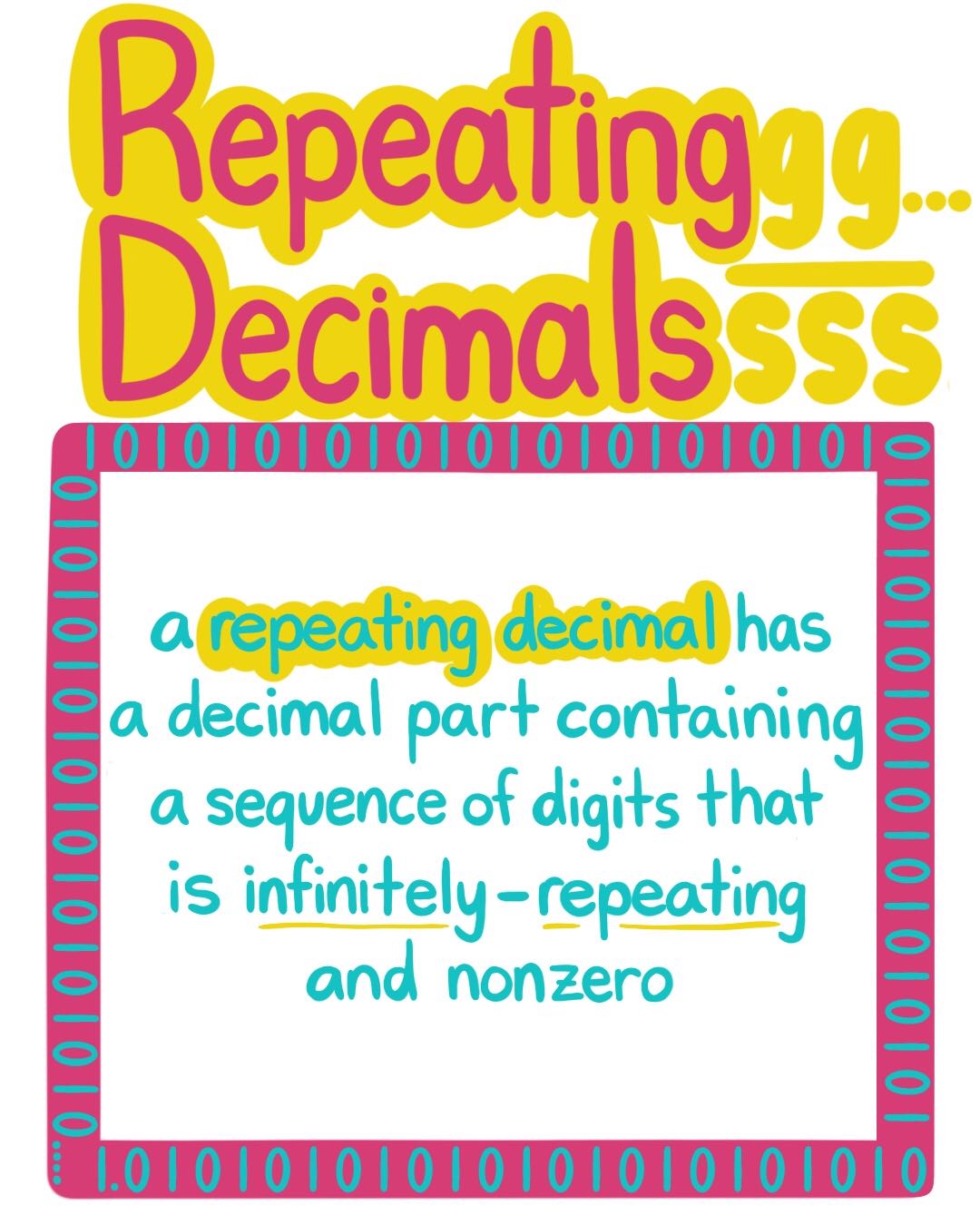
Repeating Decimals: a repeating decimal has a decimal part containing a sequence of digits that is infinitely-repeating and nonzero

Image by Caroline Kulczycky

Examples

Here are some examples of repeating decimals. The part that infinitely repeats is boxed. 1.0101010101010⋯1.\boxed{01}01010101010\cdots 15.183333333333⋯15.18\boxed{3}333333333\cdots −213.233789437894378943⋯-213.233\boxed{78943}7894378943\cdots

Notation

Sometimes, you will see a bar above the infinitely-repeating component of the repeating decimal, signifying that it is infinitely-repeating. This notation makes it clear that you are dealing with a repeating decimal. For example: 1.0101010101010⋯=1.01‾1.\boxed{01}01010101010\cdots = 1.\overline{01} 15.183333333333⋯=15.183ˉ15.18\boxed{3}333333333\cdots = 15.18\bar{3} −213.233789437894378943⋯=−213.23378943‾-213.233\boxed{78943}7894378943\cdots = -213.233\overline{78943}

It's also easier to write the numbers this way. If only calculators always did that.

Terminating Decimals

The following number is not a repeating decimal: 35.9080000000⋯35.908\boxed{0}000000\cdots Notice that the part that infinitely repeats is completely composed of 0s.0\text{s}. We could have also written the number like this: 35.90835.908 In cases like this, the number is referred to as a terminating decimal. Think about it—terminating means ending. Terminating decimals do not go off into infinity...they terminate or end.

Converting Repeating Decimals to Fractions

Believe it or not, repeating decimals are rational numbers. We can convert these to fractions just like any other decimal. Here is an explanation on how to convert repeating decimals to fractions.

Video · + 1 min read

(Video) Converting Repeating Decimals to Fractions

by Art of Problem Solving

Here's a video by the Art of Problem Solving where he teaches you how to turn a repeating decimal into a fraction.

Summary\large{\text{Summary}}

So you've mastered converting decimals into fractions but there's still one type of decimal that won't convert: repeating decimals.

Suppose we have the decimal 0.6ˉ0.\bar{6}. The bar over the 66 tells us that the 66 repeats forever. 0.6ˉ=0.666666666…0.\bar{6}=0.666666666\dots

This can be challenging to work with since we can't really write it down fully. The first step is to set it equal to a variable. This way we can reference it easier. x=0.666666…x=0.666666\dots

Next, we can multiply this by 1010. All that does is move the decimal point over, so we don't actually have to work through multiplying an infinite amount of decimal places. 10x=6.666666…10x=6.666666\dots

Here's the trick! We can subtract these two. This will cancel out any repeating portion of our decimal. 10x=6.666666…−x=0.666666…(10x−x)=(6.66…−0.66… )9x=6\begin{align} 10x&=6.666666\dots\\ -\quad x&=0.666666\dots\\ \hline (10x-x)&=(6.66{\dots}-0.66\dots)\\ 9x&=6 \end{align}

Finally, we just solve for our variable, xx. This involves dividing both sides by 99 to isolate the xx. 9x=6x=69x=23\begin{align} 9x&=6\\ x&=\frac69\\ x&=\boxed{\frac23} \end{align}

What if our decimal is now: 0.36ˉ=0.36363636…0.\bar{36}=0.36363636\dots If do the exact same steps above, it won't work. Instead we need to multiply the decimal by 100100. Why? We need the decimal point to move over so that the repeating portions end up canceling when we subtract.

Multiply by a power of 1010 with zeros equal to the number of digits being repeated.

Since our decimal has two digits being repeated, 3636, we multiply it by a power of ten with two zeros: 100100. 100x=36.363636…x=0.363636…100x=36.363636\dots\\ x=0.363636\dots Now we can follow the steps from before. Subtract these equations. 100x=36.3636…−x=30.3636…(100x−x)=(36.3636…−0.3636… )99x=36\begin{align} 100x&=36.3636\dots\\ -\quad x&=\phantom{3}0.3636\dots\\ \hline (100x-x)&=(36.3636{\dots}-0.3636\dots)\\ 99x&=36 \end{align} Finally, we solve for xx. 99x=36x=3699x=411\begin{align} 99x&=36\\ x&=\frac{36}{99}\\ x&=\boxed{\frac{4}{11}} \end{align}

Type a concept, like “slope” or “photosynthesis”.

↑ ↓ to choose · Enter to openSearch explanations and problems