Reproduce (Asexual and Sexual) — Characteristics of Life

Illustrated · 1 min

What Are Offspring?

All living things reproduce in one way or another. It's part of the life cycle of all organisms. Reproduction is the creation of offspring by a parent or parents. Think of offspring as children (or baby versions of the parents—whatever works for you).

All kinds of parents and offspring are shown, including tigers, plants, cells, and lemurs.

Image source: By Dave Pape [Public domain], via Wikimedia Commons \\ Image source: By Dr U [Public domain], via Wikimedia Commons \\ Image source: By Janice Carr [Public domain], via pixnio.com \\ Image source: By Eric Kilby from Somerville, MA, USA CC BY-SA 2.0, via Wikimedia Commons

Types of Reproduction

There are two types of reproduction:

  1. Sexual reproduction
  2. Asexual reproduction

Let's consider sexual reproduction first:

Sexual reproduction requires two parents of different sexes. The offspring has a combination of the parents' genetic information. Male sex cells (sperm) combine with the female sex cell (egg). These sex cells are also called gametes. The combination of gametes is called fertilization. It occurs in animals, some plants, and a few types of fungi.

Image source: By Hannah Bonville

Now, let's compare this to asexual reproduction:

Asexual reproduction requires one parent and the offspring is a clone of that parent (they have identical DNA). It occurs in some plants, fungi, almost all unicellular organisms (e.g. bacteria), and a few animals (e.g. starfish, anemones). It can happen in two ways: binary fission and budding.

Image source: By D.328 (modified by expii) CC BY-SA 3.0, via Wikimedia Commons \\ Image source: By Dartmouth Electron Microscope Facility, Dartmouth College [Public domain], via Wikimedia Commons

Key Vocabulary:

  1. Organism
  2. Sexual reproduction
  3. Asexual reproduction
  4. Offspring

Interactive · 1 question

Reproduction

Living things share seven important features: they undergo growth and development, reproduce, respond to their environments, are made of cells, maintain homeostasis, inherit traits, and have a metabolism.

Image source: By Chris Packard (modified by expii) CC BY-SA 4.0, via Wikimedia Commons

All living things produce new organisms through reproduction. Two types of reproduction exist: sexual and asexual.

  • Sexual: With another partner, requiring both a male and female sex cell
  • Asexual: A single parent organism reproducing by itself

Sexual Reproduction

Sexual reproduction occurs when offspring is produced by the combination of two parents' genetic information. It is the common method of creating offspring in multicellular organisms. This type of reproduction helps evolution happen faster than asexual reproduction does due to the random combination of the parents' genetic information. Changes in a population, like behavioral isolation, greatly affect this mode of reproduction.

A lovely lemur couple

Image source: By Treehgr at English Wikipedia CC BY-SA 3.0, via Wikimedia Commons

Asexual Reproduction

Asexual reproduction occurs when there is only one parent. This is most common for unicellular organisms. Asexual reproduction can happen through budding (a bud forms on the parent and grows into another organism) or binary fission. Because the offspring is basically a clone of its parent, it takes much longer for evolution to occur in the population.

The odd, wispy-looking hydra can reproduce through budding. It grows a bud that eventually falls off to become a new hydra.

Hydras can reproduce through budding.

Image source: By CNX OpenStax CC BY 4.0, via Wikimedia Commons

On the small scale, different types of living things use a few kinds of cellular division, as shown below. Mitosis and binary fission are types of asexual reproduction, where one parent cell divides into two daughter cells. Meiosis is a kind of sexual reproduction where the genetic information from two parent cells are combined.

There are three common kinds of cellular reproduction. Binary fission is used by prokaryotes and is a type of asexual reproduction, the offspring only has one parent. Mitosis and meiosis are common in eukaryotes. Mitosis requires one parent cell while meiosis involves two parent cells.

Image source: By domdomegg CC BY-SA 4.0, via Wikimedia Commons

Which of the following organisms will most likely use sexual reproduction?

Choose one answer

Interactive · 4 questions

Types of Reproduction

One defining feature of living organisms is their ability to reproduce. Reproduction is the creation of a new living organism whose genetic material is sourced from one or more parent organisms.

There are two kinds of reproduction: asexual and sexual.

Asexual Reproduction

In asexual reproduction, the genetic material comes from one parent. The offspring are genetically identical to that parent. Examples:

  • Fission, when single-celled organisms split evenly into identical offspring. Each offspring is identical to the original. Occurs in bacteria and most other prokaryotes.

  • Budding, where a completely new organism grows out of the side of the parent organism. Occurs in flatworms, starfish, and yeast.

  • Parthenogenesis, where a parent organism that usually reproduces sexually creates offspring using only its own genetic material. Occurs in some lizards, some bees, and some fish.

One cell with two pieces of genetic information divides into two separate cells, each with one piece of genetic information.

Binary fission, where one cell duplicates its genetic material and then splits in two. This is one of the most common forms of asexual reproduction. It is the main form of reproduction for bacteria and most prokaryotes. \\ Image source: By Alex Falk

A flatworm grows its offspring on its back. The offspring then falls off and matures into an adult.

Budding, where the daughter organism grows out of the side of the parent organism, is seen in many organisms including fungi, protists, flatworms, and sea stars. Simple body structures enable this form of reproduction. \\ Image source: By Alex Falk

Sexual Reproduction

In sexual reproduction, two or more (but usually two) parents each contribute genetic material to create offspring through use of their sexual organs. The genetic material of this offspring is a mix of that of both parents. During this process, the genetic material can recombine in new ways. Examples:

  • Sex in animals, which results in sperm cells penetrating an egg cell to create an embryo that will become an offspring animal.

  • Sex in plants, where genetic material (pollen) from one plant mixes with that of another to create offspring plants. Sexual reproduction in plants is called pollination.

Humans and flowers both use sexual reproduction. In the case of flowers, they need some help from bees.

Sexual reproduction requires the donation of genetic material by two participants. The offspring organism is similar, but not identical, to each parent. \\ Image source: By Alex Falk

Chart showing the differences between asexual and sexual reproduction.

Image source: By Alex Falk

Which of these organisms always has the exact same genes as its parent(s)? Select the best answer.

Choose one answer

Video · + 1 min read

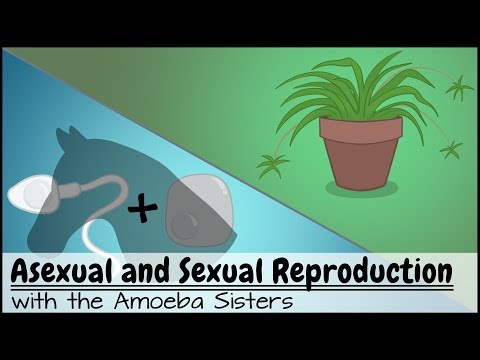
(Video) Asexual and Sexual Reproduction

by Amoeba Sisters

Reproduction is a defining feature of life. Without organisms reproducing, we wouldn't have all the critters we have on Earth now. Non-living things can't possibly reproduce. Rocks aren't having babies.

In this video, the Amoeba Sisters describe different kinds of reproduction and how it produces offspring.


Summary

Asexual reproduction results in offspring that are genetically identical to the parent. This process occurs in some plants and most single-celled organisms. Some examples are binary fission and budding. However, not all plants reproduce asexually. They can also reproduce sexually.

Sexual reproduction involves the combination of gametes. Gametes have half the number of chromosomes as somatic cells. Another name for gametes is haploid cells. So, human gametes have 23 chromosomes (half of the normal chromosome number). When fertilization occurs, we end up with a zygote with 46 chromsomes. The fertilized egg then goes through cell division to make more cells, eventually forming a human. Gametes are made during the process of meiosis.

In asexual populations, reproduction occurs much more quickly, but evolution happens more slowly. In sexual populations, reproduction takes more time, but it also leads to more variety.

Type a concept, like “slope” or “photosynthesis”.

↑ ↓ to choose · Enter to openSearch explanations and problems