Illustrated · 1 min
By Gabi Slizewska

+1 contributors
Contributors


Image source: By Gabi Slizewska

Before this, knowWhat Is Speciation? — Definition & Types
Illustrated · 1 min
Image source: By Gabi Slizewska
Illustrated · 2 min
Imagine that you have many kinds of fish living in a pond. These fish reproduce by laying eggs in the water, then releasing sperm that eventually float through the water, reach the eggs, and fertilize them. The fish all take part in this reproductive process in the late spring.
If the fish all live in the same area, reproduce at the same time, and do so using the same method, how can they remain separate species?
In this case, reproductive isolation occurs because the sperm of one species of fish is only able to latch onto and fertilize the same type of egg. If it were to run into the egg of a different species of fish, the sperm either would not be able to latch onto the egg, or the egg could destroy it during fusion.

Image source: By Mariamichelle CC0, via pixabay.com
Of course, this is a fairly extreme example. In general, reproductively isolated populations are not able to have viable offspring together.
This is also a pre-zygotic reproductive isolation mechanism. That is, the isolation takes place before any sort of zygote can form because the sperm is not able to reach the egg. Another example of pre-zygotic isolation is mechanical isolation. In mechanical isolation, the two organisms are not able to mate because of physical differences in sexual organs. This often happens with insects.

Image source: By Lolame CC0, via pixabay.com
When two different species do mate, they can create a hybrid. Usually, hybrids are sterile and are not able to keep creating more hybrids. They are also usually weaker than the parent species and are selected against by the environment.
Hybrid inviability and sterility are examples of post-zygotic reproductive isolation. The isolation happens after the zygote organism has developed.
: One species splitting into two distinct species
: Types of isolation that lead to the formation of a new species
: A portion of a species undergoes a behavior change and no longer mates with the other part of the species
: A portion of a species becomes separated by geography (like a mountain range) and can no longer mate with the other part of the species
: A portion of a species changes the time they are awake or time they breed and can no longer mate with the other part of the species
Illustrated · 1 min
Dog breeds are not examples of reproductively isolated species. Even though it's a little weird, you can still mate a dachshund and a great dane. Their puppies will look strange, but they will still be able to mate.
Even though the manta rays below look pretty similar, they are all separate species and cannot reproduce. Don't let two species' physical characteristics affect your understanding of species. The only thing that divides two populations into different species is that they can't interbreed and produce fertile offspring.

Image source: By Jaine FRA, Couturier LIE, Weeks SJ, Townsend KA, Bennett MB, et al CC BY 2.5, via Wikimedia Commons

Image source: By jon hanson from london, UK CC BY-SA 2.0, via Wikimedia Commons
Reproductively isolated populations have separate gene pools. They cannot mix their genes, so they will experience genetic drift and natural selection as separate units. A mutation that occurs in one gene pool will not be transferred over to the other population. This lack of gene flow will cause the two populations to evolve separately, eventually producing organisms that act and look unique.
Video
by squareman177
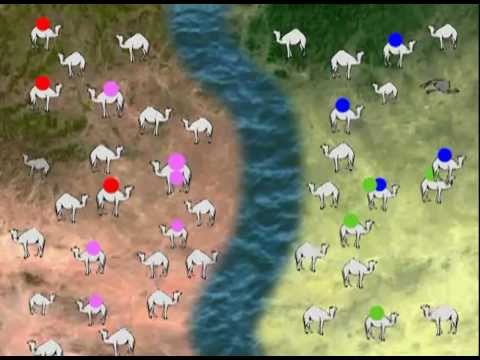
Speciation occurs after two populations have become reproductively isolated. This is when the members of two different populations can no longer interbreed and produce viable and fertile offspring. In this video, squareman177 explains how this all works.


