Illustrated · 1 min
By Gabi Slizewska

+1 contributors
Contributors


Image source: By Gabi Slizewska

Before this, knowWhat Is Transcription? (Biology) — Definition & Process
Illustrated · 1 min
Image source: By Gabi Slizewska
Illustrated · 1 min
RNA polymerase is the enzyme responsible for transcribing DNA into RNA. This is the first step of gene expression. When a cell wants to produce a specific protein, it must first call over this enzyme to the section of DNA that contains the gene for the protein.
The polymerase knows where to attach to the DNA molecule because the DNA contains segments called promoters. Promoters are where transcription starts. In eukaryotic organisms, the promoter region is called the TATA box.
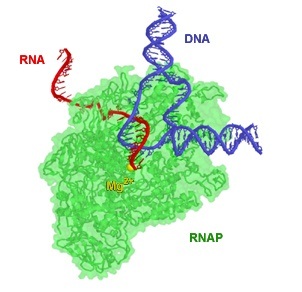
Image source: By Abbondanzieri on the English Wikipedia [Public domain], via Wikimedia Commons
The complex produces a complementary RNA strand. This type of RNA is called messenger RNA or mRNA. Remember that RNA contains the base uracil instead of thymine. So, if the parent strand has ATTTACGAG, the mRNA strand will be UAAAUGCUC.
DNA is double-stranded, but during transcription, only one strand is transcribed. The strand that contains the correct promoter is called the antisense strand. It is also called the template strand. The other strand is called the sense strand.

Image source: By Dovelike CC BY-SA 3.0, via Wikimedia Commons
If you studied DNA replication already, you might recall another protein complex called DNA polymerase. It is very similar to RNA polymerase. Instead of making a complementary RNA strand, DNA polymerase uses one DNA strand to make a complementary strand of DNA.
After an mRNA strand is made, it is ready to be translated. This is the process in which bases of the mRNA are used to put together a string of amino acids that make up a protein.
Video
by CrashCourse

RNA polymerase is the enzyme that assists with transcription. It takes one strand of DNA and uses it as a blueprint for a strand of RNA. Transcription begins at a spot on the DNA called a promoter, which has a specific base sequence.
: How complementary RNA molecules are produced by copying part of the DNA sequence
: The enzyme that separates the strands of DNA during transcription and creates a complementary piece of RNA
: Parts of the DNA sequence that are not used to carry genetic information
: The DNA sequences that code for proteins
Illustrated · 1 min
RNA polymerase is one of the most crucial enzymes for life to exist. It uses one type of nucleic acid to make another type. It's responsible for the first step of the Central Dogma. The Central Dogma is considered the general passage of information through a cell. It states: DNA RNA Protein.
This protein complex is able to attach to a specific area of DNA by searching for a promoter region. Promoter DNA is a segment with a specific nucleotide sequence. Although promoter regions vary between organisms, a common promoter sequence is known as the TATA Box, named after the sequence of nucleotides.
DNA has a double helix structure. This means that it is composed of two complementary strands of DNA. When talking about transcription, these two strands can be labeled as either the Coding Strand or the Template Strand. In order to synthesize RNA from DNA, RNA polymerase must first unwind these two strands to form a transcription bubble. The coding strand is left mostly untouched during this process. The template strand, however, is used as a template for RNA synthesis.
The polymerase then adds nucleotides to the 3' end of the mRNA molecule which correspond to the nucleotides located on the template strand. For example: every A on the template strand codes for a U on the mRNA strand, T codes for A, C codes for G, and G codes for C. The resulting strand of mRNA will be identical to the coding strand of DNA except every Thymine in DNA is replaced with a Uracil in the RNA molecule.
RNA polymerase then unwinds the RNA from the template strand so that the template strand can go on and rewind with the coding strand and the RNA can exit through a separate channel. Below is a good visual for the overall process of RNA transcription.

Image source: By Calibuon at English Wikibooks [Public domain], via Wikimedia Commons

