
Illustrated · 1 min
To recap, in sequence space, RNA are made up of 4 different nucleotides: Adenine (A), Guanine (G), Uracil (U) and Cytosine (C).
Before we launch into our discussion of RNA secondary structure, let's consider whether RNA is single-stranded or double-stranded. Most of us would have been taught in high school that RNA is single-stranded while DNA is double-stranded. Yet, RNA can be classified as "double-stranded" too. Consider a single-stranded RNA undergoing base-pairing with another part of the same RNA - this RNA is technically "double-stranded" since it is base-paired with itself. We'll be referring to such RNA as "double-stranded" in this introduction too.
Alright, back to the topic. In secondary structural space, RNA is in fact very complex, and highly branched structures. Take a look at the image in the next section.
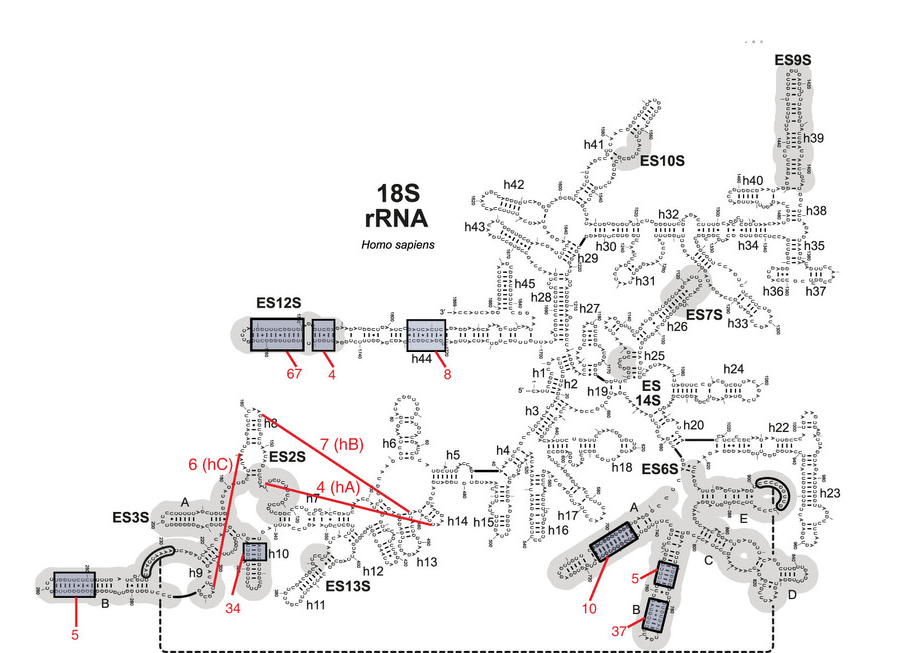
Incredibly extensive and branched structure of RNA. (Image from Ule, 2015)
This extensive form of branching is unique to RNA (not usually found in DNA). What actually contributes to this branching???
Well, less people would know that there are many imperfections inherent within the RNA secondary structure. These imperfections come in the form of junctions, hairpin loops, uncanonical bases (or mismatches)... Wait a minute, what do all of these terms mean? Take a look at the next image for a quick definition.
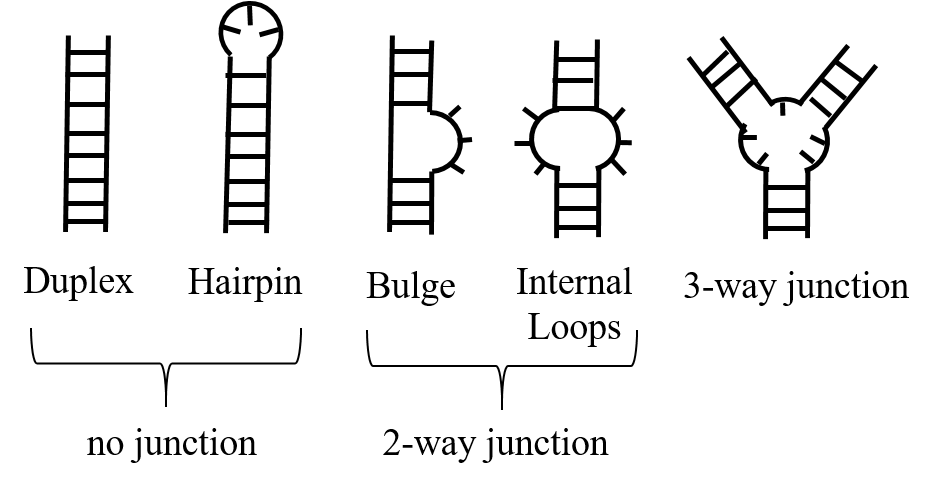
These are some terms you'll see in a secondary structural study of RNA. A duplex is a double-stranded region; a hairpin is just a single-stranded loop over a duplex. A junction is defined as a region with single-stranded regions connecting more than 1 duplex.
As you have seen in the quick introduction to some of the terms used in secondary structural studies, RNA is not made up of strictly base-paired regions. Within its structure lie periodically single-stranded regions, acting as some form of "disruption" to the idealized situation where all bases are paired. These are considered imperfections, that result in the branching observed in RNA structures.
Think about this in 3D space (Tertiary Structures of RNA)
These disruptions in the secondary structure also cause disruptions in the tertiary structures of the RNA. This will not be covered within the scope of this article, but you're encouraged to read on!